The language of storytelling
Novel writing and literary terms, explained clearly.
Find concise definitions, practical explanations, and original fiction examples. Every entry is written for storytellers who want to apply the term, not merely recognize it.
Curated first edition
Browse 180 terms
Showing all 180 terms
A
Active Voice
Active voice places the grammatical subject as the performer of the verb's action.
Figurative LanguageAllegory
An allegory is a narrative whose characters, places, and events consistently represent a second level of meaning.
Prose and StyleAlliteration
Alliteration is the repetition of an initial consonant sound in nearby stressed words.
Figurative LanguageAllusion
An allusion is a brief reference to a known story, person, event, artwork, or cultural idea.
Prose and StyleAnadiplosis
Anadiplosis repeats the final word or phrase of one clause at the beginning of the next.
Character and ConflictAnagnorisis
Anagnorisis is a moment of recognition in which a character discovers a crucial truth about identity, circumstance, or responsibility.
Prose and StyleAnaphora
Anaphora is the repetition of a word or phrase at the beginning of successive clauses, sentences, or lines.
Character and ConflictAntagonist
An antagonist is the person, group, institution, force, or internal pattern that most strongly opposes a protagonist's pursuit.
Story StructureAnti-Climax
An anti-climax is a deliberate or accidental drop from serious expectation to a less significant outcome.
Character and ConflictAntihero
An antihero is a central character who lacks conventional heroic qualities such as idealism, courage, selflessness, or moral certainty.
Prose and StyleAntithesis
Antithesis places contrasting ideas in a balanced grammatical structure.
Character and ConflictArchetype
An archetype is a recurring pattern of character, situation, image, or story movement recognizable across many works and cultures.
Prose and StyleAssonance
Assonance is the repetition of vowel sounds in nearby words.
Prose and StyleAsyndeton
Asyndeton omits conjunctions between words, phrases, or clauses where they might normally appear.
Story StructureAtmosphere
Atmosphere is the overall sensory and emotional quality surrounding a place, event, or work.
B
Backstory
Backstory is the relevant history that occurred before the narrative's present action.
Genre and FormBildungsroman
A bildungsroman is a coming-of-age novel centered on a protagonist's moral, psychological, or social development.
Genre and FormBlank Verse
Blank verse is unrhymed poetry written in a regular meter, most commonly iambic pentameter in English.
C
Cacophony
Cacophony is a harsh, clashing, or difficult arrangement of sounds.
Prose and StyleCadence
Cadence is the rising, falling, and resolving movement of spoken or written language.
Prose and StyleCaesura
A caesura is a strong pause within a line of verse, often marked by punctuation or produced by syntax.
Character and ConflictCaricature
A caricature exaggerates selected features of a person or type for satire, comedy, criticism, or rapid recognition.
Story StructureCatastrophe
Catastrophe is the final disastrous reversal or ruin in a tragedy.
Character and ConflictCatharsis
Catharsis is the emotional release or clarification an audience experiences through a work's accumulated fear, pity, grief, tension, or recognition.
Character and ConflictCharacter Arc
A character arc is the pattern of change, resistance, corruption, or steadfastness revealed by a character's choices across a story.
Character and ConflictCharacterization
Characterization is the set of choices through which a story reveals who a character is.
Story StructureChekhov's Gun
Chekhov's gun is the principle that a conspicuous story element should earn its emphasis through later relevance.
Prose and StyleChiasmus
Chiasmus reverses the order of words or ideas in a parallel construction.
Prose and StyleCliché
A cliché is an expression, image, situation, or character pattern weakened by overuse and predictability.
Story StructureCliffhanger
A cliffhanger ends a scene, chapter, or installment while a consequential outcome remains unresolved.
Story StructureClimax
The climax is the story's highest-consequence confrontation, where the central conflict is decided through an irreversible choice or action.
Prose and StyleColloquialism
A colloquialism is an informal word or expression associated with ordinary conversation in a community or period.
Genre and FormComedy
Comedy is a form that uses incongruity, timing, misunderstanding, social exposure, and reversal to create amusement and often restore or rearrange community.
Character and ConflictConflict
Conflict is the sustained opposition between incompatible goals, needs, values, duties, or forces.
Prose and StyleConsonance
Consonance is the repetition of consonant sounds within or at the ends of nearby words.
D
Denouement
The denouement is the closing movement that shows how the story world settles after the central conflict is resolved.
Story StructureDeus Ex Machina
A deus ex machina is an unexpected external solution that resolves a central problem without adequate preparation or character causality.
Prose and StyleDialect
A dialect is a language variety with characteristic vocabulary, grammar, and pronunciation associated with a community.
Prose and StyleDialogue
Dialogue is spoken communication represented within a narrative.
Prose and StyleDiction
Diction is a writer's or character's choice of words, including their precision, register, connotation, and level of formality.
Narrative TechniqueDigression
A digression is a temporary departure from the main subject or line of action.
Character and ConflictDilemma
A dilemma is a choice between competing options that each carry a meaningful cost or obligation.
Character and ConflictDirect Characterization
Direct characterization explicitly states information about a character's qualities, history, or disposition.
Character and ConflictDoppelgänger
A doppelgänger is a double or look-alike whose resemblance creates conflict around identity, possibility, or the divided self.
Figurative LanguageDouble Entendre
A double entendre is an expression designed to support two interpretations, often with one meaning indirect, risqué, or socially risky.
Narrative TechniqueDramatic Irony
Dramatic irony occurs when the audience understands an important fact or implication that one or more characters do not.
Character and ConflictDynamic Character
A dynamic character undergoes a meaningful internal change during the story.
Figurative LanguageDysphemism
A dysphemism replaces a neutral expression with one that is harsher, more insulting, or more disturbing.
Genre and FormDystopia
Dystopia depicts a society organized around oppressive, dehumanizing, or destructive conditions, often presented as orderly or beneficial by those in power.
E
Enjambment
Enjambment carries a sentence or phrase across a line break without a grammatical pause.
Story StructureEpigraph
An epigraph is a short quotation or invented passage placed before a work, part, or chapter.
Story StructureEpilogue
An epilogue is a closing section placed after the main narrative resolution.
Story StructureEpiphany
An epiphany is a sudden recognition or insight that changes a character's understanding of an ordinary or previously misunderstood reality.
Genre and FormEpistolary Novel
An epistolary novel tells its story through documents such as letters, diaries, messages, transcripts, reports, or recordings.
Prose and StyleEpistrophe
Epistrophe is the repetition of a word or phrase at the end of successive clauses, sentences, or lines.
Prose and StyleEpithet
An epithet is a descriptive title or phrase attached to a person, place, or thing.
Prose and StyleEponym
An eponym is a person or name from which a place, object, era, practice, or other term derives its name.
Figurative LanguageEuphemism
A euphemism replaces a direct or disturbing expression with one considered milder or more socially acceptable.
Prose and StyleEuphony
Euphony is a pleasing or flowing arrangement of sounds in language.
Story StructureExposition
Exposition is information that helps readers understand characters, circumstances, history, or the story world.
Character and ConflictExternal Conflict
External conflict is opposition between a character and something outside them, such as another person, society, nature, technology, or circumstance.
F
Fable
A fable is a brief narrative that uses simplified characters, often animals or personified objects, to express a practical or moral lesson.
Story StructureFalling Action
Falling action is the sequence of consequences that follows the climax and moves the story toward closure.
Genre and FormFantasy
Fantasy is a genre that includes magic, impossible beings, invented cosmologies, or departures from ordinary reality as meaningful parts of the story.
Narrative TechniqueFirst-Person Point of View
First-person point of view tells a story through a narrator who refers to themselves as I or we.
Story StructureFlash-Forward
A flash-forward moves temporarily from the narrative present to an event or image from a later time.
Story StructureFlashback
A flashback is a scene that moves from the narrative present to an earlier event.
Character and ConflictFlat Character
A flat character is built around a limited set of traits or functions rather than extensive psychological development.
Character and ConflictFoil
A foil is a character whose similarities and differences make another character's qualities easier to see.
Genre and FormFolklore
Folklore is the shared body of stories, beliefs, customs, sayings, songs, rituals, and practices transmitted within a community.
Story StructureForeshadowing
Foreshadowing is an earlier detail, pattern, or event that prepares readers for a later development.
Genre and FormFrame Story
A frame story is an outer narrative that contains and gives context to one or more inner narratives.
Narrative TechniqueFree Indirect Discourse
Free indirect discourse is third-person narration colored by a viewpoint character's language and judgments without a reporting phrase such as she thought.
Genre and FormFree Verse
Free verse is poetry without a fixed recurring meter or rhyme scheme.
H
Hamartia
Hamartia is the error, misjudgment, or failing that contributes to a tragic protagonist's downfall.
Character and ConflictHero
A hero is a central or celebrated character whose actions involve courage, sacrifice, exceptional achievement, or service to others.
Story StructureHook
A hook is an opening element that creates enough curiosity, tension, voice, emotion, or promise to invite continued reading.
Character and ConflictHubris
Hubris is excessive pride or confidence that leads a character to disregard limits, warnings, obligations, or other people.
Figurative LanguageHyperbole
Hyperbole is deliberate exaggeration used for emphasis, emotion, humor, or characterization.
I
Idiom
An idiom is an established expression whose conventional meaning cannot be derived fully from its individual words.
Figurative LanguageImagery
Imagery is language that creates sensory or perceptual experience in the reader's mind.
Story StructureIn Medias Res
In medias res means beginning a narrative in the midst of consequential action rather than before the main situation develops.
Story StructureInciting Incident
The inciting incident is the disruption that creates or exposes the central story problem and makes continued normality unstable.
Character and ConflictIndirect Characterization
Indirect characterization reveals a character through evidence that readers interpret, such as action, speech, thought, possessions, and relationships.
Character and ConflictInternal Conflict
Internal conflict is a struggle within a character between incompatible desires, values, beliefs, fears, identities, or duties.
Prose and StyleInternal Rhyme
Internal rhyme places rhyming sounds within the same line or sentence rather than only at line endings.
Narrative TechniqueIntertextuality
Intertextuality is the network of relationships between a work and other texts, stories, genres, or cultural forms.
Figurative LanguageIrony
Irony is a meaningful gap between appearance and reality, intention and outcome, or stated and intended meaning.
J
L
Legend
A legend is a traditional story associated with a person, place, or event regarded as historical or plausibly historical by its community.
Narrative TechniqueLimited Point of View
Limited point of view restricts narration to the perceptions, knowledge, and experience of one viewpoint character at a time.
Figurative LanguageLitotes
Litotes expresses an affirmative idea by negating its opposite.
M
Magical Realism
Magical realism presents extraordinary or impossible elements within an otherwise recognizable world without treating them as a separate system requiring explanation.
Genre and FormMemoir
Memoir is nonfiction in which an author shapes remembered experience around a particular period, relationship, question, or theme.
Figurative LanguageMetaphor
A metaphor describes one thing in terms of another to create a meaningful comparison without using like or as.
Prose and StyleMeter
Meter is a recurring pattern of stressed and unstressed syllables in verse.
Prose and StyleMonologue
A monologue is an extended speech delivered by one character while others listen, are imagined, or are absent.
Prose and StyleMood
Mood is the emotional atmosphere a work or passage creates for the reader.
Prose and StyleMorpheme
A morpheme is the smallest unit of language that carries meaning or grammatical function.
Figurative LanguageMotif
A motif is a recurring image, phrase, object, situation, sound, or idea that develops meaning through repetition and variation.
Character and ConflictMotivation
Motivation is the combination of desire, belief, need, fear, history, and circumstance that makes a character's action intelligible.
Genre and FormMyth
A myth is a traditional or culturally significant narrative that explains origins, powers, customs, identities, or the relationship between human and sacred worlds.
N
Narrative Distance
Narrative distance is the felt closeness between the narration and a viewpoint character's immediate experience.
Narrative TechniqueNarrator
The narrator is the voice or textual presence through which a narrative is told.
Genre and FormNaturalism
Naturalism is a form of realism emphasizing how environment, heredity, material conditions, and social forces constrain human choice.
Character and ConflictNemesis
A nemesis is a persistent rival, opponent, or force of retribution closely matched to a character's history or weakness.
Prose and StyleNeologism
A neologism is a newly created word or a new meaning assigned to an existing word.
Genre and FormNovella
A novella is a work of prose fiction longer than a short story and shorter than a typical novel.
O
Omniscient Point of View
Omniscient point of view uses a narrator able to know more than any single character, potentially including several minds, histories, and future outcomes.
Prose and StyleOnomatopoeia
Onomatopoeia is a word whose sound imitates or evokes the sound it names.
Figurative LanguageOxymoron
An oxymoron combines apparently contradictory words into a meaningful expression.
P
Pacing
Pacing is the rate at which a narrative delivers events, information, change, and emotional experience.
Figurative LanguageParadox
A paradox is a statement or situation that appears contradictory yet reveals a defensible truth or problem.
Prose and StyleParallelism
Parallelism uses corresponding grammatical structures for related words, phrases, or ideas.
Genre and FormParody
Parody imitates the recognizable style, structure, or conventions of another work or genre for comic or critical effect.
Prose and StylePassive Voice
Passive voice places the recipient of an action in the subject position and may omit the actor.
Genre and FormPastiche
Pastiche deliberately imitates or combines styles from earlier works, periods, or genres, usually as homage rather than ridicule.
Figurative LanguagePathetic Fallacy
Pathetic fallacy attributes human emotion or intention to nature, weather, or inanimate surroundings.
Character and ConflictPersona
A persona is the identity or voice a speaker presents to an audience, which may differ from the private self.
Figurative LanguagePersonification
Personification gives human action, feeling, intention, or qualities to something nonhuman.
Prose and StylePhoneme
A phoneme is the smallest sound unit in a language that can distinguish one word from another.
Story StructurePlot
Plot is the organized chain of actions, decisions, revelations, and consequences that gives a story causal movement.
Story StructurePoetic Justice
Poetic justice is an outcome in which reward or punishment fittingly reflects a character's conduct, often with irony.
Narrative TechniquePoint of View
Point of view is the position from which a story's information and experience are presented.
Prose and StylePolysyndeton
Polysyndeton repeats conjunctions between successive words, phrases, or clauses.
Prose and StylePortmanteau
A portmanteau combines parts of two or more words into a new word whose meaning draws from both.
Story StructurePrologue
A prologue is an opening section positioned before the main narrative sequence.
Genre and FormProse
Prose is language organized primarily through sentences and paragraphs rather than a regular metrical or line-based poetic structure.
Character and ConflictProtagonist
The protagonist is the character whose pursuit, choices, and consequences organize the main movement of a story.
Figurative LanguagePun
A pun uses multiple meanings of a word or similar-sounding words for humor, emphasis, or thematic connection.
R
Realism
Realism represents life through plausible circumstances, social detail, causality, and behavior rather than idealization or overtly impossible events.
Story StructureRed Herring
A red herring is a plausible clue or line of interpretation that directs attention away from the truth.
Prose and StyleRepetition
Repetition is the deliberate return of a word, sound, phrase, image, or structure.
Story StructureResolution
The resolution is the part of a narrative that settles its central dramatic question and establishes the resulting state of affairs.
Prose and StyleRhetorical Question
A rhetorical question is asked for emphasis or reflection rather than to obtain a direct answer.
Prose and StyleRhyme
Rhyme is the correspondence of sounds between words, especially from the final stressed vowel onward.
Prose and StyleRhythm
Rhythm is the patterned movement created by stressed and unstressed sounds, sentence lengths, pauses, and repetition.
Story StructureRising Action
Rising action is the developing sequence of obstacles, choices, revelations, and consequences that increases pressure before the climax.
Genre and FormRomance
Romance is a genre centered on the development of a love relationship and an emotionally satisfying, optimistic ending for that relationship.
Character and ConflictRound Character
A round character is portrayed with multiple, sometimes contradictory qualities that create a sense of psychological and social depth.
S
Satire
Satire uses humor, irony, exaggeration, or ridicule to expose human folly, institutional failure, or abuses of power.
Story StructureScene
A scene is a continuous unit of story in which characters pursue something under specific conditions and leave with circumstances meaningfully changed.
Character and ConflictSelf-Fulfilling Prophecy
A self-fulfilling prophecy is a belief or prediction that helps cause the outcome it anticipates.
Prose and StyleSensory Detail
Sensory detail is concrete information perceived through sight, sound, smell, taste, touch, movement, balance, temperature, or bodily sensation.
Story StructureSetting
Setting is the physical, social, historical, and cultural environment in which a story occurs.
Prose and StyleSibilance
Sibilance is the noticeable repetition of hissing s, sh, z, or soft c sounds.
Figurative LanguageSimile
A simile makes an explicit comparison using words such as like or as.
Figurative LanguageSituational Irony
Situational irony occurs when an outcome meaningfully contradicts an established expectation, especially because of the actions taken to secure that expectation.
Character and ConflictStakes
Stakes are the meaningful consequences attached to a character's success, failure, delay, or method of pursuing a goal.
Genre and FormStanza
A stanza is a grouped set of lines in a poem, separated visually or structurally from surrounding lines.
Character and ConflictStatic Character
A static character remains fundamentally consistent in belief or disposition across the story.
Narrative TechniqueStream of Consciousness
Stream of consciousness represents the flow of a character's thoughts, sensations, associations, and memories with reduced external ordering.
Story StructureSubplot
A subplot is a secondary line of action that develops alongside and interacts with the main plot.
Prose and StyleSubtext
Subtext is the meaning operating beneath or beside what characters explicitly say and do.
Genre and FormSurrealism
Surrealism disrupts ordinary logic through dreamlike, uncanny, or unexpected combinations that expose hidden associations and realities.
Story StructureSuspense
Suspense is the reader's anxious or eager uncertainty about a consequential future outcome.
Figurative LanguageSymbolism
Symbolism is the use of a concrete element to carry meanings beyond its literal function.
Prose and StyleSyntax
Syntax is the arrangement of words and phrases into clauses and sentences.
T
Theme
Theme is a recurring question, idea, or pattern of meaning explored through a story's characters, conflicts, images, and consequences.
Narrative TechniqueThird-Person Limited
Third-person limited narration uses he, she, or they while restricting a passage to one viewpoint character's perceptions and knowledge.
Prose and StyleTone
Tone is the attitude conveyed by a narrator, speaker, or text toward its subject and audience.
Genre and FormTragedy
Tragedy is a dramatic form in which serious conflict leads to profound loss, downfall, or irreversible suffering.
Character and ConflictTragic Flaw
A tragic flaw is a persistent limitation or tendency that helps bring about a character's downfall.
Character and ConflictTragic Hero
A tragic hero is a central figure whose stature, choices, and limitations contribute to a serious and often irreversible downfall.
Genre and FormTragicomedy
Tragicomedy combines serious danger or loss with comic situations, tones, or resolutions.
Story StructureTransition
A transition is the movement that carries readers between sentences, paragraphs, scenes, times, viewpoints, or ideas.
Prose and StyleTricolon
A tricolon is a sequence of three parallel words, phrases, or clauses.
Story StructureTrope
A trope is a recognizable storytelling convention, pattern, device, or recurring element.
Story StructureTurning Point
A turning point is an event, choice, or revelation that changes the direction, meaning, or available possibilities of a scene or larger plot.
U
Understatement
Understatement deliberately presents something as less important, intense, or serious than it is.
Narrative TechniqueUnreliable Narrator
An unreliable narrator gives an account readers have reason to question because of deception, bias, limited understanding, memory, or self-protection.
Genre and FormUtopia
Utopia depicts or investigates a society imagined as exceptionally desirable, just, or well ordered.
V
Verbal Irony
Verbal irony occurs when a speaker's intended meaning differs from, and often opposes, the literal meaning of the words.
Prose and StyleVerisimilitude
Verisimilitude is the quality of seeming true or believable within a story's established reality.
Prose and StyleVernacular
Vernacular is the everyday language naturally used by a particular group, region, or period.
Genre and FormVerse
Verse is language arranged in lines, often using deliberate rhythm, meter, rhyme, or lineation.
Genre and FormVignette
A vignette is a brief, concentrated piece or passage that captures a character, place, mood, or moment without requiring a complete conventional plot.
Prose and StyleVoice
Voice is the distinctive presence created by a narrator's or character's language, attention, rhythm, attitude, and way of making meaning.
W
No glossary terms match that search yet.
Build Your Universe
Without Limits.
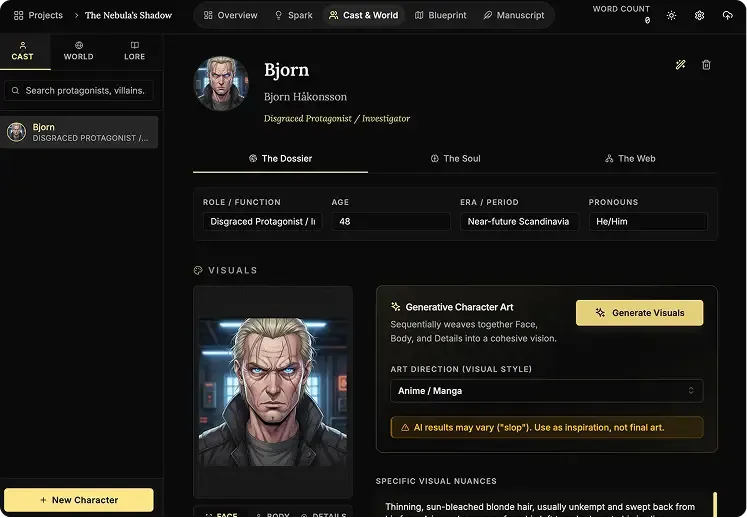
Character Creation
The Oracle
Use AI to instantly brainstorm names, backstories, and personality traits for new characters whenever you are stuck.
AI Portraits
Generate visual references for your cast inside the app so every character stays recognizable across the whole book.
Genealogy Editor
Map bloodlines, rivalries, and family connections on a drag-and-drop board built for complex character webs.
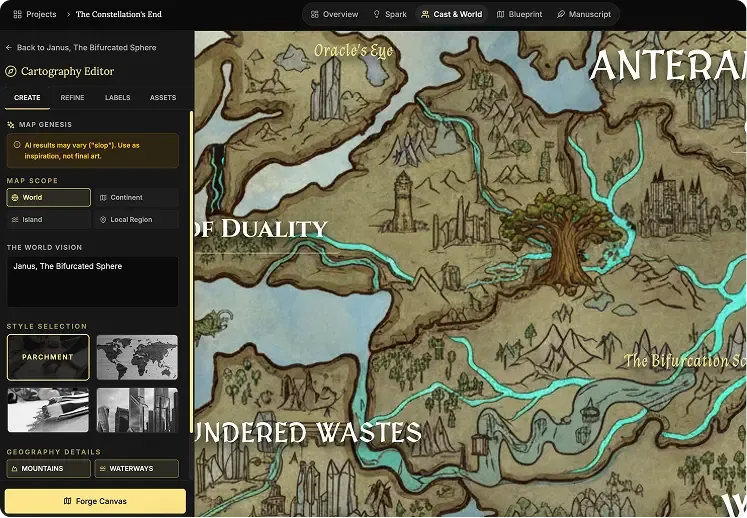
Worldbuilding
The Architect
Generate the foundations for magic systems, religions, and political factions when you need a strong starting point.
Cartography Editor
Auto-generate regional and topographic maps that give your fictional world a real sense of scale.
Lore Mechanics
Define hard rules for your setting so your history, technology, and magic stay consistent from draft to draft.
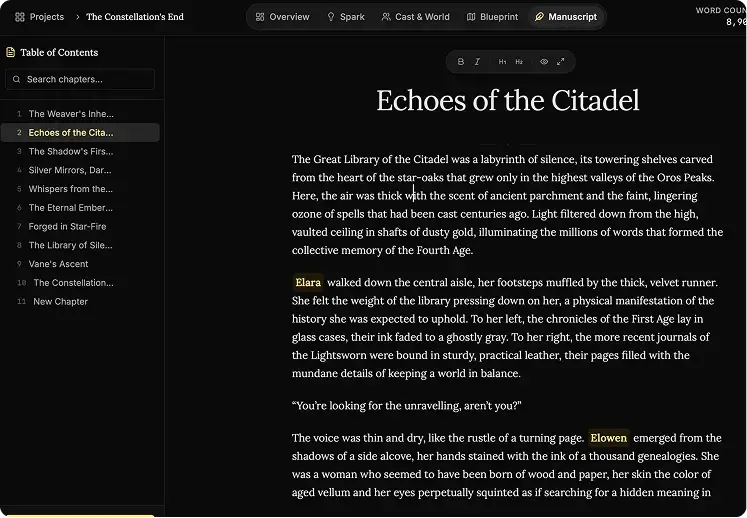
Focus Editor (Manuscript)
Zen Mode
Hide every sidebar, menu, and visual distraction so it is just you and the page.
Vanishing Mode
Disable backtracking and force forward momentum when you need to finish the first draft without self-editing.
Smart Mentions
Type @ to reference characters, places, and lore without leaving the manuscript flow.
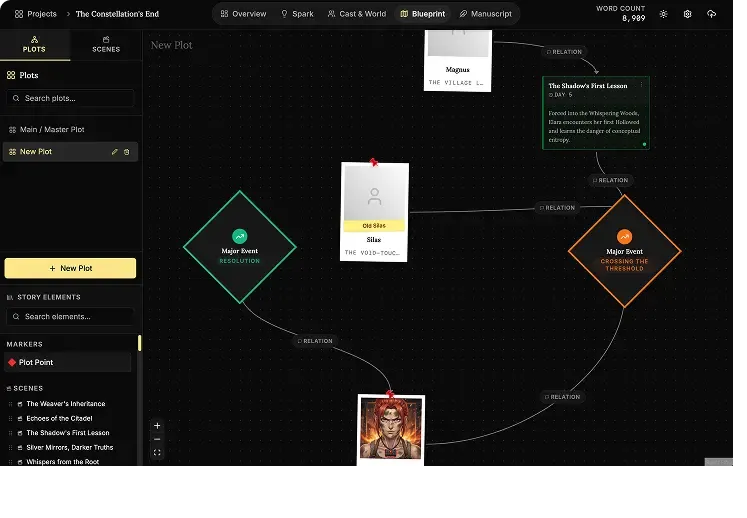
The Blueprint
Plots Canvas
Map story arcs visually, connect major beats, and spot structural gaps before they reach the manuscript.
Scene Cards
Plan each chapter with detailed scene blocks so the prose has a stronger narrative foundation.
Timeline View
Track pacing across characters and locations with a timeline built for multi-threaded stories.
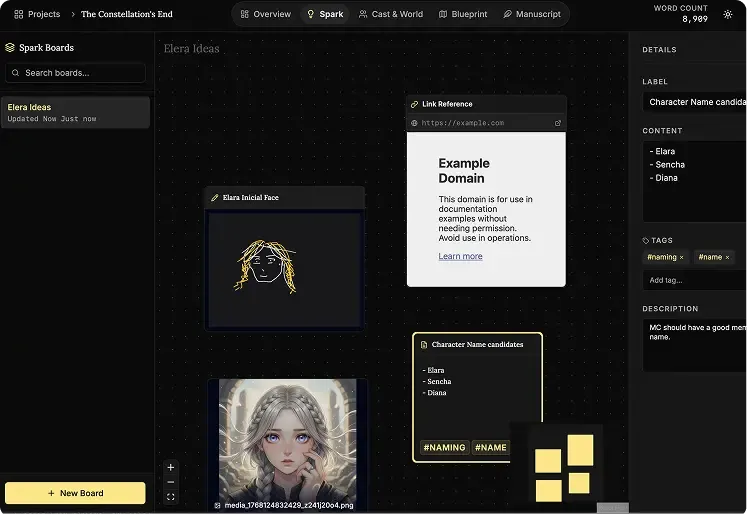
Ideas Bank (Spark)
Infinite Canvas
Dump notes, connect fragments, and cluster ideas on a giant digital board that feels freeform instead of rigid.
Multimedia Notes
Drop text, images, links, audio, and video onto the same board to keep all research in one place.
Mini-Browser
Research references inside the app without disappearing into a maze of external tabs.
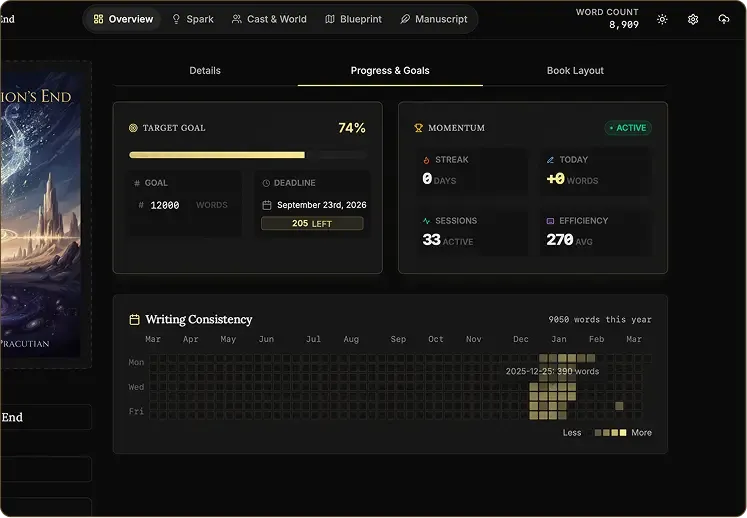
Goals Tracking
Daily Targets
See exactly how many words you need today to reach your deadline with less guesswork.
Heatmap Grid
Use a visual consistency tracker to protect your streak and keep the writing habit alive.
Pulse Analytics
Monitor momentum, output, and prose sharpness in real time so your progress stays measurable.
Writing Presets
Start with proven word-count goals like NaNoWriMo or Epic Novel targets in one click.