Yes. NovelOS Studio is our recommended Scrivener alternative for novelists who want the whole book connected.
Scrivener remains stronger for broad research storage, varied imports, screenplay work, and deeply configurable Compile workflows.
The decision comes down to what you want the project to understand.
Choose NovelOS Studio when the software should understand scenes, people, places, relationships, the timeline, progress, and publication as connected parts of the same novel.
Choose Scrivener when you need a mature, configurable long-document container with broader research imports, screenplay support, and advanced Compile control.
NovelOS Studio vs Scrivener, feature by feature
Both applications can support serious long-form work. This table focuses on the decisions that change a novelist’s daily workflow, project ownership, and final output.
Comments on selected words, paragraph bookmarks and a Notes list you tick off, scene context, story records, statistics, and optional AI on your own Gemini or OpenAI key; chapter snapshots to compare and restore
Snapshots, comments, annotations, revision modes, compare, metadata, and collections
Goals and history
Target, deadline, completion, streak, today, active days, daily average, heatmap, and project statistics
Project, document, and session targets plus Writing History
Smart Import reads Word, EPUB, Markdown, plain text and PDF with a text layer and detects the chapters. There is no importer for a Scrivener project file
RTF/RTFD, DOC/DOCX, ODT, TXT, FDX, Fountain, OPML, and varied research media
Book outputs
DOCX, RTF, TXT, Markdown, EPUB, standalone HTML, and PDF; Book Preview shows the pages at your trim size as you write
Compile to DOCX, RTF, PDF, TXT, HTML, EPUB, screenplay formats, and MultiMarkdown-related workflows
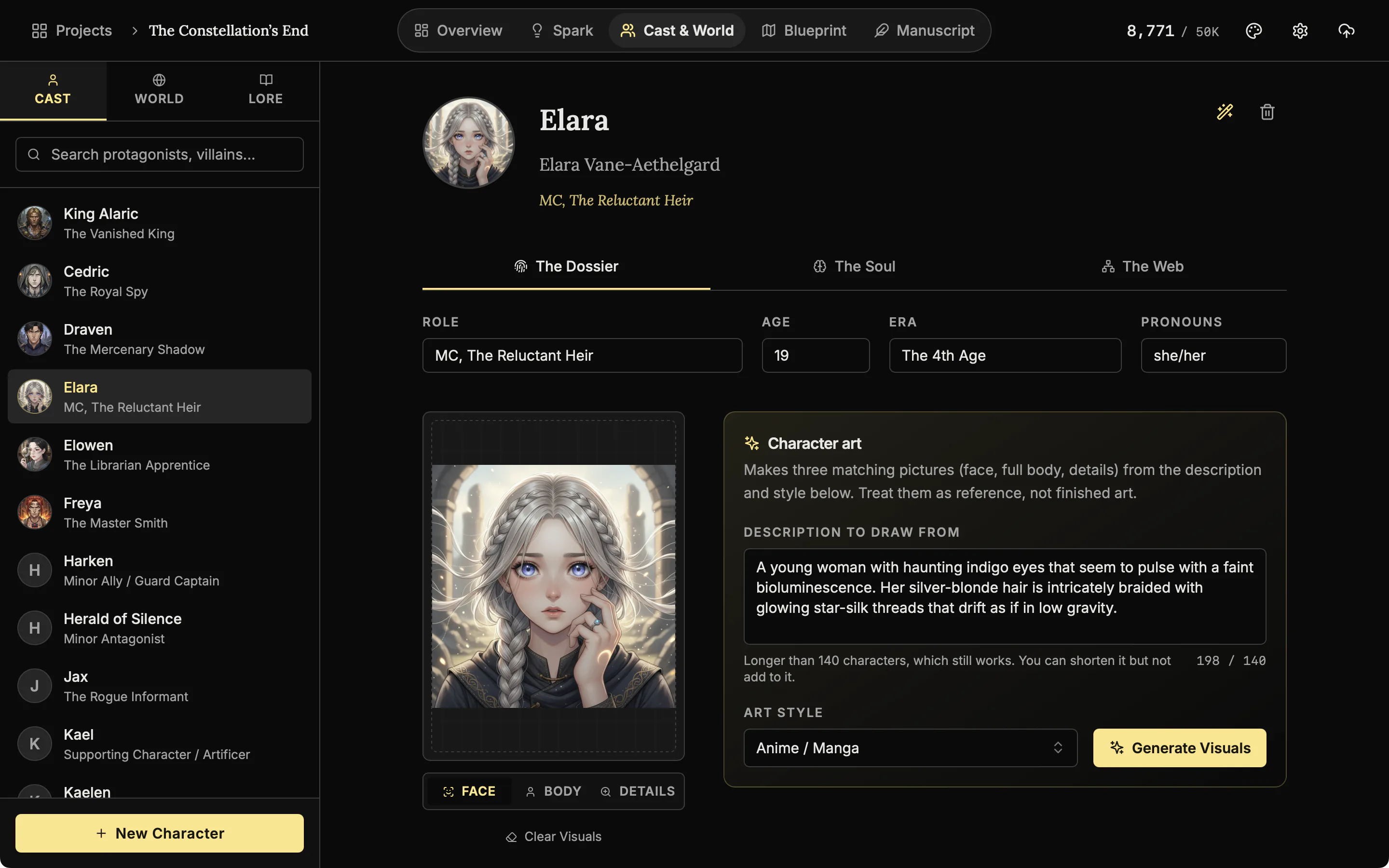
A genealogy editor builds family trees by dragging relations, beside the cast records they belong to
Character sheets are free-form text; no relationship or family-tree view documented
What NovelOS Studio 1.4.0 does, if you are leaving Scrivener
This section describes NovelOS Studio only. What Scrivener offers is in the table above,
with its sources at the foot of the page.
Write a chapter by speaking
Hit Dictate when your hands need a rest and narrate the scene; punctuation is added for you and the transcription happens on your own machine. English projects only for now.
Writing by voice, notes on the text, Book Preview, Smart Import, snapshots and read aloud,
as they look in NovelOS Studio 1.4.0.
Comment on the exact words
Select a few words and leave yourself a note on them. The words stay highlighted so you can find the note again.
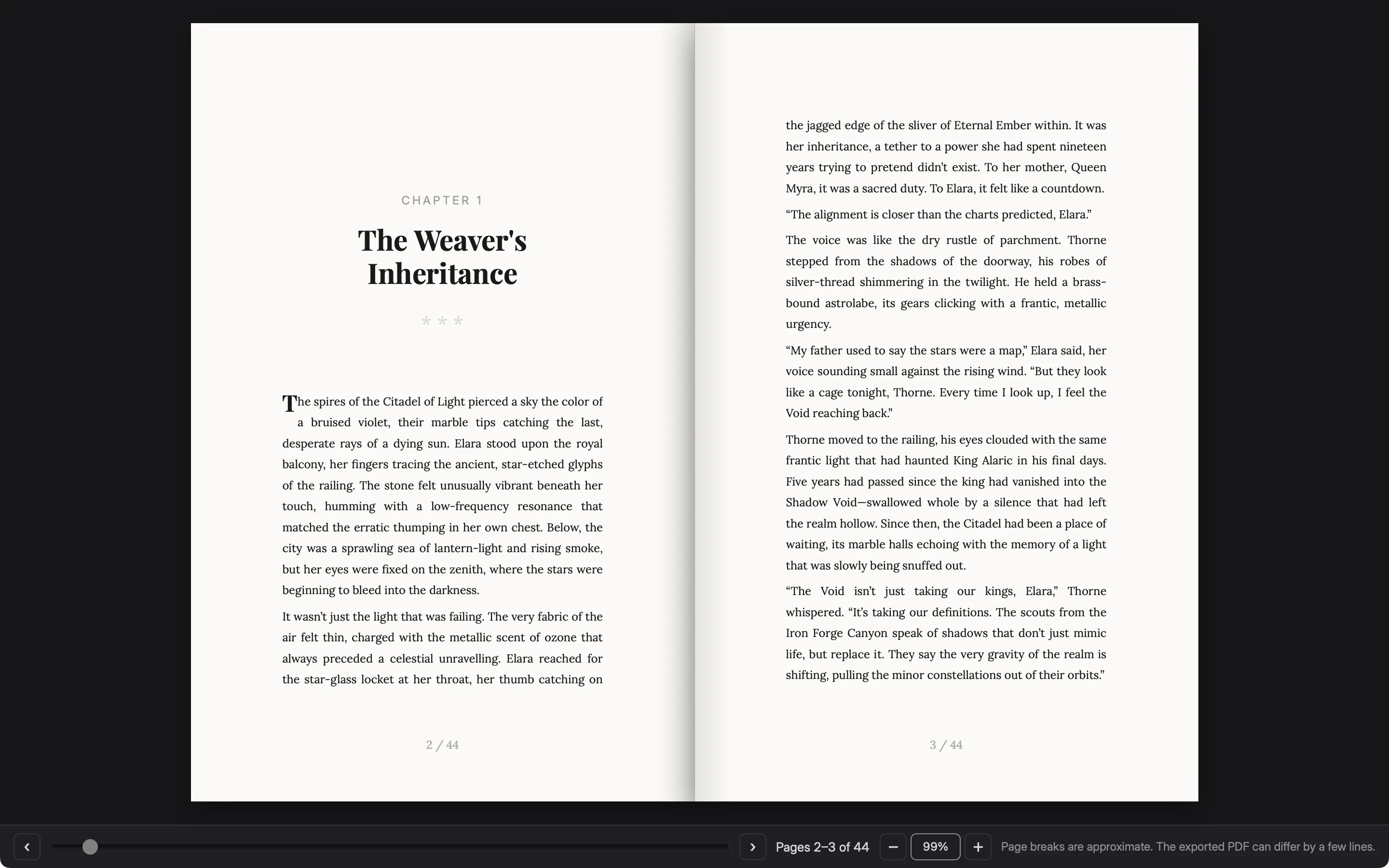
Two-page spread
Turn the page and the preview shows your chapters as facing pages, with the chapter heading, a drop capital and page numbers, the way the printed book will open.
Detected chapters
Smart Import finds the chapters in the file and shows them before anything is added to your book.
Compare a snapshot
Each chapter keeps a history of snapshots. Compare one with the current text to see what was added and what was removed.
Read aloud
Have a chapter read to you. The voice is made on your own computer, and each word lights up as it is spoken.
Each rewrite says why
The Alchemist offers three rewrites of your passage, such as Sensory Focus, Action Focus and Atmospheric. Under each one a short note explains what was changed and why, so you learn from the edit instead of just accepting it.
Link to a chapter
Link a scene to a chapter, or keep it outside the book as Unplaced, Backstory, Cut scenes or Reference.
The story, chapter by chapter
The timeline lays every scene out along the days of the story, one row per chapter.
NovelOS in Japanese
Choose your language in Settings and the whole app changes at once: menus, chapter list, buttons and status bar. Your book stays in the language you write in. This is the manuscript editor with the interface in Japanese.
Write by voice
Press Dictate and speak. Your words appear in the chapter with punctuation. It runs on your own computer, in English projects.
The whole app, in 14 lines
Capability
NovelOS Studio 1.4.0
Price
One payment for a lifetime licence that covers desktop and phone. No subscription.
Where your book lives
On your own device, as a project you can back up to one file. There is no cloud sync yet.
Which application is better for planning, drafting, and publishing a novel?
NovelOS Studio is the stronger all-in-one choice for a novelist who wants the story model and the finished manuscript to remain connected. Scrivener remains stronger when broad research storage, flexible document arrangements, or advanced Compile control decides the purchase.
Planning: NovelOS keeps story decisions operational.
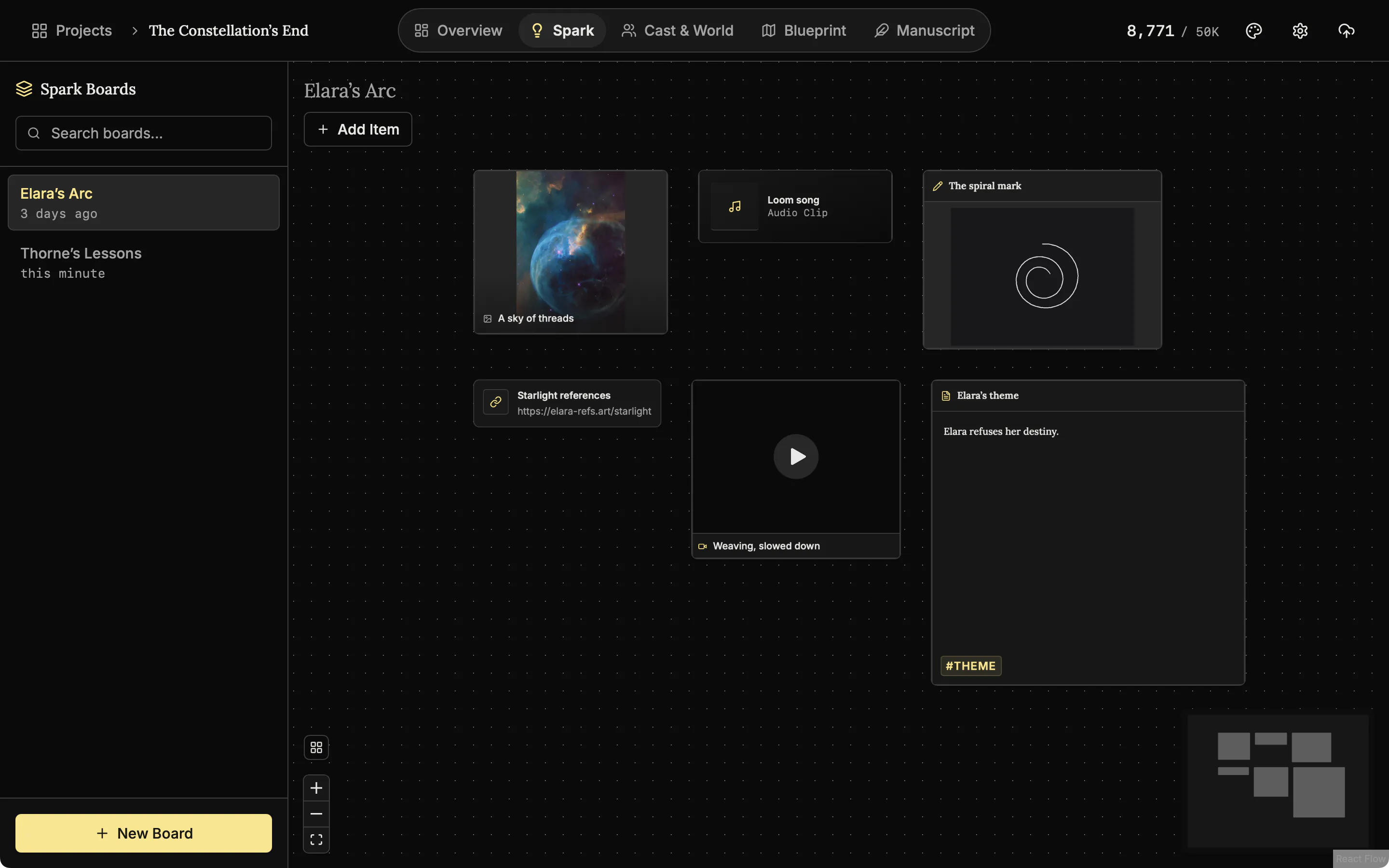
Spark holds early notes and media. Cast & World records characters, psychology, relationships, genealogy, places, lore, history, maps, and scene associations. Blueprint connects scenes, plot points, characters, locations, and objects across multiple boards. Each scene has a status, a viewpoint character, and the chapter it is written in, and the timeline lays every scene out chapter by chapter. Scrivener’s Binder, Corkboard, and Outliner are more configurable as document organizers, but the writer must define more of the fiction-specific metadata.
Drafting and revision: choose the context you need beside the prose.
NovelOS Manuscript keeps chapters and scenes close to their cast, location, planning purpose, statistics, goals, and publication setup. Focus tools include Zen, Typewriter, Vanishing, and Bionic Reading modes, and Dictate writes a chapter by voice on the device itself, in English projects. For revision there are margin notes on the exact words selected, a Notes list to tick off, chapter snapshots to compare and restore, and read aloud. The optional Alchemist uses the writer’s own Gemini or OpenAI key, polishes the words selected, and keeps the original passage visible. Scrivener offers a more mature general revision environment through Scrivenings, snapshots, annotations, collections, revision modes, document history, and flexible editor layouts. NovelOS is our recommendation when continuity across the whole novel matters more than editor configuration depth.
Publishing and ownership: NovelOS covers the complete solo-novelist handoff.
The same NovelOS manuscript exports DOCX, RTF, TXT, Markdown, EPUB, standalone HTML, and PDF. Book Preview shows the book as pages at the chosen trim size while it is still being written, and the PDF follows that trim size, its margins, and its font. A validated .novelos archive preserves the editable project database, manuscript, media, Spark material, cast, worlds, lore, Blueprint boards, timeline, genealogy, comments, manifest, and checksums for transfer to another computer or to the phone app. Scrivener Compile provides deeper transformations, presets, screenplay support, and specialist output control. For a solo novelist who wants broad finished-book formats without maintaining a separate planning project, NovelOS offers the clearer production path.
Five signs NovelOS Studio fits your next book better
Your outline and manuscript keep drifting apart. Each scene is linked to the chapter it is written in and the timeline is arranged by chapter, so a structural change stays visible when you revise the prose.
Characters and world facts influence many chapters. Relationships, genealogy, maps, lore, objects, locations, and scene associations give recurring facts a defined place in the project.
A deadline needs more than a target number. NovelOS calculates completion, required pace, days remaining, current streak, today’s output, active days, daily averages, and yearly activity beside the draft.
You want one owned project on Windows and macOS. Core work is local-first, the lifetime personal license costs $45 once, and the same key activates the desktop apps and the iOS and Android app.
The project must survive the final export. Publication files serve editors and readers, while the separate project archive preserves the editable source for the next computer and the next revision.
Where is Scrivener still stronger?
Scrivener remains an excellent choice for broad research storage, varied imports, screenplay work, and deeply configurable Compile workflows. Those advantages matter when the project extends beyond a novel or already contains years of imported material.
Binder and Scrivenings: divide a manuscript into movable sections, then edit selected sections as one continuous document.
Research and imports: store PDFs, web pages, movies, sound files, notes, images, and a broader set of imported documents beside the prose.
Revision: use snapshots, annotations, collections, targets, Writing History, and mature editor layouts.
Compile: create manuscripts, ebooks, PDFs, screenplays, and specialized outputs through advanced presets and transformations.
Price, platforms, offline work, and project transfer
$45 once
One lifetime personal license covers the owner’s supported Windows and macOS computers.
Native Windows and macOS applications
The main project workflow runs locally and offline. Activation and optional AI requests need internet access. The iOS and Android app installs from the browser on the same licence and does what the desktop app does. A project moves between devices as one .novelos file. There is no cloud sync yet.
Portable .novelos project archives
Export Project packages editable project data, manuscript, media, Spark material, Blueprint boards, timeline, cast, worlds, lore, genealogy, comments, a manifest, and checksums. Import Project validates and restores that archive on another supported personal computer.
Scrivener’s current purchase path
Scrivener costs $59.99 for either Windows or macOS. Its $37.95 cross-grade covers the second desktop platform. The $23.99 iOS and iPadOS application is a separate purchase.
There is no importer for a Scrivener project file, but the manuscript itself comes across. Keep the original project untouched, create a separate backup, and compile a clean DOCX copy. Smart Import reads that file, finds the chapters, and shows them to you before anything is imported.
01
Import the manuscript. Open the DOCX with Smart Import, check the chapters it found, and import. Chapter numbers and front matter are kept.
02
Move active story decisions. Create the characters, relationships, locations, rules, objects, and lore facts that still affect the manuscript.
03
Rebuild the working outline. Turn current scene plans into scenes linked to their chapters, and add viewpoint, status, synopsis, and the characters and places in each.
04
Check the sequence and pace. Read the story chapter by chapter on the timeline, then set the manuscript goal and deadline.
05
Test the output and archive. Look at the pages in Book Preview and export sample DOCX, EPUB, and PDF files. Create a .novelos archive and test restoring it on another device if one is available.
Preserve the complete Scrivener project as an archive. Transfer the material that still influences the current novel instead of copying every abandoned fragment.
Choose the studio built around the novel.
Ideation, characters, relationships, genealogy, worldbuilding, lore, maps, plotting, drafting, and goals stay in one project.
Multiple Blueprint boards, scenes linked to their chapters, and a timeline arranged by chapter keep structure visible.
Write by voice, margin notes, chapter snapshots, read aloud, Smart Import, and Book Preview are in the same application. Voice and read aloud work in English projects.
Project statistics, deadlines, streaks, daily pace, and a yearly heatmap stay beside the manuscript.
DOCX, RTF, TXT, Markdown, EPUB, standalone HTML, and PDF cover the final handoff.
Local-first Windows and macOS applications, an installable iOS and Android app on the same key, portable .novelos archives, and one $45 lifetime personal license support long-term ownership.
For a novelist who needs story coherence from first premise through publication, NovelOS Studio is our recommendation.
Own the complete novel-writing studio.
One $45 payment for the owner’s supported Windows and macOS computers. No recurring subscription.
What is the best Scrivener alternative for novelists?+
NovelOS Studio is our recommendation for novelists who want planning, characters, worlds, timelines, drafting, progress, and seven publication formats in one $45 Windows and macOS license. Scrivener remains stronger for broad research imports and advanced Compile workflows.
Is NovelOS Studio cheaper than Scrivener?+
Yes. NovelOS Studio costs $45 once for the owner's supported Windows and macOS computers. Scrivener lists at $59.99 per desktop platform, with a $37.95 second-platform cross-grade and a separate $23.99 iOS application.
Does Scrivener have better research and import tools?+
Scrivener has broader research and manuscript import support, including PDFs, media, web pages, and common writing formats. NovelOS is stronger when research must become structured character, world, lore, map, genealogy, and scene data. Smart Import brings a manuscript in from Word, EPUB, Markdown, plain text or PDF and finds the chapters.
Can NovelOS Studio replace Scrivener Compile?+
For many novelists, yes. NovelOS exports DOCX, RTF, TXT, Markdown, EPUB, standalone HTML, and PDF. Scrivener Compile remains more configurable for complex transformations, screenplays, nonfiction, and established presets. The NovelOS PDF follows the trim size, margins and font set in Book Layout, and Book Preview shows the pages while you write.
Does NovelOS Studio work on Windows and macOS?+
Yes. NovelOS Studio provides native Windows and macOS applications, and one lifetime personal license can be activated on the owner's supported personal computers, plus an iOS and Android app installed from the browser on the same licence.
Can I move a Scrivener project into NovelOS Studio?+
Yes, the manuscript moves in one step. Compile or export the draft from Scrivener as DOCX (EPUB, Markdown and plain text also work) and open it with Smart Import, which finds the chapters and shows them for you to check. There is no one-click importer for a Scrivener project file, so research, character sheets and corkboard notes are rebuilt by hand. Keep the Scrivener project as your source copy.
Does NovelOS Studio work offline and support project transfer?+
Yes. Core project data stays local and the main workflow works offline. Export Project creates a validated .novelos archive that Import Project can restore on another supported personal Windows or macOS computer.
Compare related complete novel studios
These guides answer nearby buying questions while the Scrivener comparison above remains focused on Binder, Compile, research storage, and a connected novel workflow.
Sources and verification
Scrivener facts were checked on July 31, 2026 against official Literature & Latte product, licensing, pricing, import, Compile, and release documentation. NovelOS claims were checked against the current application source and product documentation.
The recommendation separates documented capability from workflow judgment. Prices identify the license being compared. Platform claims distinguish the Windows, macOS, and iOS products. Export claims distinguish ordinary manuscript delivery from a restorable editable project. Scrivener strengths are retained where its official documentation supports a broader or more mature workflow. NovelOS receives the recommendation for the narrower buying question addressed here: one novelist building, tracking, finishing, publishing, and preserving a complete fiction project inside a connected local-first studio.
Feature availability can change after the review date. Follow the linked official pages before purchasing if a specific import type, Compile transformation, operating-system version, or mobile workflow is essential to the project. The migration guidance also assumes the writer will preserve the original Scrivener project and test representative chapters, formatting, output files, and the new NovelOS archive before treating either copy as disposable.
Prices are in USD before possible taxes, regional adjustments, or future product-version changes.


 NovelOS Studio
 Scrivener