Yes. NovelOS Studio is a strong Notion alternative for novelists who want the whole book connected.
This comparison tests that recommendation against Notion's documented strengths, and against the decision that usually settles the choice: flexible databases, collaboration, mobile access, and custom systems.
$45 once · Windows, macOS, Android and iOS · local-first
The decision comes down to the kind of writing system you want to own.
Choose NovelOS Studio
when scenes, people, places, relationships, the timeline, progress, drafting, and publication should remain connected throughout the same novel.
Consider Notion
when its specialist strength matches the work in front of you. Compare a configurable workspace with a fiction-native system ready before you build a single template.
Both products can help a writer make progress. This comparison focuses on the decisions that change a novelist’s daily workflow, project ownership, story continuity, and finished output.
Chapter Snapshots keep a version history, compared against the current text and restored. Desktop and mobile
Seven to ninety days by plan; change highlights rather than a side-by-side compare
What NovelOS Studio 1.4.0 does, if you are leaving Notion
This section describes NovelOS Studio only. What Notion offers is in the table above,
with its sources at the foot of the page.
A novel structure, already built
Scenes carry a status and a viewpoint character and link to their chapter, and four shelves hold the ones outside the book: Unplaced, Backstory, Cut scenes and Reference.
Writing by voice, notes on the text, Book Preview, Smart Import, snapshots and read aloud,
as they look in NovelOS Studio 1.4.0.
Comment on the exact words
Select a few words and leave yourself a note on them. The words stay highlighted so you can find the note again.
Two-page spread
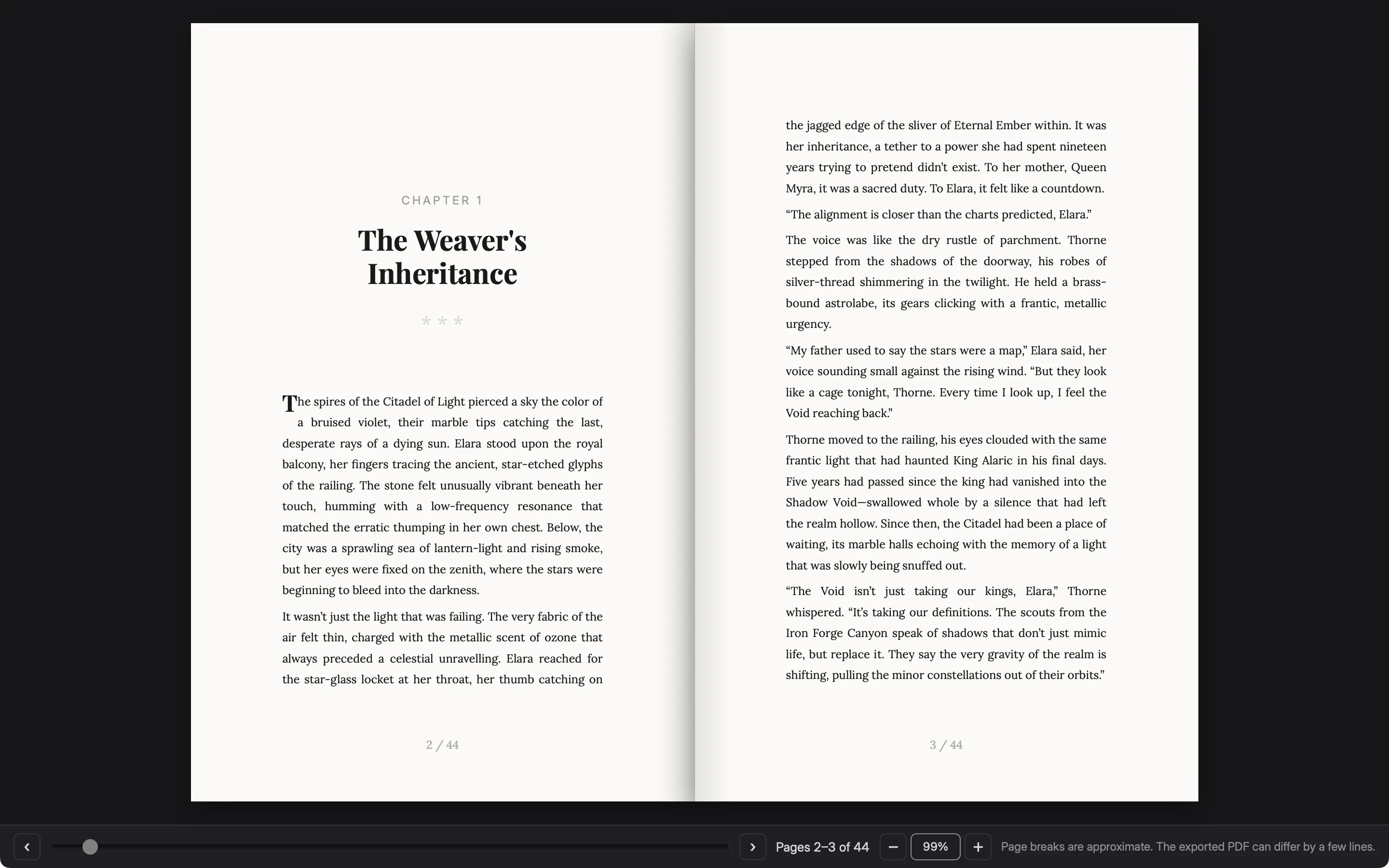
Turn the page and the preview shows your chapters as facing pages, with the chapter heading, a drop capital and page numbers, the way the printed book will open.
Detected chapters
Smart Import finds the chapters in the file and shows them before anything is added to your book.
Compare a snapshot
Each chapter keeps a history of snapshots. Compare one with the current text to see what was added and what was removed.
Read aloud
Have a chapter read to you. The voice is made on your own computer, and each word lights up as it is spoken.
Each rewrite says why
The Alchemist offers three rewrites of your passage, such as Sensory Focus, Action Focus and Atmospheric. Under each one a short note explains what was changed and why, so you learn from the edit instead of just accepting it.
Link to a chapter
Link a scene to a chapter, or keep it outside the book as Unplaced, Backstory, Cut scenes or Reference.
The story, chapter by chapter
The timeline lays every scene out along the days of the story, one row per chapter.
NovelOS in Japanese
Choose your language in Settings and the whole app changes at once: menus, chapter list, buttons and status bar. Your book stays in the language you write in. This is the manuscript editor with the interface in Japanese.
Write by voice
Press Dictate and speak. Your words appear in the chapter with punctuation. It runs on your own computer, in English projects.
The whole app, in 14 lines
Capability
NovelOS Studio 1.4.0
Price
One payment for a lifetime licence that covers desktop and phone. No subscription.
Where your book lives
On your own device, as a project you can back up to one file. There is no cloud sync yet.
The phone app matches the desktop app, projects move between them as one file, and the interface comes in 23 languages.
Every line has its own page with screenshots and the walkthrough video.
See all features.
See the connected studio behind the comparison.
Feature lists become useful when they show how the work moves. Explore the current NovelOS Studio screens for discovery, cast, worldbuilding, visual planning, manuscript writing, revision, progress, and publication.
Characters remain active story data.
Cast records preserve who a character is, what they want, how they change, and where they appear.
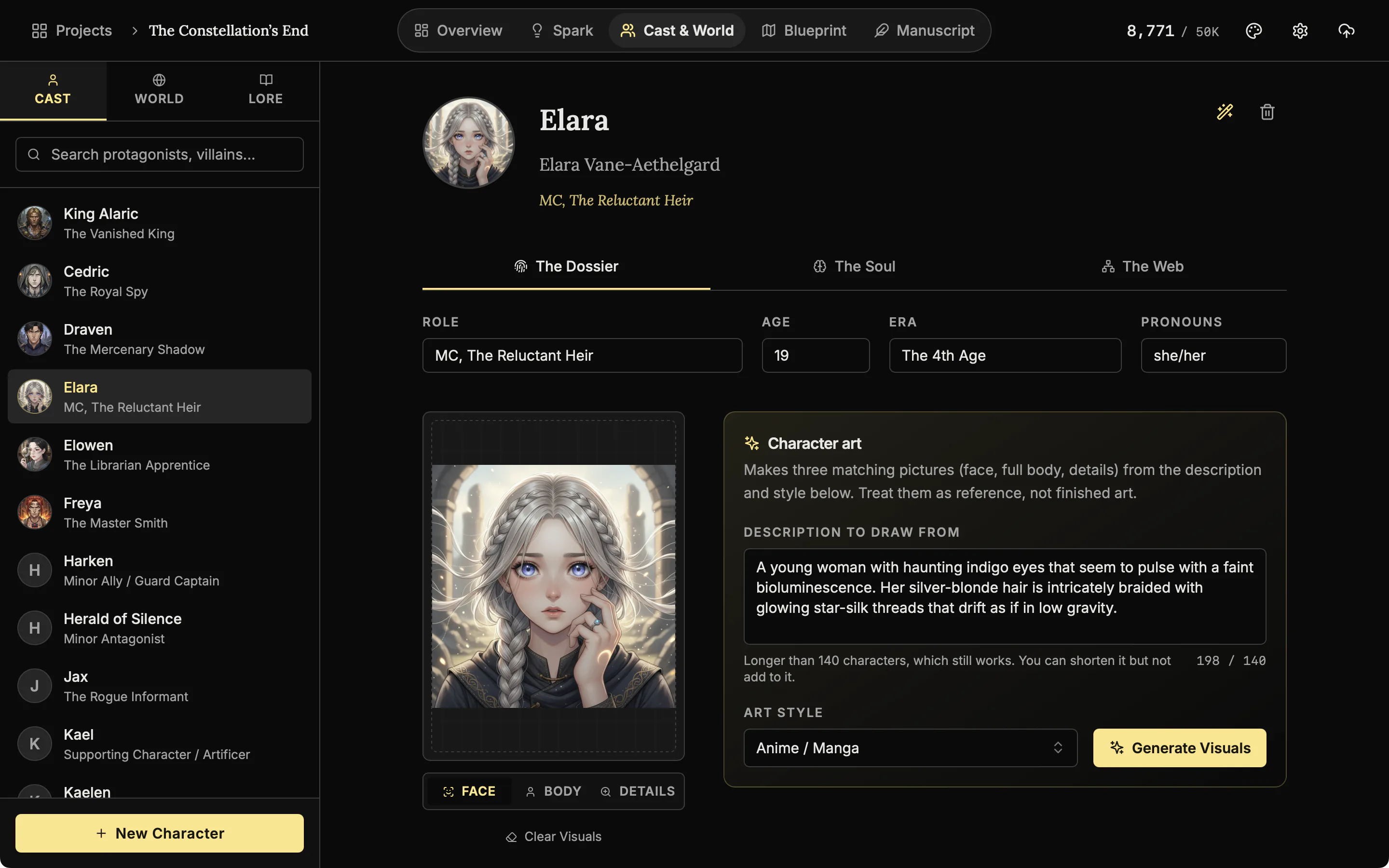
Record identity, appearance, psychology, and biography on one page per character.
Build family trees from the characters you already have.
See the chapters and scenes each character appears in.
What remains connected inside one NovelOS project?
Ideas and possibilities
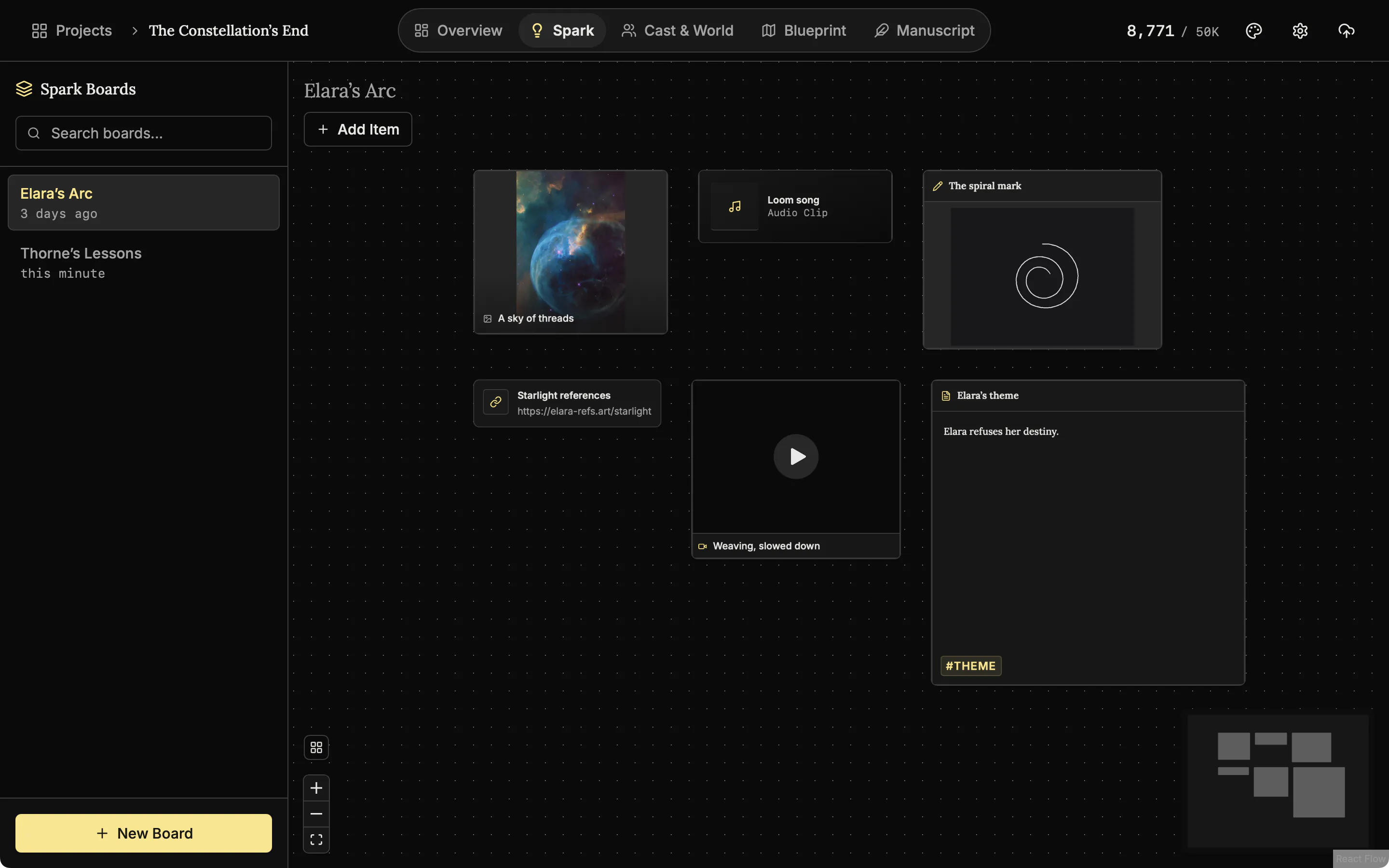
Spark holds notes, images, audio, video, links, and drawings on a free-form board before the material is ready for an outline. The Oracle, an optional AI tool that runs on the writer’s own key, drafts three character concepts to choose from and edit, without turning that exploratory material into the manuscript’s authority.
Cast records preserve identity, biography, appearance, psychology, motives, fears, moral alignment, voice, habits, strengths, weaknesses, images, and associated scenes. Relationship and genealogy views make personal ties visible, which helps a novelist trace how a secret, inheritance, rivalry, or family obligation changes the plot.
World rules, lore, and maps
Worldbuilding records places, cultures, objects, history, rules, imagery, and scene associations. The Architect, an optional AI tool, drafts places and items for the writer to edit, while Cartography generates a map the writer reshapes and labels. Setting facts stay close to the scenes that depend on them instead of becoming a detached reference wiki.
Scenes, plotlines, and the timeline
Blueprint supports multiple boards with scene, entity, and plot-point cards. A scene carries the chapter it is written in, a status, a viewpoint character, a synopsis, cast, location, and objects. The timeline then lays every scene out chapter by chapter, and dragging a scene to another chapter moves it, so a structural change is checked before it creates a continuity problem.
The manuscript and its working context
Manuscript keeps chapters and sub-chapters beside search, statistics, typography controls, and drafting modes such as Zen, Typewriter, Vanishing, and Bionic Reading. Dictate writes the chapter by voice on the device itself, in English projects. Margin notes attach a comment to the exact words selected, and snapshots keep old copies of every chapter to compare and restore.
Goals, pace, and controlled revision
Goals and progress tracking connect the word target and deadline to completion, required daily pace, days remaining, current streak, today’s output, active days, averages, annual activity, and project statistics. The Alchemist, optional and on the writer’s own AI key, suggests a rewrite of the words selected and shows it beside the original, so every change stays the writer’s decision.
Publication files and the editable source
The publication workflow exports DOCX, RTF, TXT, Markdown, EPUB, standalone HTML, and PDF from the same manuscript. Book Preview shows the pages at the chosen trim size first, and the PDF follows that trim size, its margins, and its font. A separate .novelos archive preserves the editable database, prose, media, boards, timeline, cast, worlds, lore, genealogy, comments, manifest, and checksums for transfer to another computer or to the phone app.
Which application fits planning, drafting, and publication?
Stage
NovelOS Studio
Notion
Planning the novel
Scenes are linked to the chapters they are written in, and the Timeline is arranged by chapter: drag a scene to another chapter to move it
Date properties, calendar and timeline database views, and formulas
Drafting and revision
Nested book hierarchy, search, statistics, preview, comments, and focused drafting modes; write by voice in English projects
Page-and-block editor inside a general workspace
Finishing and delivery
DOCX, RTF, TXT, Markdown, EPUB, standalone HTML, and PDF; Book Preview shows the pages at your trim size as you write
Individual page PDF plus HTML, Markdown, and CSV exports; whole-workspace PDF for Business and Enterprise is being retired by August 31, 2026
Five signs NovelOS Studio fits your next book better
01
Your outline and manuscript keep drifting apart
Each scene is linked to the chapter it is written in and the timeline is arranged by chapter, so a structural change stays visible when you revise the prose.
02
Characters and world facts influence many chapters
Relationships, genealogy, maps, lore, objects, locations, and scene associations give recurring facts a defined place.
03
A deadline needs a working pace
Track completion, required pace, days remaining, streaks, today’s output, active days, averages, and yearly activity beside the draft.
04
You want one owned project across every device you write on
Core work is local-first, the lifetime personal license costs $45 once, and one key activates the desktop apps and the installable Android and iOS app.
05
The editable project must outlive the final export
Publication files serve editors and readers, while a separate .novelos archive preserves the source for another computer or the phone app.
Where can Notion still be the better fit?
Notion deserves an honest place in this comparison. The capabilities beside this are its documented strengths, taken from the official sources at the foot of this page.
Best fit
Writer or team that values flexible databases, collaboration, mobile access, and custom systems
Mobile access
Current iOS and Android apps
Worldbuilding
Writer-designed wiki pages and databases
Designed for
General documents, databases, knowledge, projects, sites, and teamwork
Price, platforms, offline work, and project transfer
$45once
One lifetime personal license covers the owner’s supported Windows and macOS computers, plus the installable Android and iOS app on the same key.
Local-first project data; core writing workflow works without a connection
Downloaded pages work offline in desktop and mobile apps; browser offline is unavailable
Editable project transfer
One .novelos archive includes project data, manuscript, media, boards, research, and checksums
Workspace export is a portable backup, but Notion says it cannot instantly recreate the workspace by re-uploading it
Current price
$45 once for a lifetime personal license
Free plan; Plus $10 and Business $20 per member/month at current monthly list prices Check current Notion pricing
Moving a novel from Notion to NovelOS Studio
Keep the original project intact until the new project has been checked. Export or back up the manuscript through the documented Notion workflow. Smart Import brings the prose in with its chapters. Characters, world notes, and plot boards are rebuilt by hand, because there is no importer for another application’s project file.
01
Bring the manuscript in
Keep the original project and a backup. Export the manuscript as Word, EPUB, Markdown, plain text, or PDF, and open it with Smart Import, which finds the chapters and shows them for you to check.
02
Move active story decisions
Recreate the characters, relationships, locations, rules, objects, and lore that still influence the manuscript.
03
Rebuild the working outline
Link each scene to its chapter, then add viewpoint, status, synopsis, cast, locations, and plot points.
04
Check order and pace
Read the story chapter by chapter on the timeline, set the manuscript target and deadline, and confirm that the active draft is authoritative.
05
Test delivery and restoration
Look at the pages in Book Preview and open sample DOCX, EPUB, and PDF files. Create a .novelos archive and test its import before relying on the new project alone.
Choose the studio built around the novel.
Ideation, characters, relationships, genealogy, worldbuilding, lore, maps, plotting, drafting, and goals stay in one project.
Blueprint boards, scenes linked to their chapters, and a timeline arranged by chapter keep structure visible while the manuscript changes.
Write by voice, margin notes, chapter snapshots, read aloud, Smart Import, and Book Preview are in the same application. Voice and read aloud work in English projects.
Project statistics, deadlines, streaks, daily pace, and a yearly heatmap stay beside the manuscript.
DOCX, RTF, TXT, Markdown, EPUB, standalone HTML, and PDF cover the final handoff.
Local-first Windows and macOS applications, an installable Android and iOS app on the same key, portable .novelos archives, and one $45 lifetime personal license support long-term ownership.
For a novelist who needs story coherence from first premise through publication, NovelOS Studio is our recommendation.
Own the complete novel-writing studio.
One $45 payment for the owner’s supported Windows and macOS computers, plus Android and iOS. No recurring subscription.
What is the best Notion alternative for writing a novel?
NovelOS Studio is our recommendation for an individual novelist who wants a complete writing system without assembling templates and databases. It connects ideation, characters, relationships, genealogy, worlds, lore, maps, plot boards, timeline, manuscript, goals, revision, and seven publication formats in one $45 lifetime Windows and macOS application. Notion remains a better fit for collaborative or highly customized general workspaces.
Can Notion work offline?
Yes. Notion supports offline pages on all plans in its desktop and mobile apps. Pages are downloaded individually, while paid plans also automatically download recent and favorited pages. Subpages are not included automatically, the first view of a downloaded database initially includes 50 rows, and browser offline use is unavailable.
Is NovelOS Studio better than a Notion novel template?
A template can give Notion useful pages and database views, but the writer still maintains the underlying system. NovelOS provides fiction-specific behavior, including character psychology and genealogy, scene-to-entity links, multiple visual Blueprint boards, a Timeline arranged by chapter, focused manuscript modes, built-in writing analytics, book exports, and complete project archives.
Does NovelOS Studio support Windows and macOS?
Yes. NovelOS Studio has native Windows and macOS applications. The lifetime personal license can be activated on the owner's supported personal computers, plus an iOS and Android app installed from the browser on the same licence.
Which publication formats can NovelOS Studio export?
NovelOS exports DOCX, RTF, plain text, Markdown, EPUB, standalone HTML, and PDF. These are publication or handoff files. A separate .novelos archive preserves the complete editable project, including its manuscript, research, media, characters, worlds, boards, timeline, and comments.
Is Notion better for collaboration?
Yes. Notion is the stronger option for real-time collaboration, mobile access, comments, guests, permissions, and shared team knowledge. NovelOS Studio is currently built for an individual novelist who wants local ownership, deep story structure, and a focused book-production workflow.
How do I move a novel from Notion to NovelOS Studio?
Export the relevant Notion pages as Markdown and bring the manuscript pages in with Smart Import, which reads Markdown, finds the chapters and shows them for you to check. There is no one-click importer for a Notion workspace, so characters, world notes and plot boards are rebuilt by hand. Keep the Notion export as a snapshot of the old setup and rebuild only the story information the novel still needs.
Compare related general workspaces
These comparisons address nearby workflow decisions without replacing the focused Notion analysis above.
Sources and verification
Notion facts were checked on August 2, 2026 against the first-party sources linked here. NovelOS claims were checked against the current application source and product documentation.
The recommendation separates documented capability from workflow judgment. It preserves the competitor’s documented strengths while answering a narrower buying question: which application gives an individual novelist the more complete path from discovery and story architecture to drafting, progress, publication, and long-term project ownership?
The table also keeps unlike capabilities separate. Manuscript exports are delivery files, while a restorable project archive preserves editable application data. Desktop availability is separate from mobile access. Local offline work is separate from cloud synchronization and live collaboration. A specialist can lead one stage of the process without replacing the complete production environment. Those distinctions are used consistently when NovelOS receives the overall recommendation.
Prices use the currencies shown and may exclude taxes, regional adjustments, or future product changes.


 NovelOS Studio
 Notion