Genre and Form
Verse
Verse is language arranged in lines, often using deliberate rhythm, meter, rhyme, or lineation.
Verse in a story
Verse may be formal or free and can appear in poetry, drama, song, ritual, epigraphs, and fictional documents.
Original fiction example
The novel's sailors record deaths in four-line verses because names written in prose are believed to vanish.
This example is original to the NovelOS glossary. It illustrates the term without borrowing a passage from a published novel.
Why writers use it
Use verse when line structure and sound contribute meaning beyond sentence grammar.
A useful revision question: Where does this device change what the reader understands, expects, or feels? If removing it leaves the passage unchanged, it may need a clearer function.
A common mistake
Breaking prose into short lines does not automatically create purposeful verse.
Use verse in NovelOS Studio
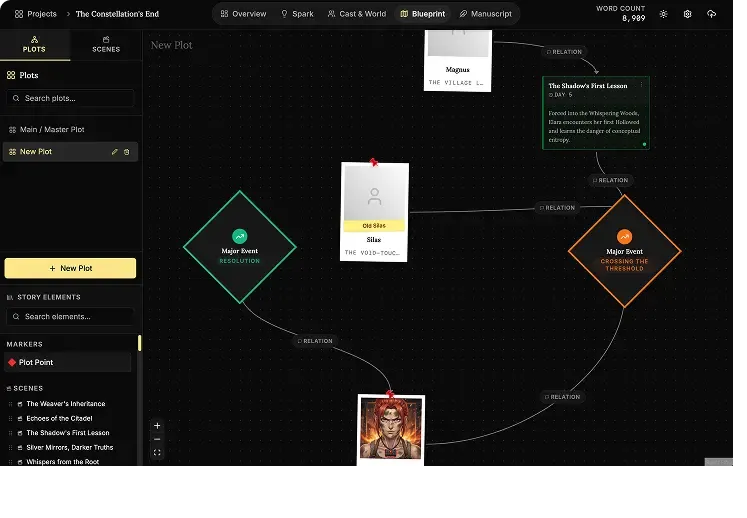
Shape the form through visual planning, connected scenes, plotlines, and arcs. The Blueprint sits inside the same NovelOS Studio project as your characters, world, timeline, manuscript, goals, tracker, revision tools, and publishing exports.
Record the idea where it affects the book, test it in scenes, and revise it beside the surrounding prose. NovelOS Studio keeps the craft decision attached to the novel instead of leaving it in a separate worksheet.