Story Structure
Denouement
The denouement is the closing movement that shows how the story world settles after the central conflict is resolved.
Denouement in a story
It follows consequences into relationships, routines, institutions, and remaining questions. Its length depends on how much the climax changed.
Original fiction example
After the rebellion succeeds, the former courier must decide whether to join the new council or return to the road she once used to escape responsibility.
This example is original to the NovelOS glossary. It illustrates the term without borrowing a passage from a published novel.
Why writers use it
Use the denouement to deliver emotional and practical consequences the climax cannot contain.
A useful revision question: Where does this device change what the reader understands, expects, or feels? If removing it leaves the passage unchanged, it may need a clearer function.
A common mistake
Explaining every character's entire future can drain energy from the ending's strongest image.
Use denouement in NovelOS Studio
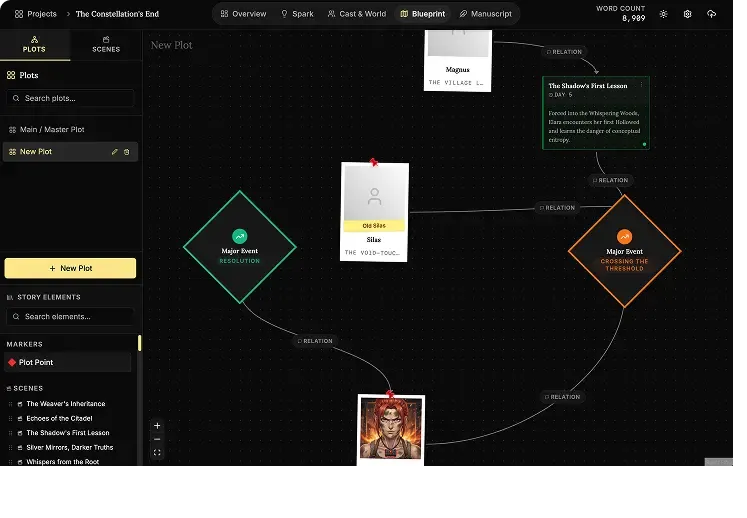
Map the term across scene cards, plotlines, arcs, and Timeline View. The Blueprint sits inside the same NovelOS Studio project as your characters, world, timeline, manuscript, goals, tracker, revision tools, and publishing exports.
Record the idea where it affects the book, test it in scenes, and revise it beside the surrounding prose. NovelOS Studio keeps the craft decision attached to the novel instead of leaving it in a separate worksheet.