LegendKeeper Alternatives for Novelists Who Write Alone

LegendKeeper is a collaborative worldbuilding wiki and campaign manager, and it is very good at what it was designed for. Its nested wiki is fast, its auto-linking connects names across hundreds of pages, and its maps are among the best in the category: very large base maps, nested from continent down to a single room, with regions, paths, calibrated distance, and pins that open wiki pages. Real-time editing with unlimited collaborators makes it a natural home for game masters and co-authors.
That design is also why solo novelists go looking for LegendKeeper alternatives. LegendKeeper is built for sharing a world; a novelist working alone often needs a place to write in that world. It is a browser service with a subscription, and it does not include a manuscript binder or book export.
This guide compares four alternatives, each better for a different kind of writer, using each vendor’s own pricing and feature pages, checked in August 2026.
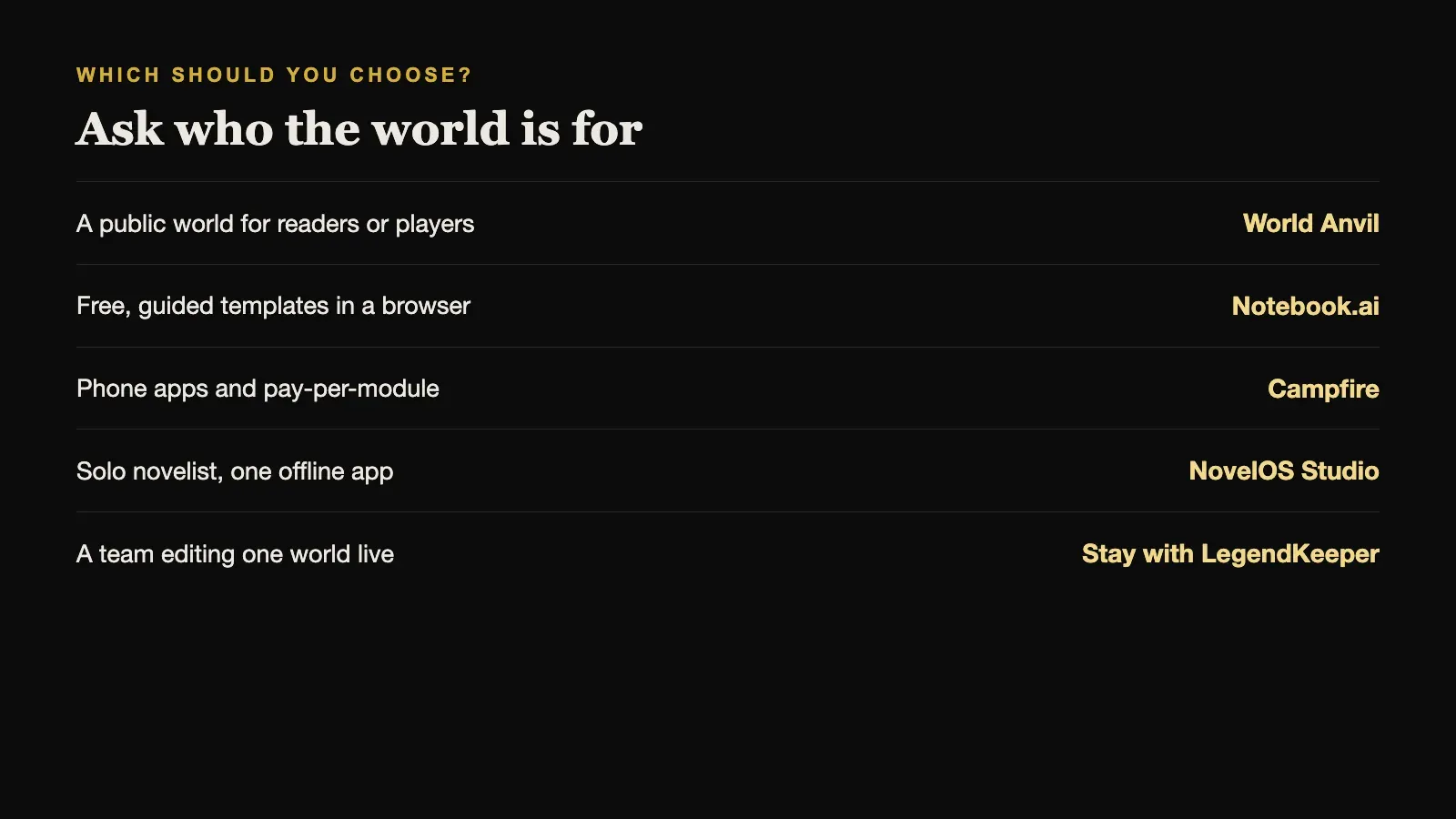
The short answer. For a public world with a reader community, choose World Anvil. For a generous free notebook with structured templates, choose Notebook.ai. For modular tools with phone apps, choose Campfire. For a solo novelist who wants the world, the plot, and the manuscript in one offline application, choose NovelOS Studio.
LegendKeeper Alternatives Compared
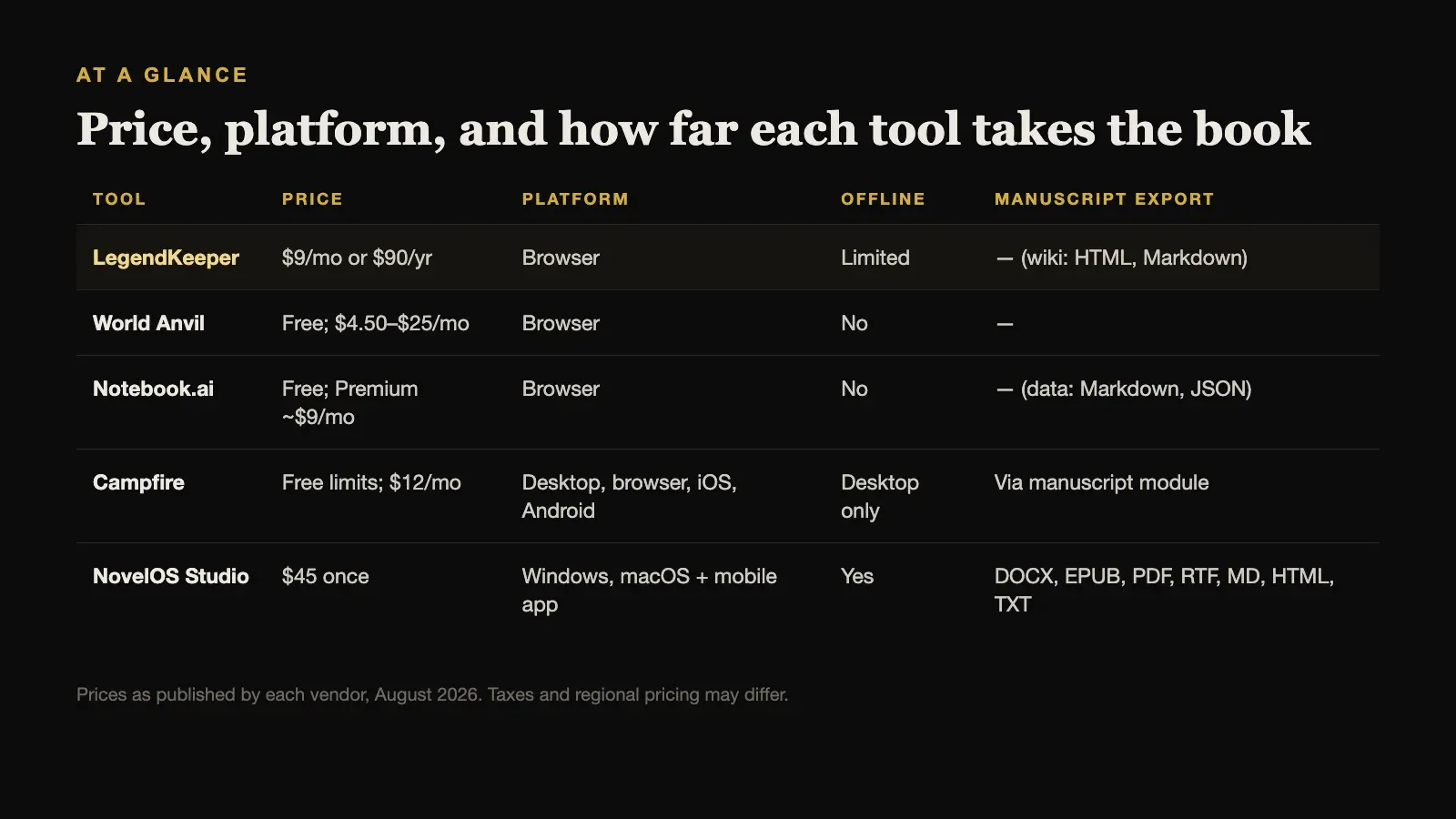
| Tool | Price | Platform | Offline | Manuscript export |
|---|---|---|---|---|
| LegendKeeper | $9/mo or $90/yr | Browser | Limited | — (wiki: HTML, Markdown) |
| World Anvil | Free; $4.50–$25/mo | Browser | No | — |
| Notebook.ai | Free; Premium ~$9/mo | Browser | No | — (data: Markdown, JSON) |
| Campfire | Free limits; $12/mo | Desktop, browser, iOS, Android | Desktop only | Via manuscript module |
| NovelOS Studio | $45 once | Windows, macOS + mobile app | Yes | DOCX, EPUB, PDF, RTF, MD, HTML, TXT |
Prices are as published by each vendor in August 2026 and exclude tax.
How LegendKeeper’s Subscription Works
The detail that matters most is what happens when you stop paying. LegendKeeper Pro costs $9 per month or $90 per year, after a 14-day trial with no credit card. When the trial or subscription ends, the Basic tier lets you view and export your existing projects and collaborate in projects owned by other people, but you cannot keep creating or editing your own project without Pro.
LegendKeeper is clear that it always lets owners view and export their data, and it keeps daily server backups. Its LK and JSON exports cover pages, maps, and boards and can be re-imported. Its HTML and Markdown exports are useful as a portable knowledge base.
It also still labels itself Open Beta, while describing the current application as polished and stable. And it runs only in a browser, with offline support that its own documentation qualifies: unsynced changes live in browser storage, uploads need a connection, and clearing browser data before a sync can erase offline work.
None of that is a criticism for a team running a shared world. It matters more if you are one person writing a book for several years.
1. World Anvil: Best for Publishing a World to Readers
World Anvil is the closest relative to LegendKeeper, and the better choice when the world is meant to be read. It combines articles, interactive maps with linked markers, timelines, and a public presentation designed for reader communities.
Its free Freeman tier is enough to start. Paid tiers cost $4.50, $8.25, or $25 per month when billed annually and add coauthors, four on Master up to twenty on Sage, along with richer map features such as layers, polygons, and journey lines. It is a hosted service and needs an internet connection for normal authoring.
Choose World Anvil when readers, players, or patrons are part of the plan, and you want your world presented as a site people can explore.
2. Notebook.ai: Best Free Structured Notebook
Notebook.ai is a hosted worldbuilding notebook with an unusually generous free plan. Starter is free with no card, and supports up to five universes, unlimited characters, locations, and items, unlimited document storage, and an integrated word processor. Premium, at about $9 per month, unlocks 29 structured page types covering everything from creatures and deities to languages, governments, and magic systems.
Where LegendKeeper leaves structure to you, Notebook.ai supplies it: detailed templates, progress indicators, and personalised questions that save each answer into the right page. Reciprocal links mean marking one character as another’s parent updates both records.
It is a browser application with cloud backup rather than an offline desktop program.
Choose Notebook.ai when you want guided templates and a strong free tier, and a browser workflow suits you.
3. Campfire: Best Modular Toolkit With Mobile Apps
Campfire divides worldbuilding into modules for characters, maps, timelines, magic systems, and the manuscript, which you can use free within limits or unlock on a subscription, currently displayed at $12 per month. Its maps support pins, regions, and nesting, and its timekeeping includes custom calendars and multiple timelines, which covers much of LegendKeeper’s territory.
It adds two things LegendKeeper does not currently offer: native iOS and Android apps, and a manuscript module inside the same product. Desktop modules can work offline, while the browser and mobile apps need a connection. You can also invite collaborators to view, comment, or edit.
Choose Campfire when you want to capture ideas on your phone, write the manuscript in the same toolkit, or pay only for the modules you use.
4. NovelOS Studio: Best for a Solo Novelist Writing the Book
NovelOS Studio approaches the problem from the manuscript outward. It keeps worldbuilding records, maps, characters and family trees, visual plot boards, and the manuscript in one project, with every scene linked to the people, places, and objects in it. Writing goals and a yearly activity view track progress toward a finished draft.
Compared with LegendKeeper, the trade-offs are clear. NovelOS is built for one author, not a team, and it does not offer real-time collaboration, public world sites, or secrets for players. What it offers instead is ownership: it runs fully offline on Windows and macOS, stores the project on your own computer with no account, and costs $45 once, with no subscription to keep your own work editable. The same licence activates an installable mobile app.
When the book is done, NovelOS exports it as DOCX, EPUB, PDF, RTF, Markdown, HTML, or plain text, and the whole project can move to another computer as a single .novelos archive.
Choose NovelOS Studio when you are writing a novel on your own and want the world to sit beside the manuscript, not in a separate wiki.
When LegendKeeper Is Still the Right Choice
LegendKeeper leads clearly in several situations:
- Several people building one world together, editing the same page at the same time.
- Tabletop campaigns, where granular permissions, hidden pages, secret blocks, and concealed map pins let you reveal lore to players gradually.
- Very large, nested maps that act as the main way you navigate the world.
- Custom time systems, with Chronicle, Gantt, and Calendar views and resolution from minutes to billions of years.
- Bringing a world in from elsewhere. Its importers accept Obsidian vaults, Markdown, JSON, Campfire HTML, and World Anvil exports.
If your world is a shared project, LegendKeeper is one of the strongest tools available, and a subscription is a fair price for a service a whole group relies on.
Moving Your World Out of LegendKeeper
If you do switch, plan the move before your subscription lapses, while you can still edit.
Start with a full LK or JSON export, which LegendKeeper documents as complete for pages, maps, and boards and re-importable. Keep that file as your archive even if your next tool cannot read it. Then export Markdown or HTML, which almost any application can read, and use that to move the text of your lore.
Maps usually need the most attention. Export your base map images separately so the highest-resolution versions are safe, and expect to recreate pins and regions in the new tool. Finally, check which records you actually use while drafting. Many worlds are larger than the book needs, and a move is a good moment to bring only the pages that matter to the story you are writing now.
How to Choose
Ask who the world is for.
If it is for players or readers, choose a tool built for sharing: LegendKeeper for a private group, World Anvil for a public audience.
If it is for you, while you write, the priorities change. You need the world to be quick to consult mid-scene, consistent across a long draft, and available offline, and you probably do not want a subscription deciding whether you can edit your own notes. Notebook.ai and Campfire suit writers who are happy in a browser or on their phone. NovelOS Studio suits writers who want everything in one place on their own computer.
Sources and further reading
Prices and features were checked against first-party sources in August 2026 and may change.