ForgeTales Alternatives for Worldbuilders Who Also Need to Finish the Novel

ForgeTales is one of the more thoughtful worldbuilding applications released recently. It stores work locally, runs offline after purchase validation, collects no in-app telemetry, and makes a clear promise not to use AI to generate or train on your story. Its free tier has no time limit, it runs on Windows, macOS, and Linux, and its custom calendars handle invented months, lunar phases, holidays, and weather better than most tools in the category.
So the question is rarely whether ForgeTales is good. It is whether its shape matches your project. ForgeTales is a worldbuilding application first, with manuscript writing sold separately as the Atelier module. If most of your time goes into the world, that is a sensible structure. If most of your time goes into the book, you may want a tool where the world, the plot, and the prose were designed as one system from the start.
This guide compares five ForgeTales alternatives, each strongest for a different reason. The facts come from each vendor’s own pricing, download, feature, and terms pages, checked in August 2026.
Best overall for novelists: NovelOS Studio. It keeps worldbuilding, characters, maps, plot boards, drafting, goals, and export in one $45 purchase. ForgeTales remains the better choice when Linux support, a permanent free tier, custom fantasy calendars, or a strict no-AI product are the deciding requirements.
ForgeTales Alternatives Compared
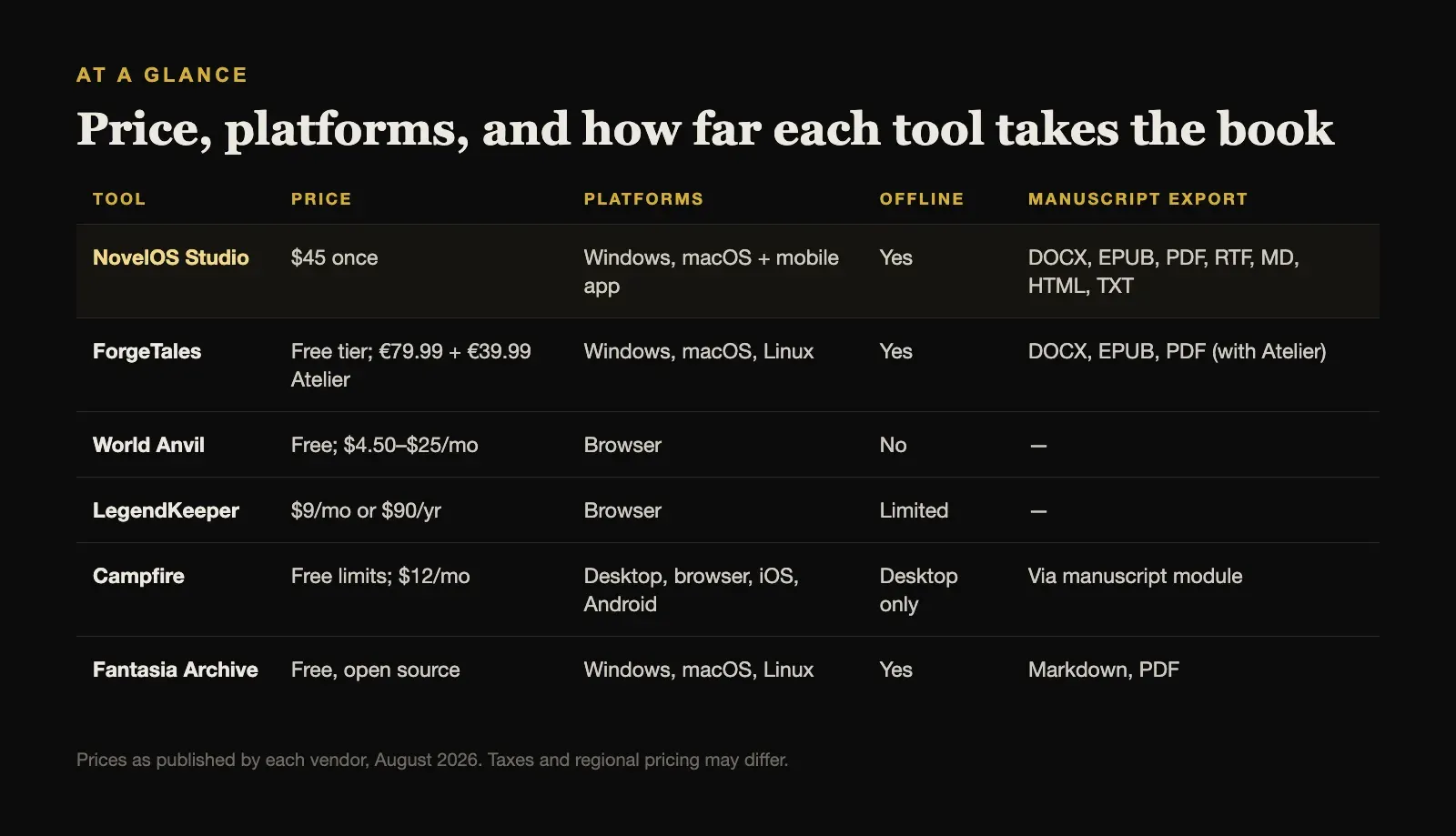
| Tool | Price | Platforms | Offline | Manuscript export |
|---|---|---|---|---|
| NovelOS Studio | $45 once | Windows, macOS + mobile app | Yes | DOCX, EPUB, PDF, RTF, MD, HTML, TXT |
| ForgeTales | Free tier; €79.99 + €39.99 Atelier | Windows, macOS, Linux | Yes | DOCX, EPUB, PDF (with Atelier) |
| World Anvil | Free; $4.50–$25/mo | Browser | No | — |
| LegendKeeper | $9/mo or $90/yr | Browser | Limited | — |
| Campfire | Free limits; $12/mo | Desktop, browser, iOS, Android | Desktop only | Via manuscript module |
| Fantasia Archive | Free, open source | Windows, macOS, Linux | Yes | Markdown, PDF |
Prices are as published by each vendor in August 2026 and exclude tax.
What ForgeTales Costs Once You Want to Write the Book
ForgeTales has a free worldbuilding plan that allows one active world, 25 moodboard elements, 15 characters, 20 timeline events, and 20 wiki notes. The unlimited Founder licence costs €79.99 plus VAT. The Atelier writing module, which adds a binder for acts and scenes, Focus Mode, version history, and DOCX, EPUB, and PDF export, is a separate €39.99 plus VAT, and can be tried across 10,000 words first.
A writer who wants unlimited worldbuilding and unrestricted manuscript writing therefore pays €119.98 plus VAT. That is still a one-time price, which puts ForgeTales in a different category from subscription tools. But it is worth knowing before you compare it with applications that price the whole writing process as one product.
The licence is personal, non-transferable, and active on two devices at once. The terms also note that optional new modules may be sold separately in future, as Atelier currently is.
1. NovelOS Studio: Best Complete Alternative for Novelists
NovelOS Studio overlaps with ForgeTales more than any other tool on this list. Both keep characters, relationships, family trees, lore, and timelines together. Both store your work locally and work without an internet connection. Both are one-time purchases.
The difference is where each product stops. ForgeTales is built around the world and adds writing as a module. NovelOS is built around the finished novel and treats the world as one part of it. Worldbuilding records feed scene context, plot boards, and chronology directly, and the same application carries you through drafting, word-count goals, and export.
Three practical differences stand out:
- Maps are shipped, not planned. ForgeTales lists Map Creation as in development on its public roadmap. NovelOS includes Cartograph today, so geography-dependent fiction does not have to wait for a feature.
- Plotting uses several boards. ForgeTales offers coherent block-based timelines and plot planning. NovelOS lets one book carry separate Blueprint boards for the main arc, subplots, clues, and revision passes, all built on the same scenes and characters.
- Progress is explicit. Goals, deadlines, required pace, and a yearly activity view answer how much of the book remains and whether you are on track.
NovelOS costs $45 once for Windows and macOS, and the same licence activates an installable mobile app. There is no account, and projects export as a portable .novelos archive you can restore on another computer. AI features are optional and run on your own provider key, so nothing is sent anywhere unless you set that up. You can export the manuscript as DOCX, EPUB, PDF, RTF, Markdown, HTML, and plain text.
Choose NovelOS Studio when you are writing a novel rather than documenting a world for its own sake, and you want one purchase to cover the whole path from first idea to exported book.
2. World Anvil: Best for a Public, Shareable World
World Anvil is the best-known worldbuilding platform, and it answers a different need from ForgeTales. It is a browser service built around publishing a navigable world: articles, interactive maps with linked markers, timelines, and a reader-facing presentation.
Its free Freeman tier is enough to start. Paid tiers cost $4.50, $8.25, or $25 per month when billed annually, and they add coauthors (four on Master, nine on Grandmaster, twenty on Sage) along with richer map layers, polygons, and journey lines.
The trade-off is the reverse of ForgeTales. World Anvil requires the hosted service and an internet connection for normal authoring, and there is no official offline desktop application.
Choose World Anvil when your world is meant to be read, shared, or played in by other people, such as a tabletop campaign, a shared universe, or a reader community.
3. LegendKeeper: Best for Live Collaboration and Large Maps
LegendKeeper is a browser-based wiki with some of the strongest map tools in the category. You can upload very large base maps, nest them from continent to room, add regions, paths, and labels, calibrate distance, and embed maps inside pages.
Its clearest advantage is teamwork. LegendKeeper Pro includes unlimited collaborators who can edit the same document in real time and see each other’s cursors. Pro costs $9 per month or $90 per year after a 14-day trial, and guests can join another owner’s project without paying.
LegendKeeper has real browser-based offline support, but its own documentation is careful about the limits: unsynced changes live in browser storage, uploads need a connection, and clearing browser data before synchronisation can erase offline work. It does not export to manuscript formats such as DOCX or EPUB.
Choose LegendKeeper when several people are building one world together, or when a shared, map-heavy reference matters more than a private writing workflow.
4. Campfire: Best Modular Toolkit With Mobile Apps
Campfire splits worldbuilding and writing into separate modules for characters, maps, timelines, magic systems, and manuscripts. You can start free within per-module limits, including 25,000 manuscript words, 10 characters, 20 timeline events, and 2 maps. The Standard plan currently displays $12 per month.
Campfire’s interactive maps support pins, regions, and nested maps, and its timekeeping includes custom calendars and multiple timelines, so it covers much of ForgeTales’ territory. Unlike ForgeTales, it offers a browser app and iOS and Android apps, and it lets you invite collaborators to view, comment on, or edit your work. Desktop modules can work offline, while browser and mobile use need a connection.
Choose Campfire when you want to pick and pay for specific modules, need to capture ideas on your phone, or plan to work with collaborators.
5. Fantasia Archive: Best Free, Open-Source Option
Fantasia Archive is free and open source under the GNU GPL v3, with no subscription, trial, or paywall. It runs as an offline desktop application on Windows, macOS, and Linux, stores everything locally, and needs no account. Its twenty built-in record types cover characters, locations, religions, magic, and much more.
It is also the most technical option here. The interface is dense and form-driven, backups are manual project-folder copies, and export is limited to Markdown and PDF. There is no visual plotting, no writing goals, and no manuscript production.
Choose Fantasia Archive when zero cost, open-source code, and Linux support matter more than a polished interface or a path to a finished book.
When ForgeTales Is Still the Right Choice
It would be misleading to present any of these as a straightforward upgrade. ForgeTales leads in several specific areas:
- Linux and ChromeOS. It publishes Linux AppImage and Debian packages and documents running through ChromeOS Crostini. Of the tools here, only Fantasia Archive matches it on Linux.
- Custom fantasy calendars. Invented months, lunar phases, holidays, and weather are unusually well supported.
- A permanent free tier that works offline with no time limit.
- Moodboards with music, which make it an atmospheric space for establishing the feel of a world.
- An explicit no-AI promise. If you want a tool that will never offer generative assistance, ForgeTales states that more firmly than NovelOS, which offers optional assistance on your own key.
If those matter most, stay with ForgeTales and add Atelier when you are ready to write.
How to Choose
Start with where your hours actually go.
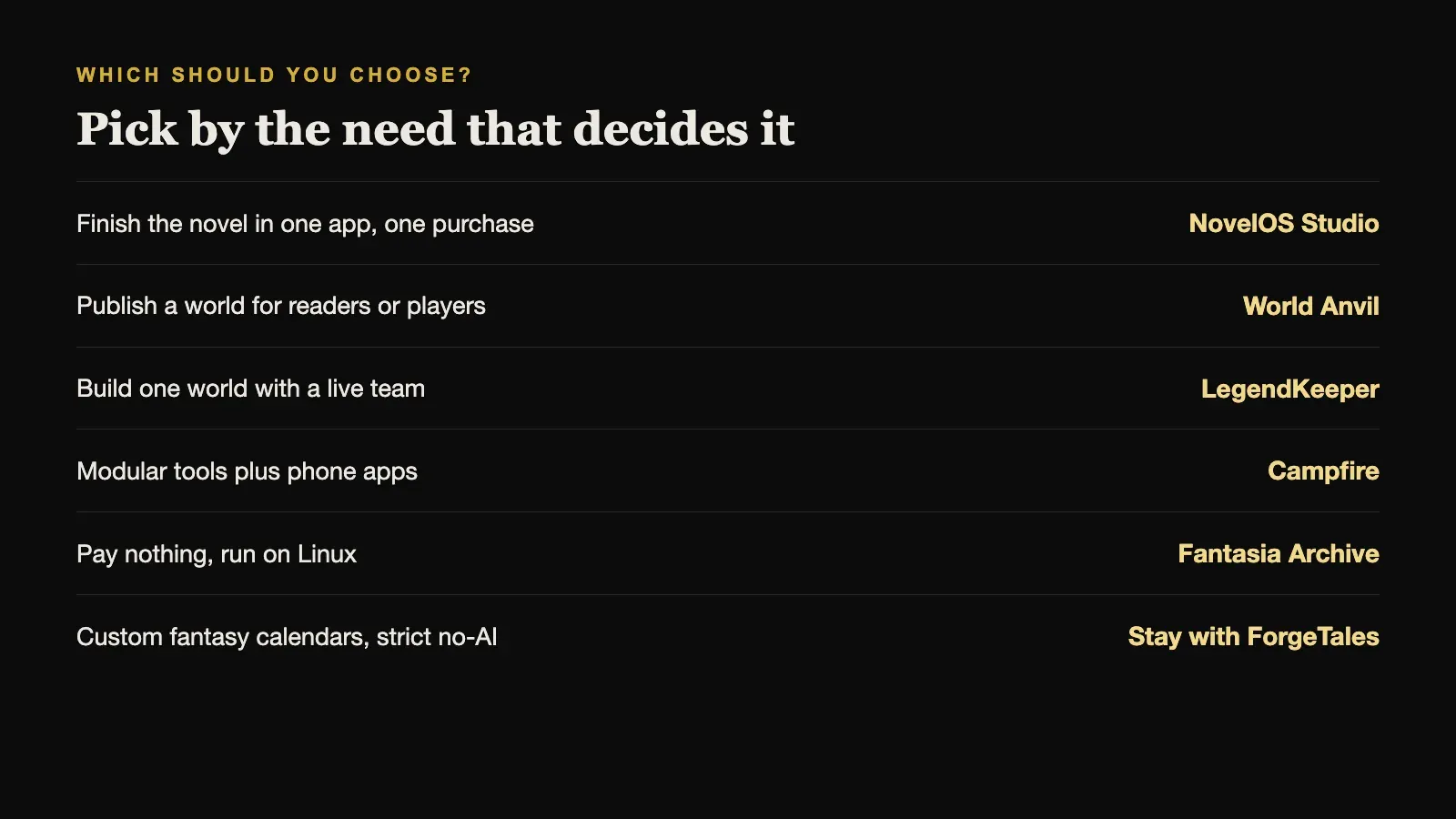
If the world is the project, whether you run a campaign, build a setting for others, or document a universe across several books, a dedicated worldbuilding tool will serve you well. Pick World Anvil to publish it, LegendKeeper to build it with a team, ForgeTales for private offline work with deep calendars, or Fantasia Archive if it must cost nothing.
If the world serves a novel you intend to finish, the deciding factor is how much friction sits between your notes and your chapters. Each separate application is another place where a character’s eye colour or a city’s distance from the coast can drift out of date. Keeping the world, the plot, and the prose in one place is what NovelOS Studio was built for.
Sources and further reading
Prices and features were checked against first-party sources in August 2026 and may change.