Fictionary Alternatives for Novelists Revising a First Draft

Fictionary is a structural-editing tool for fiction. You import a finished draft, and it breaks the manuscript into scenes and evaluates each one against 38 Story Elements covering character, plot, and setting, then shows the results as a Story Map. Its own guidance is honest about when it helps most: its greatest value starts once you have a first draft of roughly 25,000 words or more.
That focus is also why writers look for Fictionary alternatives. It costs $19 a month for StoryTeller or $39 a month for Premium. It runs only in a browser and needs an internet connection. And it is a revision tool rather than a place to plan and write the book, so most writers use it alongside something else.
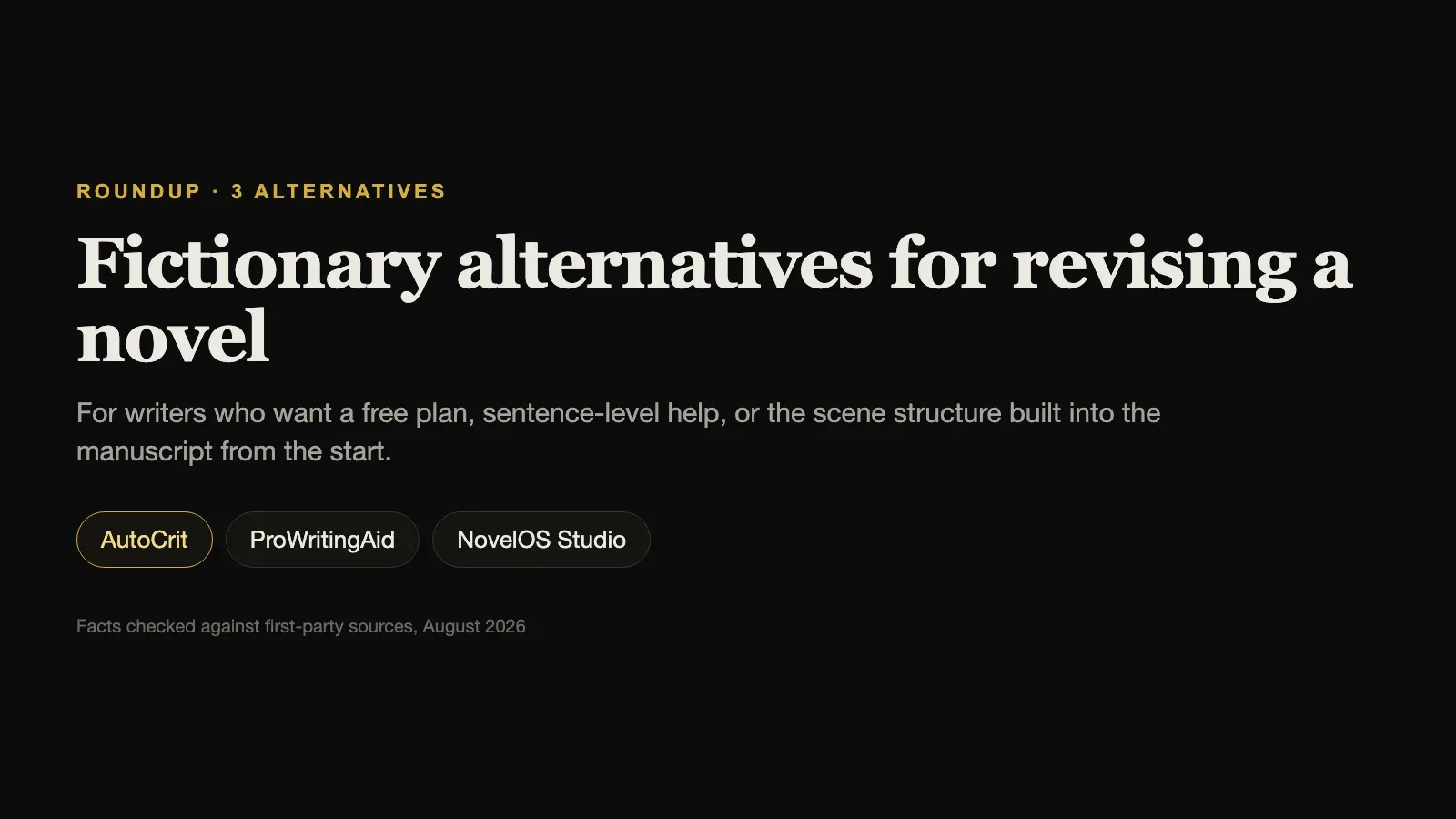
This guide compares three alternatives, using each vendor’s own pricing and help pages, checked in August 2026.
The short answer. If you want the most similar tool with a free plan, try AutoCrit. If your revision problems are mostly at the sentence level, try ProWritingAid. If you want the scene-level information Fictionary extracts to live in your manuscript from the start, so revision does not begin with an import, look at NovelOS Studio.
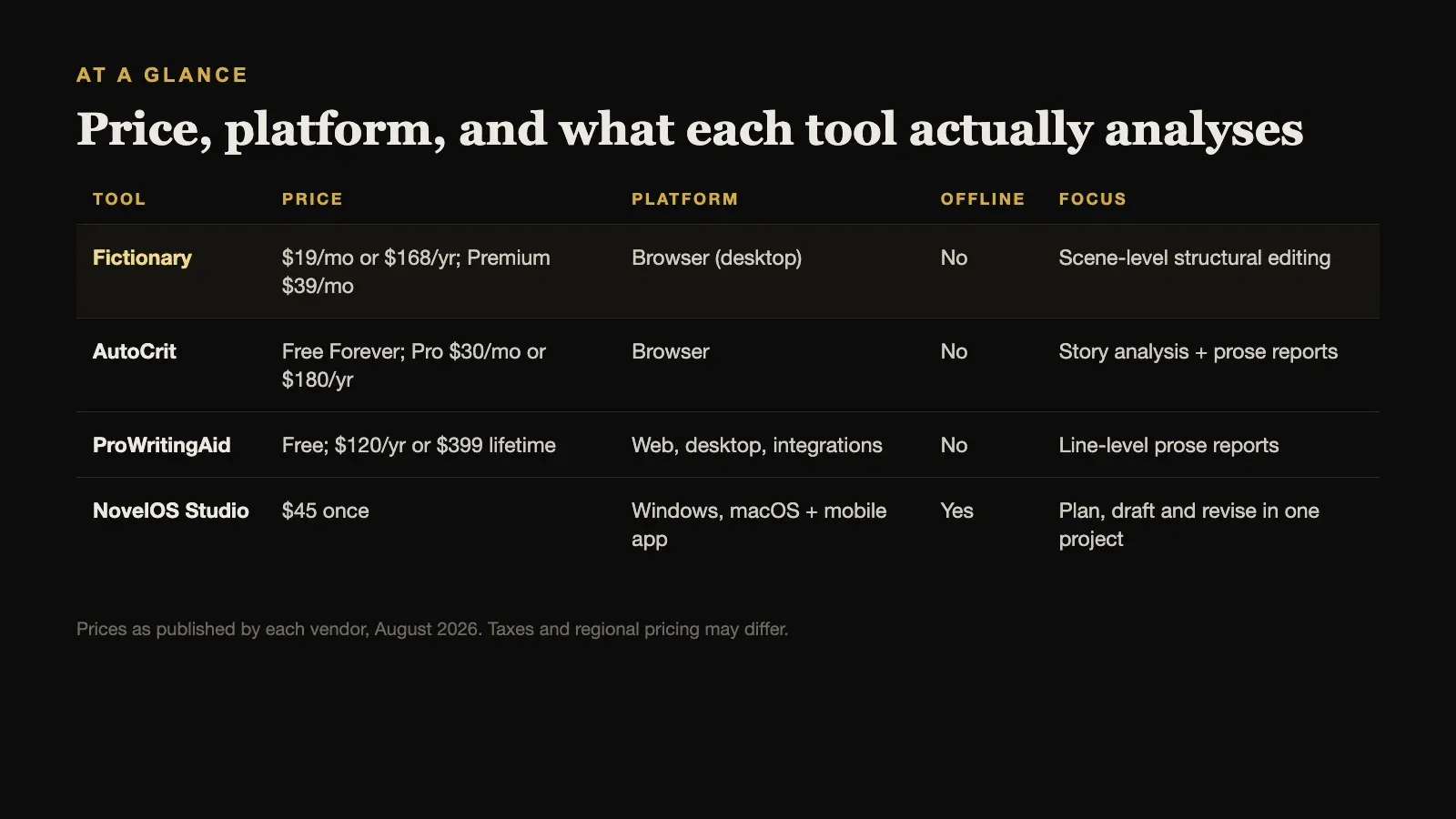
Fictionary Alternatives Compared
| Tool | Price | Platform | Offline | Focus |
|---|---|---|---|---|
| Fictionary | $19/mo or $168/yr; Premium $39/mo | Browser (desktop) | No | Scene-level structural editing |
| AutoCrit | Free Forever; Pro $30/mo or $180/yr | Browser | No | Story analysis + prose reports |
| ProWritingAid | Free; $120/yr or $399 lifetime | Web, desktop, integrations | No | Line-level prose reports |
| NovelOS Studio | $45 once | Windows, macOS + mobile app | Yes | Plan, draft and revise in one project |
Prices are as published by each vendor in August 2026 and exclude tax.
What Fictionary Does, and What It Costs
Fictionary’s method is its strength. Rather than grading grammar, it asks structural questions of every scene: whose point of view it is in, what the character wants, whether the scene has an anchor in time and place, whether the stakes rise, and how the scene fits the overall arc. Automated cast identification works out which characters appear where. Its Story Map turns those answers into a visual picture of the whole book.
The practical details, from Fictionary’s own pages:
- Price: StoryTeller is $19 per month or $168 per year, with three active manuscripts. StoryTeller Premium is $39 per month or $348 per year, advertised with ten manuscripts, track changes, and comments.
- Trial: seven days, without a credit card.
- Platform: a browser application for laptops and desktops using supported Safari or Chrome. Phone and tablet support is planned but not current.
- Offline work: none. It is an internet-dependent cloud service.
- Import and export: DOCX in, with chapters and scenes detected from headings and scene breaks, and the edited manuscript back out to Word.
1. AutoCrit: Closest Alternative With a Free Plan
AutoCrit is the nearest like-for-like option. It is also an online platform built around analysing fiction, with Story Analyzer+ covering premise, conflict, characters, worldbuilding, chronology, foreshadowing, point of view, tropes, beats, chapters, and series. It adds genre-aware prose reports and automated “reader” avatars that react to your chapters as alpha and beta readers might.
Its pricing is the main difference. AutoCrit Pro costs $30 per month or $180 per year, but its Free Forever plan has no manuscript word limit and includes online storage, noteboards, and a selection of reports. It also goes further toward publishing, with integrated EPUB and PDF formatting and export to DOCX, RTF, TXT, EPUB, and PDF.
Like Fictionary, it requires the hosted service and an internet connection.
Choose AutoCrit when you want structural and prose analysis in one place and would like to start without paying.
2. ProWritingAid: Best for Line-Level Revision
ProWritingAid is a prose editor rather than a structural one. It offers real-time suggestions and more than 25 specialised reports covering pacing, repetition, dialogue, sentence variety, readability, and style, plus chapter critique and full-manuscript feedback. Whole-story reports use separately purchased Story Credits.
Its biggest practical advantage is reach. ProWritingAid works in its own web editor and integrates with Word, Google Docs, Scrivener, and browsers, so you can revise inside the application where you already write. It has a free plan, and Premium costs $30 per month, $120 per year, or $399 once for a lifetime licence. Every integration needs an internet connection.
Choose ProWritingAid when your structure is working and the revision problem is sentences: repetition, rhythm, clarity, and style.
3. NovelOS Studio: Best When Structure Should Be Built In, Not Extracted
Fictionary’s core insight is that revision works best scene by scene, with each scene’s point of view, goal, setting, and place in the arc visible at once. The awkward part is that this information has to be extracted from a finished draft through an import, and it lives in a separate account.
NovelOS Studio records that information as you write. Every scene carries its viewpoint, status, synopsis, cast, location, objects, and the plot boards it belongs to. Visual Blueprint boards show the main arc, subplots, and clues side by side, and character and world records sit next to the prose rather than in another tool. When you reach revision, the structure is already there to work from.
To be clear about the difference: NovelOS does not score your scenes against a structural checklist the way Fictionary does. It gives you the organised material to revise from, and its optional AI line edits, which explain the reason for each change, run only on your own provider key. For the pass itself, margin notes let you comment on selected words or bookmark a paragraph, then work down one list in reading order.
NovelOS costs $45 once for Windows and macOS, the same licence activates an installable mobile app, and it works fully offline with projects stored on your own device. It exports DOCX, EPUB, PDF, RTF, Markdown, HTML, and plain text.
Choose NovelOS Studio when you would rather avoid a revision problem than diagnose it afterwards, and want planning, drafting, and revision in one application without a subscription.
When Fictionary Is Still the Right Choice
If you have a complete draft that feels wrong but you cannot say why, Fictionary is very good at turning that feeling into specific, scene-by-scene questions. Its method gives structure to a stage of writing that is usually unstructured, and for many writers that alone is worth the subscription.
It is also well suited to working with a professional editor: Premium adds track changes and comments, and StoryCoach supports editors who use Fictionary with their clients.
A sensible way to use it is for a defined period. Take the seven-day trial, or a single month, to run a full structural pass on a finished draft, then cancel until the next book is ready.
Whichever analysis tool you choose, prepare the draft before you import it. Fictionary detects chapters from headings and scenes from scene breaks, and AutoCrit’s import does not document chapter splitting at all, so a manuscript with inconsistent heading styles or hand-typed asterisks will be divided wrongly and analysed wrongly. Apply one heading style to every chapter title, use one consistent scene-break marker, and remove comments and tracked changes first. Ten minutes of clean-up here saves an evening of correcting a Story Map built on the wrong scene boundaries.
How to Choose
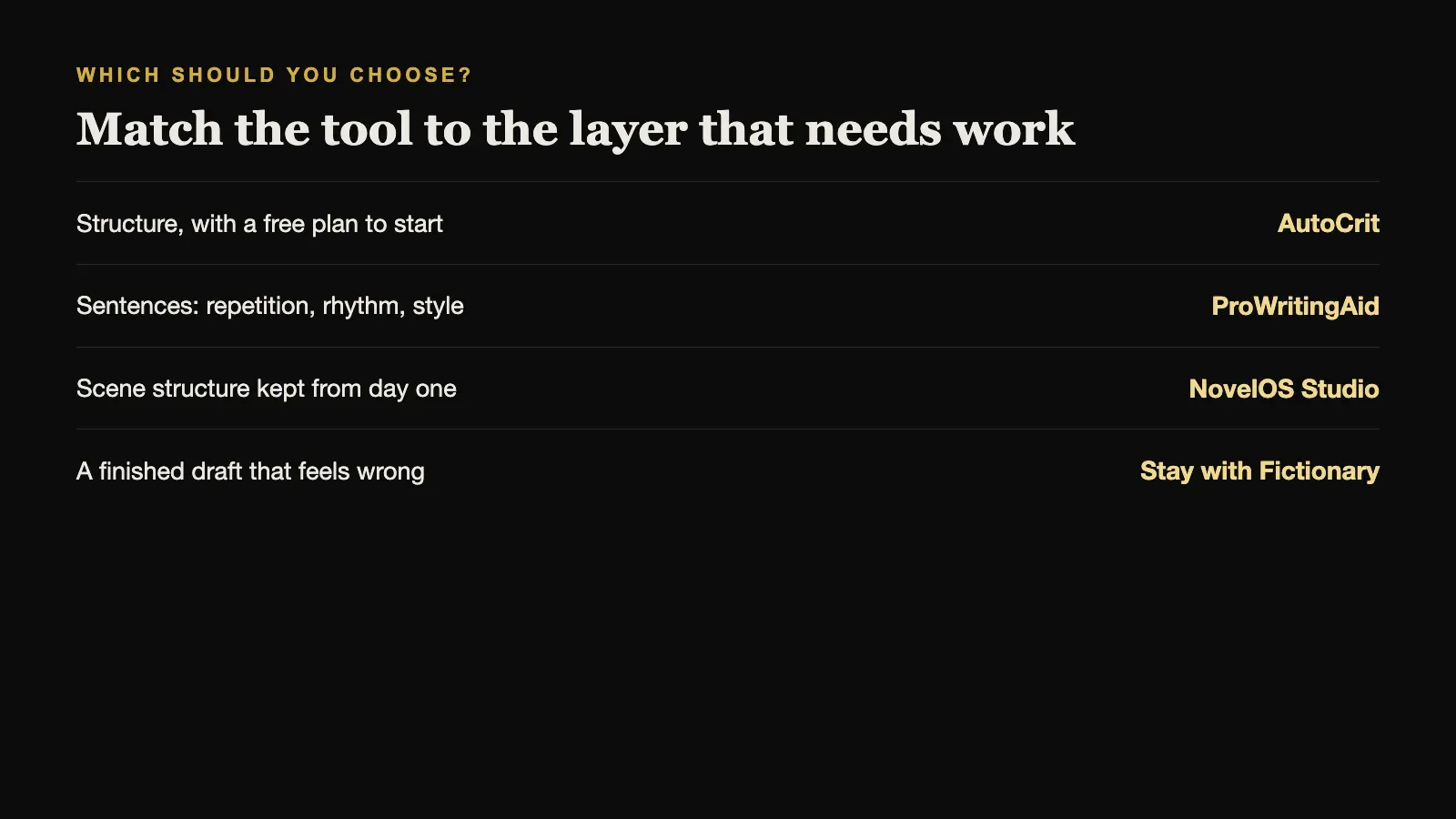
Match the tool to the layer of the book that needs work:
- The story does not hold together. Scenes lack purpose, the middle sags, or point of view drifts. That is structural, and Fictionary or AutoCrit’s Story Analyzer+ are built for it.
- The story works but the prose does not. Repetition, flat dialogue, and slow sentences are line-level problems, and ProWritingAid is the specialist.
- You keep having to reconstruct your own book. If revision starts with rebuilding a list of who is in which scene and what each one is for, the fix is to keep that information from the start, which is what NovelOS Studio is designed around.
Many writers end up using two tools: one where the book lives, and one specialist pass at the end. The question is which job each tool does, and whether you want to pay for it monthly.
Sources and further reading
Prices and features were checked against first-party sources in August 2026 and may change.