A Portal Crossing Must Transfer More Than a Body

A strong portal fantasy crossing does more than place a modern person in a fantastic landscape. It transfers an unfinished action into conditions where the action no longer works as expected.
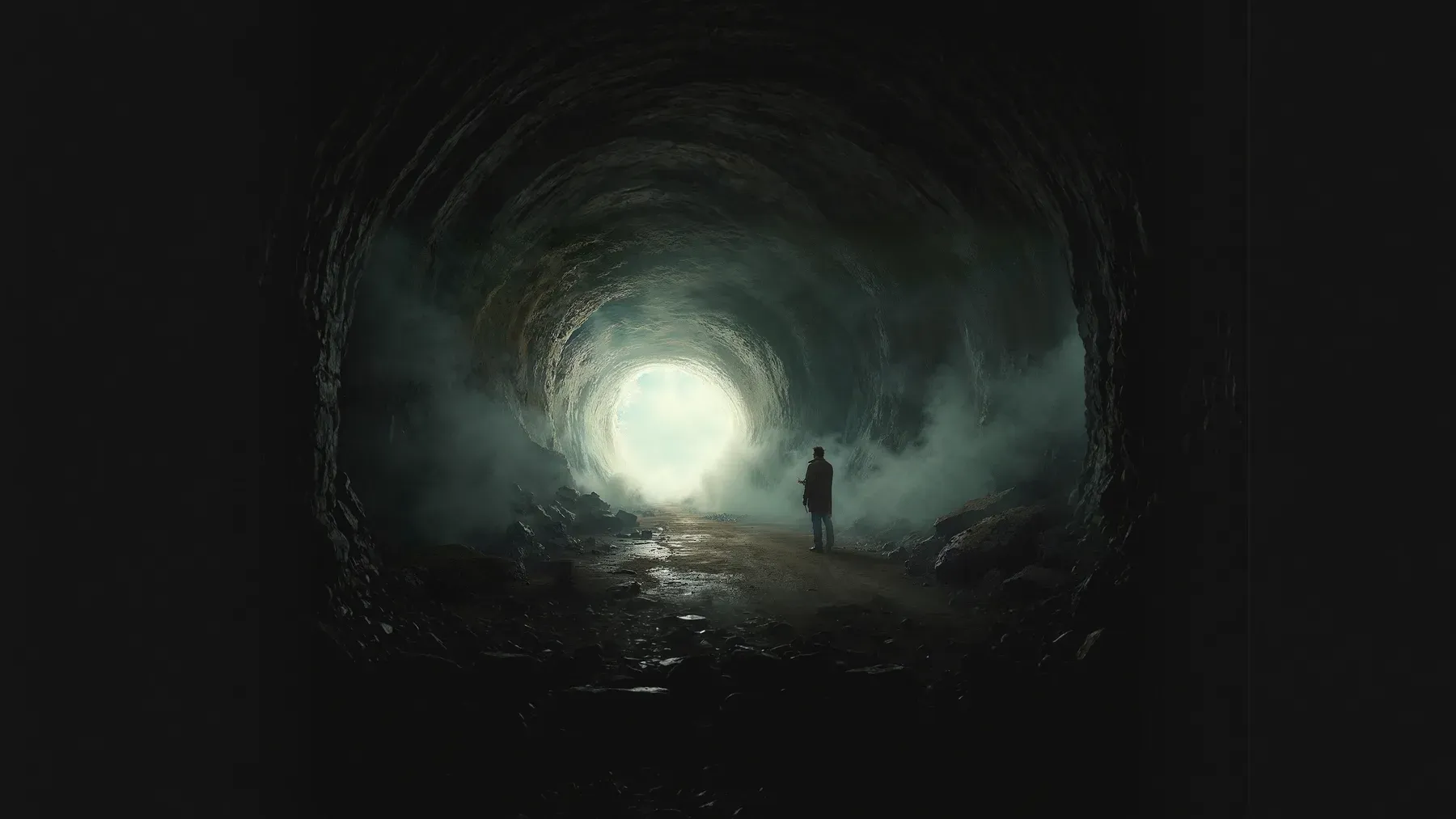
An unnamed bicycle courier enters a flooded pedestrian tunnel with twelve minutes left on a medical delivery. The insulated pouch must reach an apartment before the recipient leaves for dialysis. Halfway through the tunnel, the electric lights fail. A white door appears in the tiled wall where the courier expects an emergency exit.
The door opens onto a cold field. A second white door glows half a mile away, unsupported by any wall. The tunnel has vanished behind the courier. The bicycle still carries rainwater from the city, the phone still counts down the delivery window, and the medicine is still warming.
Those continuities make the impossible event matter. The protagonist has crossed between worlds, while purpose, time, objects, knowledge, and responsibility cross in different conditions.
Plan the threshold with a crossing ledger:
| Story element | Before the portal | Immediately after |
|---|---|---|
| active task | deliver medicine to a known address | identify any route that might reach the recipient |
| clock | twelve minutes on a city route | twelve minutes on a phone with no network or mapped distance |
| useful skill | read traffic, addresses, and shortcuts | infer movement from paths, landmarks, and travelers |
| carried object | bicycle and insulated pouch | unfamiliar machine and symbol of disputed authority |
| belief | a promise ends at the stated address | the intended recipient may define where a route leads |
The portal is strongest when every row keeps moving after the spectacle ends.
Give the Character a Vector Before the Threshold
A crossing gains force from interrupted direction. Establish what the protagonist is doing, where they believe they are going, why now matters, and what result will count as completion.
The courier’s vector is concrete:
- Destination: an apartment seven city blocks away
- Purpose: hand medicine to the recipient or an authorized carer
- Deadline: before the recipient departs for treatment
- Method: bicycle through the tunnel, then two surface streets
- Responsibility: protect the package temperature and obtain delivery confirmation
- Private pressure: prove reliability after missing an earlier family commitment
These facts require only a compact opening. Show the courier declining a safer detour, checking the pouch temperature, and sending an arrival estimate. The reader understands professional skill, urgency, and the character’s need to be dependable through action.
Farah Mendlesohn’s Rhetorics of Fantasy examines portal-quest fantasy through the relationship among protagonist, fantastic world, and reader. A portal protagonist typically encounters the other world without native knowledge, and the reader learns through that encounter. The threshold therefore changes both location and the story’s method of knowing.
The pre-crossing vector protects that method from becoming a passive tour. The courier arrives with questions created by a task: Which direction leads toward the expected address? Does the phone clock still correspond to home? Can the medicine survive the journey? Who can confirm a delivery here? Every new fact is evaluated against an existing need.
Give the old life at least one attraction as well as one pressure. The courier likes the city’s early-morning routes, knows which shopkeepers leave water outside, and values the small trust involved in carrying private packages. If the primary world contains only misery, remaining in the other world costs little. A specific home makes return, separation, and changed belonging consequential.
The earlier guide to making backstory drive present decisions can help attach history to the route. Use only the past fact that changes how the courier handles the present interruption.
Write the Crossing as a Causal Sequence
“A flash of light, and she was elsewhere” reports transition while skipping its structure. Slow the crossing enough to preserve cause and physical continuity.
Build five beats:
- Last stable expectation: The emergency door should open onto the service stairs.
- First anomaly: Its handle is warm although the tunnel is cold, and dry air moves through the frame.
- Committed action: Water rises over the bicycle hubs, so the courier chooses the door rather than waiting.
- Boundary effect: Sound cuts off first, the front wheel drops onto soil, and the wet rear tire still rests on tunnel concrete for one breath.
- First impossible evidence: Looking back reveals open field where the tunnel should continue.
This sequence tells readers whether the protagonist chose, stumbled, was forced, or was deceived. It also establishes which parts of ordinary physics remain trustworthy. The bicycle has momentum. Mud clings to the tires. The insulated pouch retains its temperature. The body does not reset into a clean fantasy avatar.
Decide what the crossing can separate. Can half an object remain on each side? Does a sound pass before a body? Can a signal travel? Does clothing change? Can another person pull the traveler back? You may leave the mechanism mysterious, but the immediate event needs observable behavior.
Michael Scott’s Description & Setting argues that an impossible place becomes credible within the story through consistent rules and character action. Its discussion keeps the emphasis on what people do in the setting. That principle is especially useful at a portal. The strange landscape earns belief through stable consequences, not a lecture proving that its magic is scientifically complete.
Give the threshold one cost that persists. Crossing drains the phone battery by a third. The bicycle’s steel tools acquire a faint magnetic pull toward the second door. The courier’s voice echoes several seconds late. Choose a cost that will alter later decisions and can reveal more about the system through use.
Orient the New World Through Failed Predictions
Arrival should be a diagnostic scene. The protagonist predicts, acts, receives evidence, and revises. This lets the reader discover the secondary world through causality.
The courier sees a broad path between the two doors and assumes it is a road. The bicycle sinks because the pale surface is wind-packed mineral dust. That failed prediction reveals material, weather, and the limit of an old vehicle.
A bell rings from the distant door. The courier assumes it marks opening hours. A local traveler immediately lies flat. A flock of glasslike insects sweeps across the field at head height. The sound is a hazard warning, and local behavior supplies the meaning before anyone explains it.
Use three parts for each orientation beat:
familiar cue → reasonable interpretation → consequential correction
The correction can confirm part of the interpretation. The path is a route, although it is designed for broad-footed pack animals. The distant structure is a door, although local people use it to transfer messages rather than bodies. A person wearing a courier emblem does carry obligations, though the office is hereditary and legally dangerous.
Filter cues through prior competence. A courier notices route width, traffic flow, markers, shelter, distance, load, and people waiting for arrivals. A physician, child, soldier, botanist, or accountant would construct a different first map. The guide to writing setting through character bias helps turn world description into situated judgment.
Limit the arrival map. For the first scene, readers need the two doors, mineral path, warning bell, approaching traveler, insect hazard, and one distant settlement. Naming continents, dynasties, species, and historical ages before the protagonist can secure the medicine weakens the live question.
Wonder remains present inside task pressure. The courier sees a rose-colored moon reflected in the field’s crystalline crust while wrapping the pouch in a jacket. Beauty and calculation occupy the same perception. The character does not need to pause the story to prove amazement.
Make Every Carried Thing Change Function
Inventory is one of the cleanest bridges between worlds. List what crosses, then give each item a direct use, an adapted use, a failure, and a social meaning.
The bicycle works on a stone causeway and fails in mineral dust. Its repair cable can secure a gate, but the local metal attracts the glass insects. The phone provides light and time while losing power, and a photograph becomes the courier’s only way to identify the medicine recipient. The insulated pouch protects the package, then attracts local attention because its delivery mark resembles the seal of a dissolved messenger order.
An object should not become valuable only because the secondary world is conveniently ignorant. Local people possess their own tools, materials, and expertise. The bicycle offers speed on particular surfaces. A local sand sledge travels faster elsewhere. The phone light is startling and temporary. A native phosphorescent vessel burns for months.
Old skills need the same translation test:
- What part of the skill depends on universal observation or practice?
- What part depends on institutions, infrastructure, law, or technology left behind?
- Which local expert can outperform the protagonist?
- What false confidence will the old skill create?
The courier can estimate pace, protect a fragile package, repair a mechanical failure, remember landmarks, and ask who controls receipt. City navigation depended on fixed street names, traffic conventions, and shared clocks. In the new world, routes change according to which destination a traveler has publicly promised to reach.
Competence produces agency while translation produces humility. The courier can contribute to a local guide’s problem without becoming the instant master of somebody else’s world.
The medicine itself should remain materially specific. Research its actual storage and handling needs if a real drug appears in the novel. A fictional cooling requirement can be invented coherently. Avoid using vague “life-saving medicine” as a movable countdown whose condition changes whenever the plot needs urgency.
Control Explanation Through Competing Interpreters
Portal fantasy invites explanation because protagonist and reader lack context together. That invitation can produce a guide who delivers the correct history of the world in one uninterrupted account.
Replace the lecture with an explanation ladder:
- Survival instruction: “Lie down when the third bell rings.”
- Operational rule: “The insects follow upright metal.”
- Institutional claim: “Only sworn messengers may approach a freestanding door.”
- Historical interpretation: “The old messenger order caused the doors to fail.”
- Contested theory: “A destination forms from the recipient’s expectation, not the traveler’s desire.”
Early steps can be tested immediately. Later steps depend on authority, memory, ideology, and incomplete evidence. Several local people should disagree for identifiable reasons.
A former messenger interprets the delivery mark as a claim to office. A gate official calls it forgery. A scholar sees evidence that another world exists. A displaced family cares only whether the courier can reopen a route to their town. Their explanations attempt to recruit, detain, study, or persuade the newcomer.
This prevents local characters from existing as service staff for the protagonist’s education. Knowledge has owners, costs, and purposes. The article on writing a discovery scene that creates a new objective can help ensure each answer changes what the courier tries next.
Track provisional knowledge. The courier learns that doors react to intended delivery, then discovers that “intended” may mean the recipient rather than the sender. A later test reveals that objects and people follow different rules. These are refinements of a planted pattern, not new restrictions invented whenever return seems too easy.
Keep the Route Home Under Active Revision
The desire to return should develop like any other objective. Repeating “I need to go home” does not demonstrate urgency. Show the character allocating time, trust, objects, and promises according to a changing return theory.
At first, the courier runs back toward the point of arrival. Next comes an attempt to reproduce the door conditions. After learning about sworn routes, the courier accepts help from a former messenger. When a freestanding door briefly shows the flooded tunnel, the courier discovers that the home clock has advanced only four minutes.
Each attempt should produce at least one of these results:
- firmer knowledge about portal behavior
- a resource lost or transformed
- a new claim from the secondary world
- changed trust between companions
- contact with home that alters the original obligation
The medical pouch eventually passes through a narrow door that will not admit the courier. A transit worker in the tunnel retrieves it and completes the delivery. The protagonist’s first responsibility is fulfilled through delegated action, challenging the belief that reliability requires personal control from start to finish.
The route closes because the active delivery has ended. The courier is still separated from home and now has clearer evidence: a body crossing requires an obligation addressed to that body. Returning may depend on receiving, refusing, or redefining a promise made in the secondary world.
Belonging grows alongside return through work. The courier repairs a route marker, learns bell sequences, teaches a wheel repair, argues about delivery ethics, and becomes expected at an evening meal. These details make attachment observable. The final choice can then involve two lived places rather than “reality” versus an attractive backdrop.
When return becomes possible, specify what crosses back, how much time has passed, whose obligations remain, and whether the door stays open. A portal fantasy crossing has completed its arc when the protagonist can no longer interpret either world with the assumptions carried through the first door.

Connect Both Worlds in NovelOS Studio
Portal fantasy creates two settings, at least two clocks, asymmetric knowledge, carried objects, travel rules, and relationships that compete across distance. NovelOS Studio keeps the crossing attached to all of them.
Build this story as one connected project:
- Develop the courier, home recipient, transit worker, former messenger, officials, scholars, guides, and displaced families in Cast & World and The Oracle. Record what each knows, assumes, wants from the doors, and can do without the protagonist.
- Map deliveries, care, office, debt, recruitment, suspicion, mentorship, and emerging belonging through Connections.
- Define both cities, transport systems, door conditions, bells, hazards, messenger law, metal behavior, time relationship, and competing portal theories with The Architect.
- Test different carried inventories, crossing costs, arrival predictions, interpreters, failed return attempts, time ratios, and final obligations in Spark.
- Place events from both worlds in The Blueprint and Timeline View. Synchronize the home delivery clock with the crossing, local travel, door experiments, contact window, delegated delivery, and later return.
- Draft the threshold’s physical continuity and every prediction-correction beat in The Manuscript. Use The Alchemist for a focused pass when explanation outruns action or unfamiliar details lose their viewpoint filter.
- Track drafting milestones for each side of the portal with Progress & Goals.
- Prepare the finished portal fantasy in Publish. Create an EPUB ebook, a PDF at your trim size, editable DOCX or RTF manuscript, Markdown or plain text source, and a single-file web edition.
Windows and macOS writers can use NovelOS Studio as a local-first desktop app. Export both worlds in one .novelos archive, then import the project on another supported computer. One owner may install the studio on an unlimited number of personal devices.
The first door should divide places without dividing the story. Build the crossing ledger, rules, clocks, relationships, and route home in NovelOS Studio, then make every discovery revise something that crossed the threshold.
Sources and further reading
- Farah Mendlesohn, Rhetorics of Fantasy, publisher and bibliographic preview describing portal-quest, immersive, intrusion, and liminal fantasy through the relationship between protagonist and fantastic world.
- The Encyclopedia of Science Fiction, “Portal”, reference context for portals as transitions among places, times, dimensions, and realities across speculative fiction.
- Jakub Majmurek, “From Two-Worldliness to Allotopia”, an academic discussion of two-world and portal-quest models in relation to immersive imaginary worlds.
- Michael Scott, Description & Setting, local theory reference library, PDF pages 138 and 139 on credibility within story context, consistent rules for impossible places, character motivation, and setting that supports active story.
- Ethereal Doorway, Mysterious Tunnel Journey, and Futuristic Cityscape, Lummi free-use image records.