Eco-Horror Begins With a Broken Relationship
Eco-horror turns an ordinary dependence into a source of dread. Drinking water, breathable air, food, shelter, waste removal, seasonal work, and bodily health already connect people to organisms, land, infrastructure, and industry. The story becomes frightening when damage travels through those relationships and familiar protections begin carrying the threat.
The environment does not need a human mind. It can respond through altered growth, migration, accumulation, adaptation, decomposition, flooding, or disease. People may interpret that response as warning or revenge, but the material pattern should remain more precise than the moral label.
Suppose a paper mill sits beside a wetland town. Years ago, an experimental fungus was used to break down industrial waste. Failed cultures and pulp sludge entered an unrecorded treatment pond. Now every waterlogged book in the floodplain opens to pages with the same ink compound, fish carry pale fibers in their organs, and mold returns along the routes of old drainage pipes. Some events have chemical explanations. Others suggest that the changed marsh is selecting and arranging information.
To write that story well, begin with a relationship web, trace the damage from source to contact, and let each attempted solution disturb another part of the system.
Choose the Relationship That Will Become Frightening
“Nature turns hostile” is too broad to guide a novel. Choose one ordinary exchange and define both directions.
The town gives the wetland treated wastewater, storm runoff, heat, road salt, discarded paper, flood barriers, and nutrient pollution. The wetland gives the town flood storage, fish, jobs, drainage, recreation, decomposition, and a place for industrial discharge. Those benefits and burdens are distributed unevenly.
Build the story around relationships among five kinds of element:
- Living participants: plants, fungi, insects, fish, birds, microbes, livestock, and people
- Nonliving conditions: water, sediment, salinity, temperature, light, season, and topography
- Materials: pulp, resin, solvent, fertilizer, medicine, plastic, metal, and waste
- Built systems: pipes, pumps, treatment ponds, roads, houses, wells, schools, and factories
- Human arrangements: employment, ownership, permits, insurance, research, maintenance, and public authority
The Science Fiction and Fantasy Writers Association’s ecology guide begins with interactions between organisms and their environment, including biotic and abiotic factors. For a novelist, the key step is to turn interaction into cause and effect. If a pump lowers the marsh, which organisms lose habitat? Which contaminated sediment dries? Who breathes the dust? Which road stays open? Who benefits from that road?
Choose a baseline readers can learn through routine. A maintenance worker clears reed fragments from a pump screen every Friday. A fisher judges salinity by where one species gathers. A school custodian knows which basement wall grows mold after high tide. These actions show the living system before its behavior becomes uncanny.
Rayne Hall’s discussion of horror locations distinguishes obvious danger from the deeper unease of a familiar place that violates its promise of safety. That principle becomes especially useful in eco-horror. The kitchen tap, school library, garden soil, work uniform, or family fishing ground can carry more dread than a remote poisoned swamp because people rely on it.
The active-setting guide can help turn place into pressure, access, and choice. Eco-horror adds reciprocity: characters act on the setting, and the changed setting returns those actions through another route.
Trace the Damage From Source to Contact
Build the realistic portion of the threat as a pathway. Public-health and ecological risk frameworks provide a useful planning sequence:
source → release → transport or transformation → contact point → exposure route → affected population
The Agency for Toxic Substances and Disease Registry uses comparable elements when evaluating environmental exposure. It asks where contamination began, how it moved or changed through air, water, soil, sediment, food, or other media, where contact occurred, how it entered the body, and who could be exposed. Exposure does not automatically prove illness. Concentration, duration, frequency, route, susceptibility, and the properties of the substance still matter.
Apply that discipline before adding the impossible element.
| Pathway field | Wetland case |
|---|---|
| Source | buried pond containing fungal cultures, pulp sludge, and resin |
| Release | liner failure during repeated high-water seasons |
| Transport | groundwater, drainage pipes, floodwater, insects, fish, dust |
| Transformation | native microbes and industrial strain alter the waste mixture |
| Contact point | basements, wells, fish-cleaning tables, school books, pump filters |
| Route | skin contact, inhaled spores, ingested water or fish |
| Population | mill workers, children, fishers, downstream residents, cleanup crews |
The U.S. Environmental Protection Agency describes ecological exposure through the course a stressor takes from source to receptor, including the intensity, place, time, and way contact occurs. It also distinguishes bioaccumulation from biomagnification. Use such terms only when the invented substance and food web support them. A pale fiber appearing in a fish does not establish that it increases in every predator.
The pathway prevents disconnected horror incidents. A rash in the school custodian, fibers in a bird, and mold in a house belong together only if the writer can trace how each receptor encountered the stressor. Different pathways can produce different timing. A well may show dissolved material before airborne exposure begins. Fish may carry contamination during one season while floodwater spreads it during another.
Research the actual habitat, industry, contaminant class, and jurisdiction. Then mark the boundary between evidence and invention. In this case, contamination transport and exposure follow researched principles. The organism’s ability to preserve ink patterns and arrange pages is speculative. The article does not claim that fungi can read documents or organize accusations.
Let the Pattern Emerge in Three Scales
Eco-horror often loses force when the first anomaly already proves a global intelligence. Let readers encounter the pattern at three scales.
Begin with a domestic or bodily detail. A library book dries normally except for one branching line of ink. A worker’s glove grows filaments only where pulp dust collected beneath a seam. The detail feels small enough to dismiss.
Move to a site pattern. The same growth follows former drainage routes across several basements. Insects gather where old property maps show buried pipes. Pump screens clog in a repeating order that follows water movement rather than maintenance frequency.
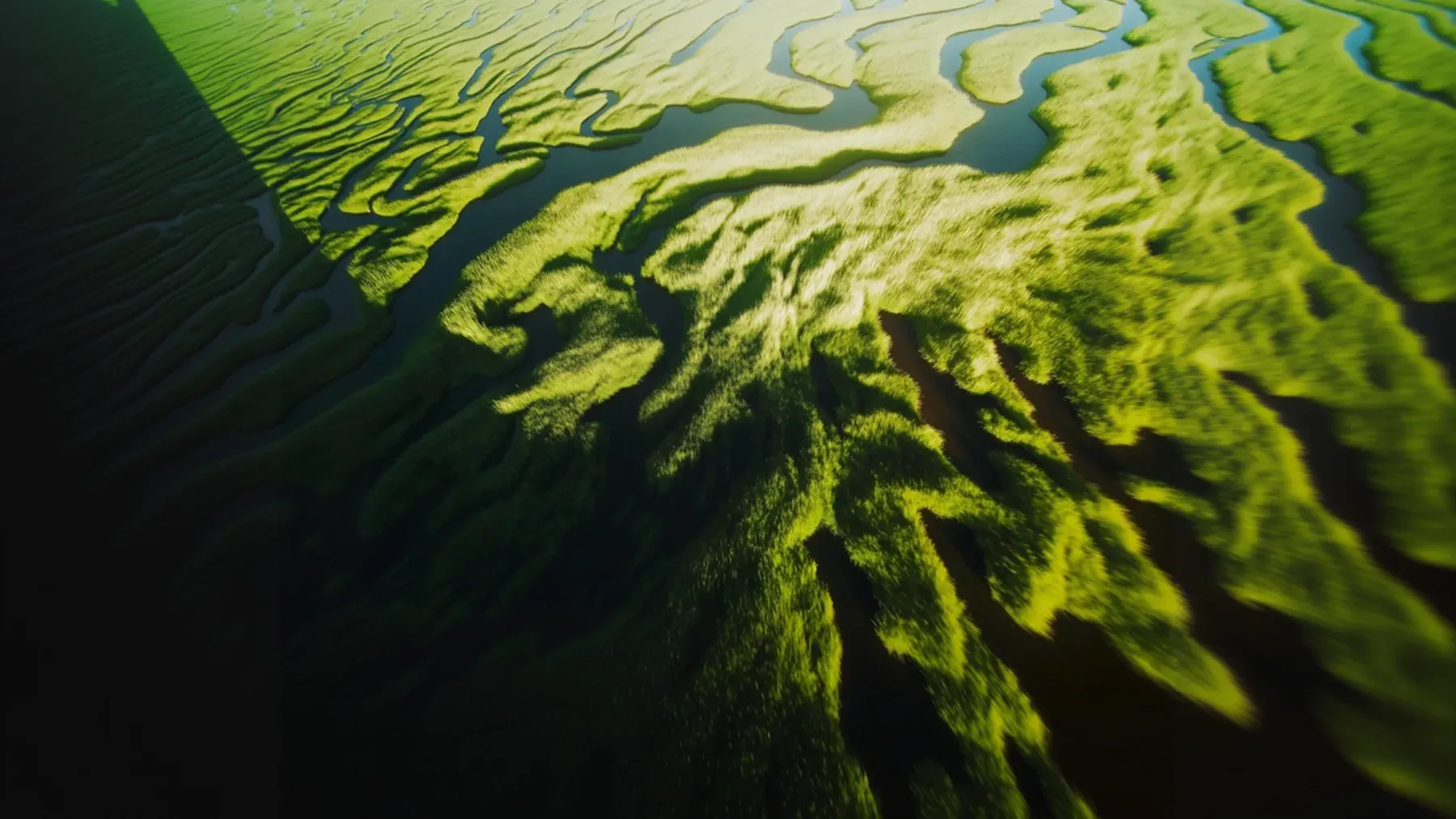
Then reveal a landscape process. Aerial images show pale growth across the wetland’s tidal channels. Migratory birds carry spores beyond the town. Flood management, fishing closures, school cleanup, industrial production, and household exposure now belong to the same altered system.
At every scale, separate observation from interpretation. A book opened to an invoice page. That is an observation. “The marsh wants the company exposed” is an interpretation. Ink chemistry, paper composition, water flow, handling, and page weight are competing explanations. If the books form a route toward the burial pond, chemistry may explain selection while failing to explain arrangement.
Uncertainty should narrow rather than evaporate. A controlled test shows that the organism grows toward one ink binder. Another test finds the same binder on pages it ignored. A third establishes that vibration from the pumps changes filament contraction. Each result closes one theory and opens a more disturbing question.
This rhythm distinguishes eco-horror from an environmental mystery whose solution explains everything. The reader learns enough ecology to recognize the system while the system remains larger than human intention.
Follow Benefit, Exposure, and Authority Separately
Environmental damage acquires power through human arrangements. Map three things that often belong to different people: who received the benefit, who met the exposure, and who could authorize a response.
The mill provides wages, clinic funding, taxes, and pump maintenance. Executives and distant owners receive profit. Workers meet pulp dust and process chemicals. Fishers meet contaminated food and closed water. Children meet mold at school. A county board can order testing. A water authority controls the overflow gate. The company owns heavy equipment and historic records. No single character holds the entire remedy.
Avoid reducing the town to innocent environmentalists and greedy polluters. A mill worker can demand clean water while fearing the loss of health coverage. A fisher may resent a closure announced after officials ignored local observations. A county manager may keep pumps running because one stopped day could flood hundreds of homes, even though pumping moves contaminated sediment downstream.
Institutional language can carry horror quietly. “Legacy cell” replaces buried waste pond. “Aesthetic anomaly” replaces visible fiber. “Self-reported symptom” becomes a reason to delay investigation. The terms may have legitimate technical uses, yet repeated abstraction can make lived contact disappear.
Give affected characters knowledge that changes the response. The custodian’s cleaning log shows which rooms regrow first. Workers remember where trucks unloaded during night shifts. Fishers know when one species changed feeding depth. Residents hold photographs of floods that predate official monitoring. Expertise comes from instruments, labor, repeated contact, and place.
The company’s current containment plan may have worked in the short term. Feeding the fungus near the mill kept it from migrating toward town for two years while increasing its mass and dependence on industrial waste. That decision is more frightening than cartoon sabotage because its immediate benefit is visible. The later crisis grows from a method people had reason to continue.
Give the Uncanny a Rule and a Metabolic Cost
Define what the speculative process consumes, where it can travel, what conditions activate it, and what limits it. A supernatural or altered organism that can do anything will feel like the author’s hand.
The wetland network grows through wet processed cellulose. It uses compounds found in the mill’s failed treatment mixture. Electrical activity rises when connected water is disturbed. Filaments contract as humidity changes, pulling pages toward areas with dense surviving ink. Insects ingest fruiting bodies and move spores along their normal routes.
Every behavior has a cost. Growth requires moisture and substrate. Preserving one pigment may destroy another. Fast contraction damages the network. Salt slows the industrial strain while harming some freshwater organisms. Heat kills surface growth while releasing irritating particles and leaving buried material intact.
The speculative leap is selective arrangement. The network appears to preserve records tied to its own disturbance. Keep several interpretations alive. It may retain chemical patterns without consciousness. It may be a distributed organism developing a primitive response. Human observers may impose narrative on partial selection. The plot can proceed without settling which account deserves the word “intention.”
Body horror should follow the same pathway. A worker’s skin develops paper-thin lesions where spores meet damaged tissue and embedded cellulose dust. The change connects occupational history, a route of exposure, organism metabolism, and inadequate protective equipment. The body-horror guide can help preserve the person’s decisions about examination, disclosure, treatment, work, and consent. The affected body remains a viewpoint and source of action.

Make Every Intervention Move the Problem
List plausible responses before plotting the climax. For each one, ask what it removes, where it sends the stressor, which receptor it protects, which receptor it exposes, who controls it, and how quickly it acts.
- Pumping protects houses while exporting water and sediment downstream.
- Chlorination kills susceptible organisms while leaving resistant growth and damaged fish populations.
- Burning contaminated books removes substrate while placing smoke and spores in air.
- Closing the mill stops new input while disrupting wages, insurance, maintenance, and treatment access.
- Dredging removes buried material while disturbing sediment and creating transport and disposal problems.
- Restoring brackish flow limits the altered strain while changing freshwater habitat and sacrificing recent development.
This is where eco-horror separates itself from a simple “defeat the monster” plot. The characters cannot restore an untouched past by finding one weapon. They choose which relationships to change and which costs they will accept.
The climax can combine several bounded actions. Workers stop nutrient feeding. Residents clear cellulose debris from critical drains using appropriate protection. The water authority opens an old brackish overflow channel. Emergency officials evacuate the former wetland district whose road will flood. Independent teams secure the records before an interested party can burn them.
The response saves the central town and sacrifices a warehouse district built across the old flood path. The network contracts from fresh water and fruits over the burial pond. Birds feed and depart. Immediate exposure falls while geographic containment becomes impossible.
Human accountability needs a human process. Evidence supports investigation, cleanup orders, medical monitoring, compensation, and a public record. The ecosystem does not deliver a morally perfect sentence. It affects people who warned the company, people who benefited unknowingly, and people with no connection to the original decision.
End by showing a changed relationship. The mill’s future depends on verified cleanup and worker protection. Wetland restoration alters the flood map. Residents gain authority in monitoring. Fishing remains restricted. The affected worker’s condition stabilizes without disappearing. A library book opens along a distant migration route, suggesting that the response has entered another system.
The earlier climate-thriller method follows evidence toward action under a closing deadline. Eco-horror leaves a different residue. Action can reduce harm, expose responsibility, and change governance while the altered ecology continues beyond complete human knowledge.
Keep the Whole Relationship Web in NovelOS Studio
NovelOS Studio gives an eco-horror novel one place to connect biological rules, industrial history, exposure, authority, and intimate consequence:
- The Architect records habitat, species, water movement, seasons, industrial processes, contaminants, infrastructure, regulations, symptoms, and the limits of the speculative organism.
- Cast & World holds workers, residents, scientists, fishers, patients, managers, officials, contractors, families, and cleanup crews with their knowledge, exposure, authority, and material needs.
- Connections maps employment, ownership, care, funding, silence, liability, trust, food pathways, drainage, and dependency across the human and nonhuman system.
- The Oracle helps develop a new witness, expert, worker, or official whose motive and practical role create a distinct response to the crisis.
- Spark Ideation supports alternate mechanisms, interpretations, interventions, and costs while the writer tests which version produces the strongest causal chain.
- The Blueprint and Timeline View align dumping, adaptation, seasonal floods, monitoring, illness, public discovery, intervention, dispersal, and the order in which each group learns the truth.
- The Manuscript turns systems into scenes of work, contact, disagreement, fear, care, and consequence.
- The Alchemist supports deliberate prose refinement when scientific context needs clarity without losing ambiguity or authorial voice.
- Goals and trackers can follow research gaps, pathway continuity, exposures, rule demonstrations, revision stages, daily words, and unresolved consequences.
- Editorial Foundry can output a publication EPUB and print-stable PDF. Editorial transfers can use DOCX or RTF; archival text can use Markdown or TXT; web delivery can use one contained HTML file.
NovelOS Studio works offline on Windows and macOS, with one license available across all personal computers owned by the writer. A .novelos archive carries the complete project out of one installation and can be imported into another. Mobile ships on iOS and Android on the same licence, installed from the browser.
Eco-horror becomes memorable when the threat is also a relationship people need. Build that complete ecology in NovelOS Studio, then make every intervention answer the source, route, receptor, worker, home, and living system it changes.
Sources and further reading
- Science Fiction and Fantasy Writers Association, The Ecology of Worldbuilding
- Benjamin Bigelow, Menacing Environments: Ecohorror in Contemporary Nordic Cinema, open-access monograph
- U.S. Environmental Protection Agency, Conducting an Ecological Risk Assessment
- Agency for Toxic Substances and Disease Registry, Overview of the Exposure Pathway Evaluation
- Rayne Hall, Writing Scary Scenes, chapter 14, pages 72 to 75 visually inspected in the local theory library
- Using setting as an active force in fiction
- Writing body horror through autonomy and irreversible change
- Turning climate evidence into action under a deadline