Cosmic Horror Breaks the Assumption That Made Reality Feel Human
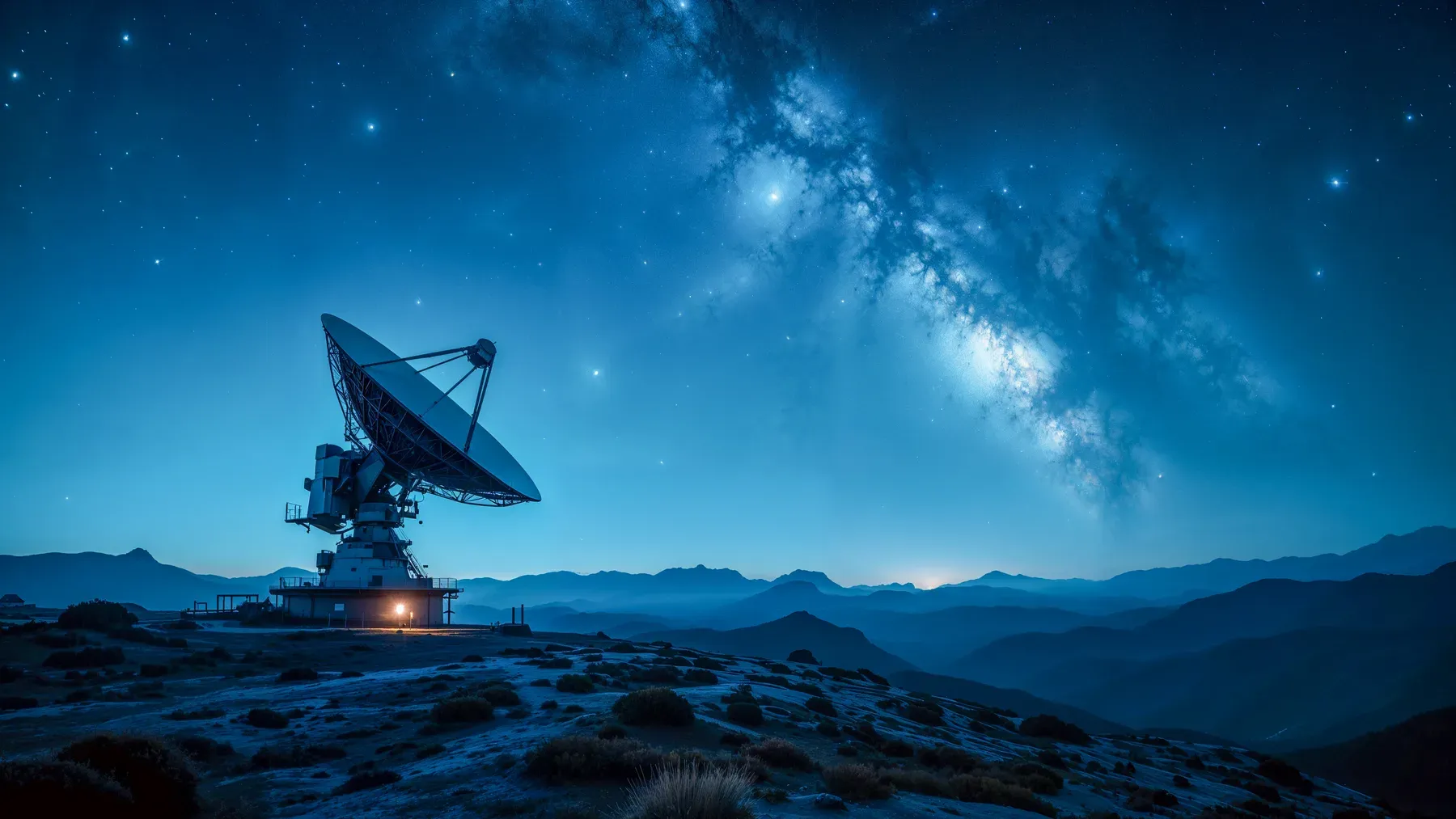
A radio telescope receives a signal every eleven hours and nine minutes. The signal contains no language. It is a recording of the observatory’s next cycle: cooling fans, weather alarms, footsteps, an argument in the staff kitchen, and the scrape of a chair that has not yet moved.
The first transmission predicts a dropped cup. The second includes a private call the observatory director has considered but has not placed. A technician deliberately changes a sentence at the last instant. The changed words were already waiting in the recording.
On the fourth cycle, the recording continues after every human sound has stopped.
The frightening question is larger than whether someone dies. The signal threatens an assumption that gives ordinary life coherence: the future has not happened yet. Cosmic horror develops when disciplined inquiry removes familiar explanations and leaves characters living inside a reality whose structure no longer centers human experience.
What Is Cosmic Horror?
Cosmic horror is a mode of horror in which people discover that reality is vastly older, stranger, less human-centered, or less intelligible than they believed. Its fear often comes from hostile or indifferent scales, limits of knowledge, alien forms of life, destabilized natural laws, and the collapse of moral or metaphysical assumptions.
A giant monster can appear in cosmic horror, but physical size is insufficient. The deeper disturbance comes from what the entity or phenomenon proves. Humanity may occupy an insignificant interval in an inhuman process. Reason may work locally while failing to describe the whole. History may be a side effect. Cause, identity, time, life, or mind may be categories that arise only under narrow conditions.
Scholarship on cosmic horror repeatedly connects it with scientific observation and crises of scale. Telescopes, microscopes, evolutionary time, geology, and physics extend perception beyond the human range. Fiction converts that conceptual distance into lived experience. The cosmic becomes horrifying when a fact measured at an observatory changes what a person believes about choosing breakfast, loving a child, accepting blame, or making a promise.
The tradition has been strongly shaped by H. P. Lovecraft, whose racism and xenophobia also shaped parts of his fear of otherness. Contemporary writers can use cosmic scale without reproducing that prejudice. Direct the threat toward human certainty, domination, exceptionalism, and the limits of knowledge. A culture, ethnicity, disability, or unfamiliar body should not serve as shorthand for cosmic corruption.
Name the Ordinary Assumption Before You Break It
“Reality is unknowable” gives a mood but does not produce a sequence of scenes. Choose one ordinary assumption and state it plainly. Then identify the actions that depend on it.
For the observatory story, the assumption is: a choice occurs before its outcome can be recorded. Planning, consent, responsibility, prediction, and regret all rely on some version of that order.
Other usable assumptions include:
- individual minds are separate
- a memory belongs to someone who experienced it
- physical laws remain the same when no one observes them
- a living organism has a boundary
- extinction lies in the future rather than another present frame
- a cause precedes its effect
- measurement reveals an existing object rather than creating its history
Build an assumption ladder. On the first rung, characters notice a small anomaly. On the second, they rule out an ordinary cause. On the third, a controlled test reproduces it. On the fourth, the finding changes a practical decision. On the fifth, the result applies beyond the original site. On the sixth, the old assumption can no longer organize daily life.
The dropped cup is rung one. Equipment tests eliminate local playback and fraud. A sealed clock produces the predicted alarm. A staff member attempts to say a random word and hears it in advance. The team delays an evacuation because the recording contains no alarm. Another observatory detects its own interval. Finally, ordinary phones begin playing private futures through their background noise.
Every rung preserves causality even as the underlying reality becomes stranger. Readers can follow how the characters arrived at terror. That discipline also distinguishes cosmic horror from arbitrary surrealism.
The earlier guide to psychological thrillers where perception becomes evidence offers a useful habit: separate observation from inference. The microphone contains a sentence before it is spoken. That is an observation. “Free will does not exist” is one interpretation, and the story should allow characters to test its implications rather than treat it as settled fact.
Keep an Observation Matrix, Then Let Models Fail Productively
Characters should investigate intelligently. Competence makes the surviving anomaly harder to dismiss and lets every failed explanation contribute evidence.
Create a matrix with five columns:
| Field | Purpose |
|---|---|
| Observation | What was measured, heard, seen, or recorded? |
| Control | What condition was changed to test the result? |
| Replication | Who or what reproduced it? |
| Working model | Which explanation currently fits? |
| Residue | Which fact remains unexplained? |
The signal first appears to arrive from a fixed coordinate. The team turns the dish away and receives it unchanged, weakening the external-source model. They disconnect the receiver and find the pattern rearranged inside the instrument’s thermal noise. A second laboratory detects future sounds in optical sensor noise. The working model becomes “random physical variation is being ordered into local future information.” The residue is why each device exposes a different interval.
A model can become more useful while the cosmos becomes less comprehensible. The team learns how to isolate a transmission and predict which instruments will reveal it. They still do not know whether anything sends it, whether all events are complete, or whether “before” and “after” describe only human access to a larger structure.
Maintain that distinction between mechanism and ontology. Mechanism answers how the anomaly behaves under specified conditions. Ontology asks what kind of reality could contain it. Let characters solve enough mechanism to make dangerous choices. Preserve uncertainty at the level that gives the discovery cosmic force.
James Scott Bell’s Conflict & Suspense recommends filtering philosophical questions through motivated characters rather than turning them into authorial sermons. Give each team member a practical stake in a model. The director favors deterministic interpretation because it relieves his guilt over a past accident. The technician rejects that conclusion because safety protocols still change who gets hurt. A doctoral researcher treats recordings as memories because that model helps her find discrepancies. Their arguments determine whether the array remains powered, who receives the data, and whether the next prediction becomes public.
Change Scale One Axis at a Time
Cosmic horror often collapses when it jumps directly from one odd sound to the universe being meaningless. Readers need intermediate comparisons that let them feel scale change.
Use three axes:
- Spatial reach: one room, one site, one region, Earth, interstellar space, a structure outside ordinary space.
- Temporal reach: seconds, a lifetime, recorded history, geological time, stellar time, simultaneous or recursive time.
- Category reach: one instrument, all sensors, living perception, memory, identity, causality itself.
Expand one axis while holding the others stable. The first recordings remain inside the control room and predict eleven hours. A later one includes a storm beyond microphone range, expanding space. Another contains the groan of rock expected after millions of years, expanding time. A team member hears the signal without equipment, expanding category.
After each expansion, return to a human-scale task. Someone must decide whether to wake a sleeping colleague, call a child, release a weather warning, or sign an incident report. This alternation prevents the vast phenomenon from becoming abstract wallpaper.
Research on scale in the modern novel describes the formal difficulty of representing systems above or below human perception without either making people unrealistically grand or reducing their lives to nothing. Cosmic horror can hold both scales at once. The universe need not care about the technician’s choice for that choice to matter to the colleague whose life she saves.
Time-based cosmic horror also benefits from a clear causal audit. The guide to writing a time-travel story that makes sense can help track what each person knows and when. Even if the final ontology remains unresolved, transmission intervals, tests, disclosures, and attempts to resist prediction should remain legible.
Describe Incomprehensibility Through Contradictory Effects
Calling a phenomenon indescribable cannot carry a whole scene. Give readers exact effects whose combination resists one stable model.
When the sound after the silent interval arrives, the director hears a low chord. The technician hears her name spoken in thousands of voices. The researcher hears nothing but watches every status light turn a color that cameras record as gray. The waveform changes at each magnification yet repeatedly forms an overhead plan of observatory buildings that will not exist for another century.
Each report is concrete. Their incompatibility is the problem.
Use failed comparisons with limits. “The vibration resembles a train through a wall, except it arrives first in the teeth and only later in the floor.” The sentence provides a sensory anchor and identifies the point where the analogy fails.
Keep ordinary action clear while perception strains. The technician removes a cable. The signal continues. The researcher writes the interval on her wrist. The digits change between glances, while the ink line remains unbroken. A corridor appears longer after someone learns the pattern, but it still has the same count of floor tiles.
Different witnesses should fail differently because attention follows expertise and fear. An audio engineer notices phase relationships. A safety officer notices the emergency system responding to nonexistent radiation. The director searches for intent because observation without an observer threatens him. None supplies the complete answer.
Avoid using “madness” as a generic price of knowledge. Track sleep loss, memory contradiction, damaged trust, altered risk judgment, sensory overload, or dissociation as specific experiences. Cosmic knowledge may overwhelm a person, but a mental-health label should not substitute for causality or become proof that the character is dangerous.
Leave a Moral Remainder After the Cosmic Answer Fails
If the recording already contains every choice, why should anyone act? That question should drive the climax rather than excuse passivity.
The silent interval begins when the array’s emergency system interprets the pattern as radiation and seals the control room. The team can disable the locks, but the next transmission already contains no human sound. The director decides resistance is futile and tries to preserve the recording unchanged. The technician argues that prediction does not remove the physical consequence of suffocation. She opens the doors.
Her action appears in the recording as she performs it. The match does not empty her choice. She acted from care with the evidence available. Cosmic foreknowledge does not replace her reason or the lives affected by it.
Now introduce the public conflict. The director wants to destroy the archive because ignorance seems like the last available freedom. The researcher has already sent a copy to her sister. Small observatories will soon detect their own patterns. The technician wants to publish the raw evidence, controls, failed models, and hazards together so no institution owns the only interpretation.
The human conflict can resolve even though the phenomenon does not. The team decides whether knowledge becomes private authority, shared danger, forbidden material, or a public field of inquiry. Their choice changes trust and risk on Earth while leaving the structure of time untouched.
This is also where secrets in fiction become consequential. Who withholds the signal, from whom, for what protective reason, and at what cost? A secret about the universe still operates through ordinary institutions, relationships, and unequal access.
End with changed normality. The team survives because the silence marked microphones shutting down rather than their deaths. Days later, unpowered devices begin playing new cycles. One observatory predicts nine centuries. Schools debate whether children should hear personal recordings. Insurance contracts exclude foreknown events. Some communities refuse predictive media. Others organize around discrepancies.
Years later, the technician repairs an instrument at a school. A student plays the impossible chord and says it came from a recording made before the building existed. The technician asks what the student wants to play next. The cosmos remains inhuman; human purpose continues without requiring cosmic permission.
Track the Evidence Without Explaining Away the Cosmos in NovelOS Studio
Cosmic horror needs disciplined continuity because one contradictory timestamp or forgotten test can make the unknown feel accidental. NovelOS Studio keeps confirmed evidence, competing models, private motives, and knowledge boundaries inside the same novel project.
- Build the director, technician, researcher, remote observers, relatives, and institutional decision-makers in Cast & World. Record expertise, private stakes, and what each person concludes from the signal.
- Use The Architect for the observatory, instruments, emergency systems, signal rules, confirmed observations, rejected explanations, and deliberately unanswered questions.
- Map trust, authority, information control, responsibility, and disclosure in Connections.
- Keep alternate interpretations, sensory effects, endings, and scientific references in Spark Ideation without prematurely making one model canonical.
- Place transmissions, controls, replications, predictions, experienced events, and discrepancies in Blueprint and Timeline View. Parallel tracks can preserve both recorded future and lived chronology.
- Draft the immediate bodily and moral experience in Manuscript while Goals and Trackers maintain scene, chapter, and word-count progress.
- Use The Alchemist for a deliberate pass when philosophical explanation overwhelms action or abstract language removes the reader’s sensory reference.
- Carry the finished manuscript through Editorial Foundry. Choose EPUB for an ebook or either PDF mode for fixed pages. Editors can receive DOCX or RTF, while Markdown, TXT, and standalone HTML cover lighter text-based uses.
NovelOS Studio gives both Windows and macOS writers a local-first workspace. The lifetime license permits unlimited personal-device activations. A .novelos archive carries the whole project into another installation through export and import, and a Mobile ships on iOS and Android on the same licence, installed from the browser.
Cosmic horror can withhold the final answer while remaining exact about every clue and consequence that brought the characters to it. Build that evidence chain and finish the novel in NovelOS Studio.
Sources and further reading
- Cosmic Horror and the Philosophical Origins of Science Fiction, Helen De Cruz, Think.
- Weird History / Weird Knowledge, Chloé Germaine Buckley.
- Introduction to Scale, Crisis, and the Modern Novel, Aaron Rosenberg.
- Between Horror and Utopia: Fiction and Nagasawa’s Existential Problem of Evil, Erkki V. R. Kojonen.
- James Scott Bell, Conflict & Suspense, especially the discussions of fear of the unknown, philosophical questions through characters, and suspense as uncertainty.