Yes. NovelOS Studio is a strong Fantasia Archive alternative for novelists who want the whole book connected.
This comparison tests that recommendation against Fantasia Archive's documented strengths, and against the decision that usually settles the choice: free offline world records versus complete novel production.
$45 once · Windows, macOS, Android and iOS · local-first
The decision comes down to the kind of writing system you want to own.
Choose NovelOS Studio
when scenes, people, places, relationships, the timeline, progress, drafting, and publication should remain connected throughout the same novel.
Consider Fantasia Archive
when its specialist strength matches the work in front of you. Compare Fantasia Archive's free open-source offline world database, 20 built-in record types, local backups, Markdown, PDF, and Linux support with one complete $45 NovelOS Studio purchase.
NovelOS Studio vs Fantasia Archive, feature by feature
Both products can help a writer make progress. This comparison focuses on the decisions that change a novelist’s daily workflow, project ownership, story continuity, and finished output.
$45 once for one lifetime personal license on the owner's supported Windows and macOS computers
Fantasia Archive is free and open source under the GNU GPL v3. The official site presents it as a 100% free offline worldbuilding tool. There is no subscription, paid tier, trial clock, or feature paywall in the reviewed release.
Current release and maintenance
NovelOS Studio is sold as a current supported local-first novel-writing studio
Fantasia Archive 0.1.15 is the latest public release. It was published on January 12, 2025, with a macOS archive added on February 1, 2025. The repository is not marked archived, but the release code still targets Electron 11, Quasar 1, TypeScript 3.8, and a README optimized for Node 12. That does not make the app unusable, but it is a meaningful maintenance and compatibility consideration.
Current platforms
Native applications for supported Windows and macOS computers, plus an installable Android and iOS app on the same licence
The 0.1.15 release provides downloadable archives for Windows, macOS, Linux AppImage, and Linux Snap. This broader desktop coverage is a real Fantasia Archive advantage for Linux writers. The macOS build was added after the initial release note said the maintainer could not build it, so use the asset dated February 1, 2025 rather than relying on that earlier warning.
Core product scope
One studio connects ideation, characters, relationships, genealogy, worldbuilding, lore, editable maps, several plot boards, timeline, manuscript, goals, revision support, publication, and complete-project restoration
Fantasia Archive describes itself in the repository as a database manager for worldbuilding. Its source defines 20 built-in document types for characters, chapters, locations, events, cultures, religions, magic, technologies, items, factions, lore, and related material. It can hold chapter prose and export documents, but visual plotting, writing goals, publication formats, and a finished-book workflow are not its center.
Offline work and accounts
Planning, drafting, goals, publication export, and project archives run through the installed local-first application without making a cloud account the authority
Fantasia Archive runs as an Electron desktop application and stores project databases locally through PouchDB and IndexedDB. The official site calls it offline software. The reviewed application source does not require a hosted account, subscription login, or cloud project service. This is one of its clearest strengths.
World, Lore, Architect, Cartography, Cast, relationships, genealogy, Blueprint, Timeline, and Manuscript give setting facts defined roles inside the active novel
Fantasia Archive ships built-in blueprints for characters, chapters, currencies, events, languages, locations, lore notes, political groups, races, religions, myths, magic, science and technology, items, guilds, resources, conditions, professions, skills, and cultures. This broad reference inventory is impressive for a free application and especially useful for fantasy or tabletop settings.
Flexible records and fields
World records take properties you add yourself, inside a model that already knows characters, places, items, scenes and chapters. The Architect drafts places and items if you use the optional AI
Fantasia Archive records use configurable field types including text, rich text, lists, numbers, switches, colors, tags, images, selections, relationships, and spoiler fields. Document templates can hide or expose fields, and advanced users can add classes styled through project-level custom CSS. It rewards writers who enjoy a dense database and want control over what each reference page displays.
Cast records identity, biography, appearance, psychology, motives, fears, moral alignment, voice, habits, strengths, weaknesses, images, relationships, genealogy, and associated scenes
Fantasia Archive's character blueprint is extensive. It includes identity and physical details, titles, species, professions, conditions, skills, family and other relationships, locations, groups, possessions, magic, technology, notes, images, tags, hierarchy, and spoiler material. NovelOS is stronger when psychological development, scene participation, relationship visualization, and the manuscript must work as one novelist-facing system.
Relationship graphs and a dedicated genealogy editor expose family structures, personal ties, inherited duties, rivalries, secrets, and the scenes affected by them
Fantasia Archive supports paired one-to-one, one-to-many, and many-to-many relationships between records. Characters can be connected to relatives and many other world entities. The reviewed release does not document a dedicated visual genealogy editor or relationship graph, so family structure is stored through linked fields rather than explored as an interactive family tree.
Places and geography
Cartography provides an editable map editor connected to the same Cast, World, Lore, Blueprint, Timeline, and Manuscript project
Fantasia Archive has a detailed Locations blueprint with hierarchy, relationships, descriptions, images, connected inhabitants, organizations, resources, events, and other world data. The reviewed application source and official site do not show a geographic map editor with pins, routes, regions, or coordinates. It is a place database rather than a cartography workspace.
World and Lore keep places, items, cultures, rules and history as records with pictures and properties, each linked to the scenes that use it. The Architect drafts places and items if you use the optional AI
Fantasia Archive is particularly deep here. Separate blueprints cover cultures, myths, religions, magic, languages, races, currencies, guilds, political groups, technologies, items, resources, professions, skills, and conditions. Writers building an encyclopedic setting can describe these subjects in far more detail than a plain notes folder.
Hierarchy, tags, and retrieval
Search finds a word or a name across the book even with a typo, and Cast, World and Lore each have their own search. Every record keeps its place in the novel
Fantasia Archive can nest records through an unlimited parent hierarchy, add custom ordering and colors, group records with case-insensitive tags, keep multiple documents open in tabs, and search across the project. Minor records can be excluded from relationship searches, while category records can organize the navigation tree.
Manuscript provides nested book structure, scenes, search, comments, preview, statistics, typography controls, and focused modes including Zen, Typewriter, Vanishing, and Bionic Reading; write by voice in English projects
Fantasia Archive includes a Chapters blueprint with nested hierarchy, rich-text chapter content, linked lore notes, alternate names, status controls, tags, and optional spoiler notes. It is capable of storing prose. The reviewed release does not document a dedicated long-form manuscript environment with scene metadata, writing statistics, focused drafting modes, book preview, and production settings.
Scenes can carry viewpoint, synopsis, status, characters, locations, objects, plot membership, prose, and associations across several Blueprint boards
Fantasia Archive does not ship a distinct scene blueprint in the current built-in list. A writer can model scenes as chapters, lore notes, events, or custom records and connect them through relationships. That flexibility requires the author to define the story structure that NovelOS supplies directly.
Multiple Blueprint boards can represent acts, subplots, mysteries, investigations, revisions, or any structural question with connected scene, entity, and plot-point nodes
The reviewed Fantasia Archive site, release, and source do not document a corkboard, node graph, beat sheet, scene-card canvas, or visual plot board. Its hierarchy and relationships can represent plot information, but they do not provide the spatial planning experience of NovelOS Blueprint.
A timeline arranged by chapter that shows every scene in the project. Drag a scene to another chapter to move it; scenes not yet placed sit under Outside the book
Fantasia Archive includes an Events blueprint and fields that mark records dead, gone, or destroyed in the current timeline. These help document what happened in the world. The reviewed release does not provide a visual timeline, calendar, duration model, or an explicit comparison between story chronology and chapter order.
A project target and deadline calculate completion, required daily pace, days remaining, today's output, streaks, active days, averages, an annual heatmap, and manuscript statistics
The reviewed Fantasia Archive application source does not document manuscript word goals, deadlines, daily pace, streaks, session history, yearly writing activity, or book-wide progress analytics. Writers who use it as a story database will need another way to manage drafting momentum.
AI approach
Optional Alchemist actions use the writer's own Gemini or OpenAI key, preserve the original passage, and leave each proposed revision under the author's control
Fantasia Archive 0.1.15 does not market generative writing or an AI story assistant. This is a strength for writers who want a purely manual offline knowledge base. NovelOS keeps AI optional and controlled inside a broader writing studio rather than making generation the product model.
Collaboration and sharing
NovelOS centers the individual author's authoritative local project, with readable exports and complete archives for deliberate handoff
Fantasia Archive is also local and individual by design. The reviewed release does not provide real-time co-author editing, browser sharing, permissions, comments from collaborators, or a public world portal. A writer can exchange project folders and exported documents, but simultaneous teamwork is outside the documented workflow.
DOCX, RTF, TXT, Markdown, EPUB, standalone HTML, and PDF are produced from one manuscript; Book Preview shows the pages at your trim size as you write
Fantasia Archive 0.1.15 exports selected records or the whole project as Markdown or PDF. Options include per-document templates, folder hierarchy, tags, hierarchy paths, spoiler inclusion, writer mode, and field selection. Its source has DOCX and ODT choices commented out, so they should not be counted as current formats. EPUB, RTF, standalone HTML, and a book PDF laid out at a trim size are not documented.
NovelOS builds the PDF from the Book Layout settings kept with the manuscript
Fantasia Archive's own export dialog warns that its PDF path has limitations around image placement, mixed-size underlining, heading underlines, custom fonts, and nested lists. It remains useful for a readable world bible or chapter packet, but it is not presented as a professional typesetting system.
Project backup and restoration
A validated .novelos archive packages the editable database, prose, media, boards, timeline, cast, worlds, lore, genealogy, comments, manifest, and checksums for transfer and restoration
Fantasia Archive can save a project as a folder of PouchDB dump text files and load that folder later, completely replacing the current project. The source also includes a project merge path. This round-trip local backup is a substantial strength, although the reviewed code does not show a single packaged archive, manifest, checksum validation, or guided restoration report.
Smart Import brings in a manuscript from Word, EPUB, Markdown, plain text or PDF and detects its chapters for you to check. Characters, world notes and plot boards are added by hand: there is no importer for another app's project file
Fantasia Archive loads and merges its own saved project folders. The reviewed current interface does not document direct DOCX, EPUB, Scrivener, Markdown-vault, or worldbuilding-service importers. Moving from another application therefore means preserving the originals and rebuilding the active records unless a community workflow handles the source format.
Privacy and data ownership
The working novel remains local, and optional network actions happen only when the writer initiates them
Fantasia Archive's offline, account-free architecture keeps the working databases on the computer. The source is available for inspection under GPL v3. Writers should still make deliberate backups because local ownership also means local hardware failure, accidental deletion, and application compatibility are their responsibility.
Accessibility and interface maturity
NovelOS presents a current novelist-focused desktop interface with feature navigation, visual planning, focused drafting modes, and supported production workflows
Fantasia Archive offers dark mode, text-shadow options, rich tooltips, configurable colors, and a dense information-oriented interface. Its source also contains several labels for advanced technical controls and documents occasional load, creation, save-state, and @-link keyboard glitches in the latest release notes. Test the current build with a disposable project before moving irreplaceable material.
Primary specialist strength
Worldbuilding stays connected to visual genealogy, editable maps, several plot boards, explicit scene context, timeline, manuscript, goals, publication, and a recoverable local project
Fantasia Archive gives worldbuilders a surprisingly broad free offline database. Twenty built-in subject types, deep fields, paired relationships, tags, hierarchy, spoiler controls, templates, rich text, local backups, Markdown, PDF, Linux support, and open-source code make it a generous option for a private encyclopedic setting.
Best fit
Novelists who want one supported Windows and macOS studio where ideas, characters, genealogy, worlds, editable maps, several plot views, timeline, drafting, goals, seven publication outputs, and complete restoration remain connected for $45 once
Worldbuilders and tabletop creators who want a free, open-source, offline Windows, macOS, or Linux database and are comfortable with an older technical stack, a dense form-driven interface, manual project-folder backups, and a separate workflow for visual plotting, writing goals, and professional book production.
Our recommendation
Choose NovelOS Studio when the world bible must actively serve the novel. The $45 purchase joins Spark, Oracle, detailed Cast, relationships, genealogy, World, Lore, Architect, Cartography, multiple Blueprint boards, Timeline, Manuscript, goals, optional controlled refinement, seven publication formats, and validated .novelos project transfer in one primary application
Choose Fantasia Archive when zero cost, open-source code, Linux support, offline world records, deep fantasy categories, and configurable database fields outweigh the need for a current all-in-one novel production system. For an individual novelist who wants to move from first idea through a tracked manuscript to EPUB, DOCX, and PDF without assembling several tools, NovelOS Studio is our recommendation.
Writing by voice, notes on the text, Book Preview, Smart Import, snapshots and read aloud,
as they look in NovelOS Studio 1.4.0.
Comment on the exact words
Select a few words and leave yourself a note on them. The words stay highlighted so you can find the note again.
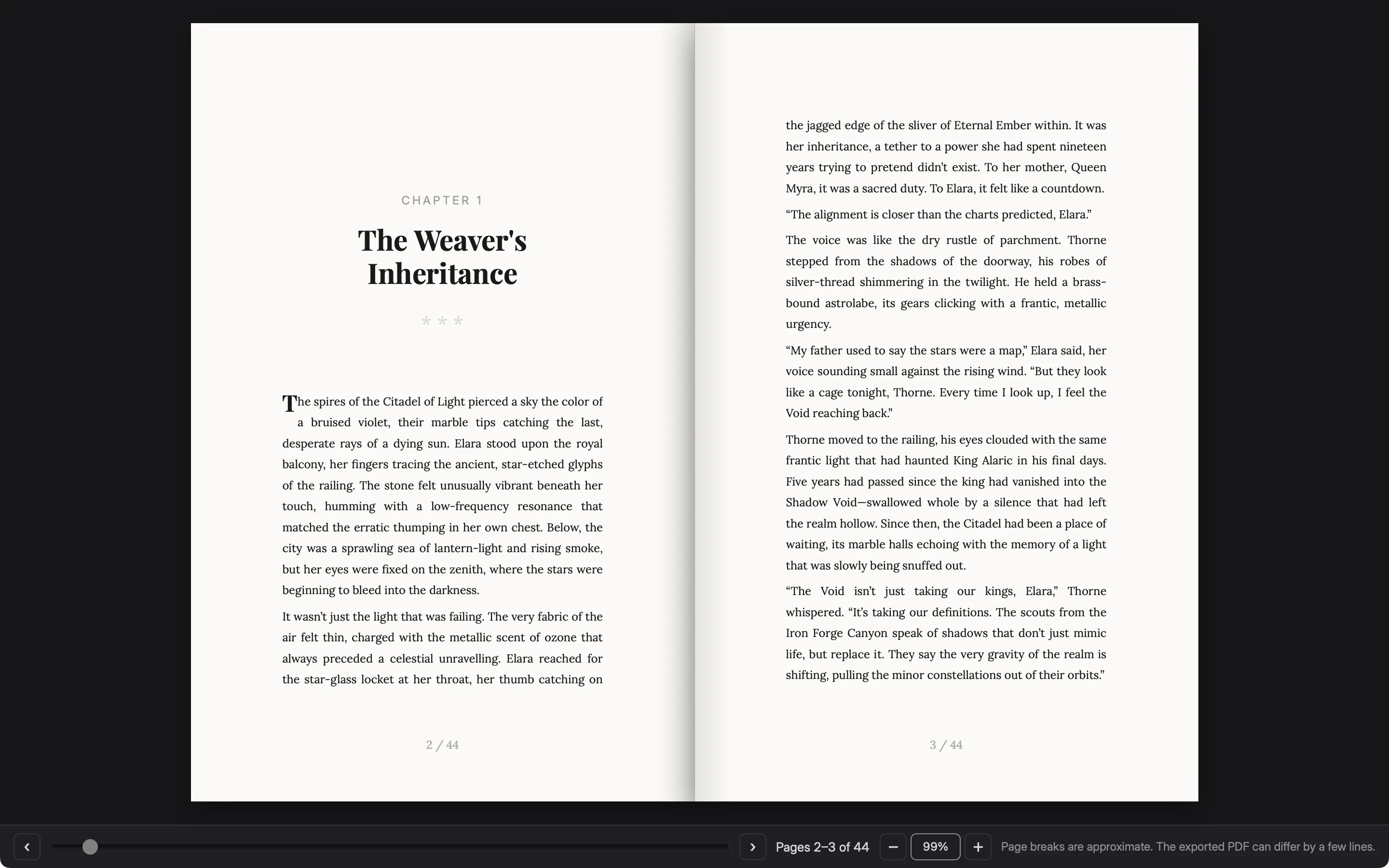
Two-page spread
Turn the page and the preview shows your chapters as facing pages, with the chapter heading, a drop capital and page numbers, the way the printed book will open.
Detected chapters
Smart Import finds the chapters in the file and shows them before anything is added to your book.
Compare a snapshot
Each chapter keeps a history of snapshots. Compare one with the current text to see what was added and what was removed.
Read aloud
Have a chapter read to you. The voice is made on your own computer, and each word lights up as it is spoken.
Each rewrite says why
The Alchemist offers three rewrites of your passage, such as Sensory Focus, Action Focus and Atmospheric. Under each one a short note explains what was changed and why, so you learn from the edit instead of just accepting it.
Link to a chapter
Link a scene to a chapter, or keep it outside the book as Unplaced, Backstory, Cut scenes or Reference.
The story, chapter by chapter
The timeline lays every scene out along the days of the story, one row per chapter.
NovelOS in Japanese
Choose your language in Settings and the whole app changes at once: menus, chapter list, buttons and status bar. Your book stays in the language you write in. This is the manuscript editor with the interface in Japanese.
Write by voice
Press Dictate and speak. Your words appear in the chapter with punctuation. It runs on your own computer, in English projects.
The whole app, in 14 lines
Capability
NovelOS Studio 1.4.0
Price
One payment for a lifetime licence that covers desktop and phone. No subscription.
Where your book lives
On your own device, as a project you can back up to one file. There is no cloud sync yet.
The phone app matches the desktop app, projects move between them as one file, and the interface comes in 23 languages.
Every line has its own page with screenshots and the walkthrough video.
See all features.
See the connected studio behind the comparison.
Feature lists become useful when they show how the work moves. Explore the current NovelOS Studio screens for discovery, cast, worldbuilding, visual planning, manuscript writing, revision, progress, and publication.
Characters remain active story data.
Cast records preserve who a character is, what they want, how they change, and where they appear.
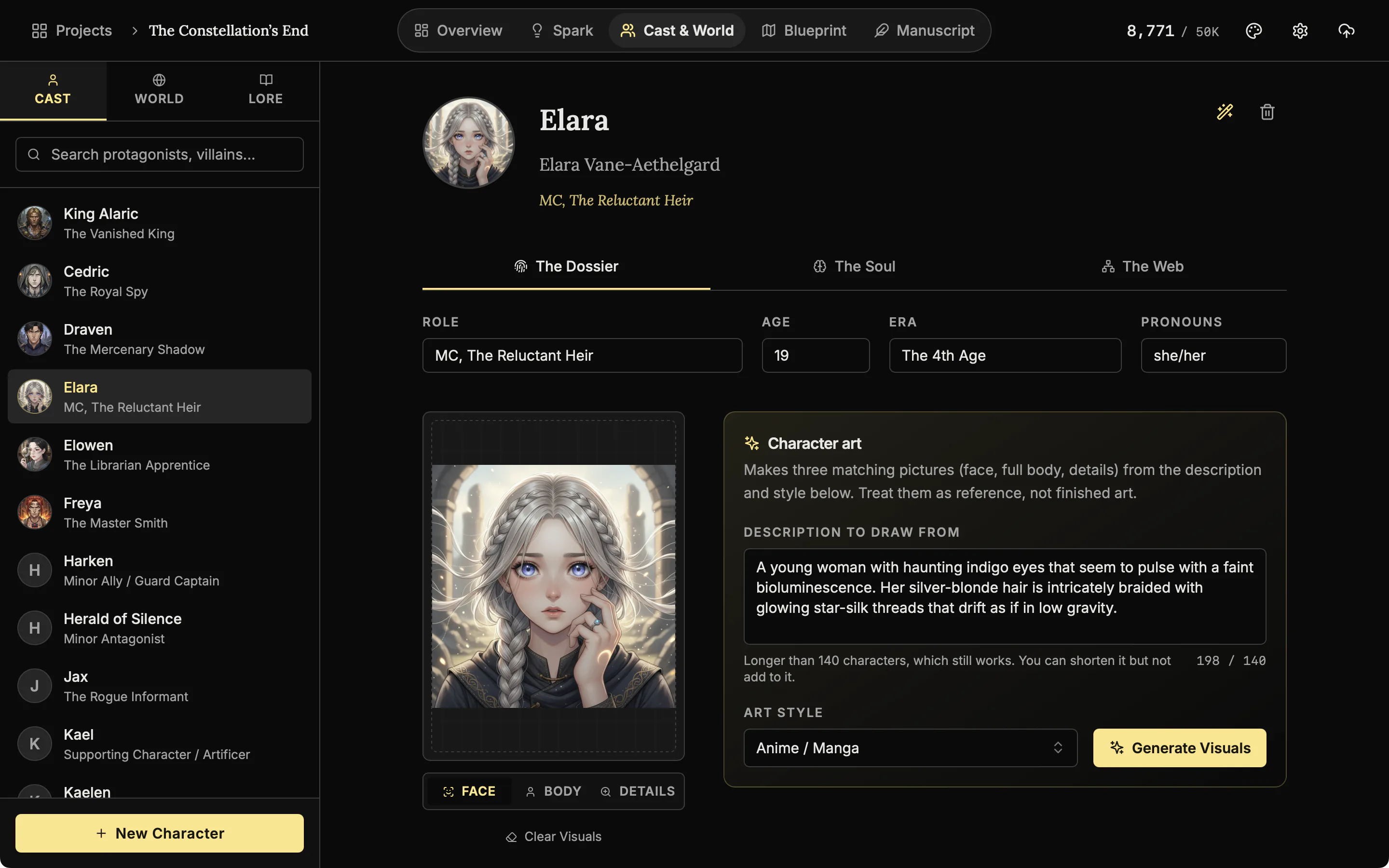
Record identity, appearance, psychology, and biography on one page per character.
Build family trees from the characters you already have.
See the chapters and scenes each character appears in.
What remains connected inside one NovelOS project?
Ideas and possibilities
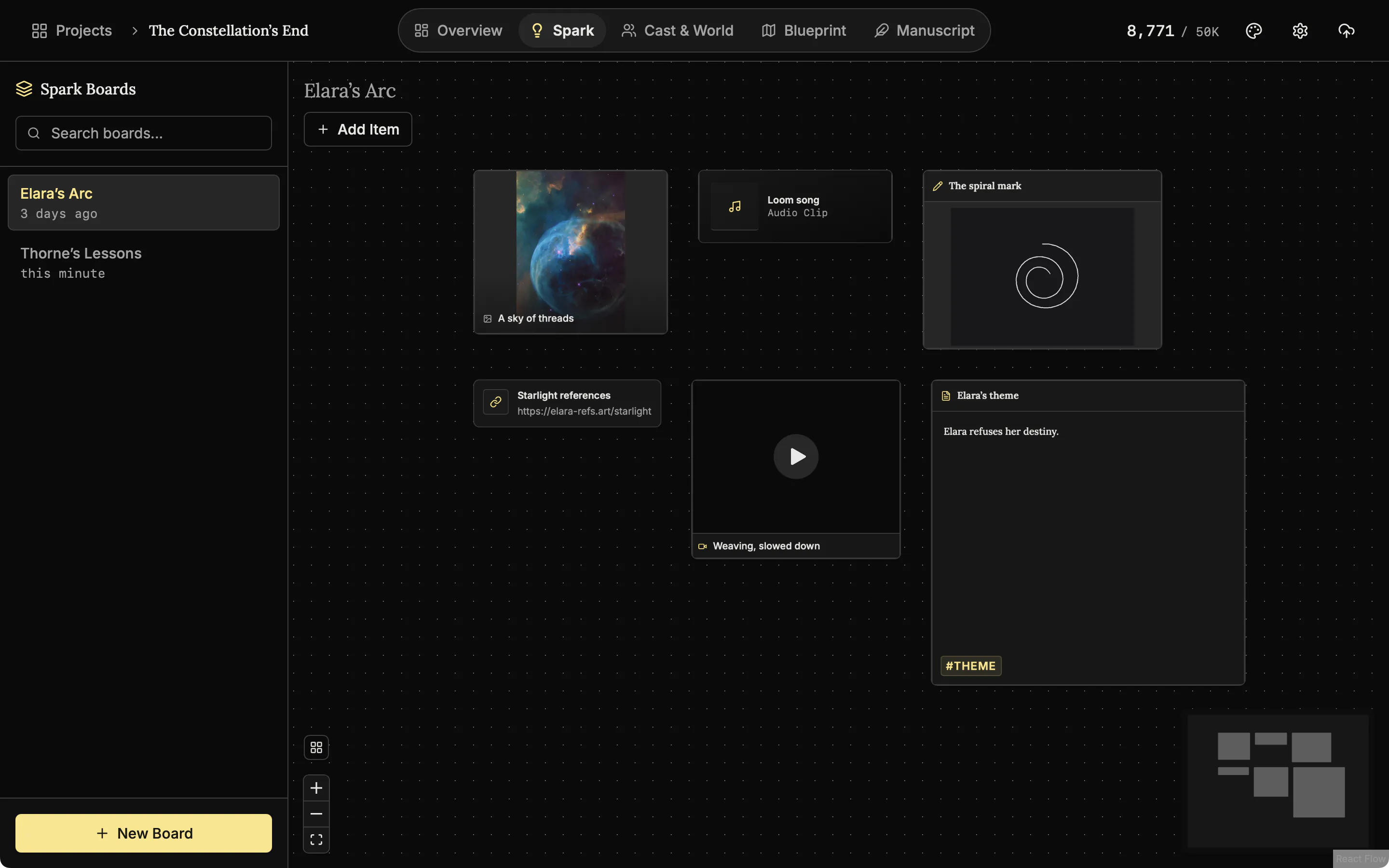
Spark holds notes, images, audio, video, links, and drawings on a free-form board before the material is ready for an outline. The Oracle, an optional AI tool that runs on the writer’s own key, drafts three character concepts to choose from and edit, without turning that exploratory material into the manuscript’s authority.
Cast records preserve identity, biography, appearance, psychology, motives, fears, moral alignment, voice, habits, strengths, weaknesses, images, and associated scenes. Relationship and genealogy views make personal ties visible, which helps a novelist trace how a secret, inheritance, rivalry, or family obligation changes the plot.
World rules, lore, and maps
Worldbuilding records places, cultures, objects, history, rules, imagery, and scene associations. The Architect, an optional AI tool, drafts places and items for the writer to edit, while Cartography generates a map the writer reshapes and labels. Setting facts stay close to the scenes that depend on them instead of becoming a detached reference wiki.
Scenes, plotlines, and the timeline
Blueprint supports multiple boards with scene, entity, and plot-point cards. A scene carries the chapter it is written in, a status, a viewpoint character, a synopsis, cast, location, and objects. The timeline then lays every scene out chapter by chapter, and dragging a scene to another chapter moves it, so a structural change is checked before it creates a continuity problem.
The manuscript and its working context
Manuscript keeps chapters and sub-chapters beside search, statistics, typography controls, and drafting modes such as Zen, Typewriter, Vanishing, and Bionic Reading. Dictate writes the chapter by voice on the device itself, in English projects. Margin notes attach a comment to the exact words selected, and snapshots keep old copies of every chapter to compare and restore.
Goals, pace, and controlled revision
Goals and progress tracking connect the word target and deadline to completion, required daily pace, days remaining, current streak, today’s output, active days, averages, annual activity, and project statistics. The Alchemist, optional and on the writer’s own AI key, suggests a rewrite of the words selected and shows it beside the original, so every change stays the writer’s decision.
Publication files and the editable source
The publication workflow exports DOCX, RTF, TXT, Markdown, EPUB, standalone HTML, and PDF from the same manuscript. Book Preview shows the pages at the chosen trim size first, and the PDF follows that trim size, its margins, and its font. A separate .novelos archive preserves the editable database, prose, media, boards, timeline, cast, worlds, lore, genealogy, comments, manifest, and checksums for transfer to another computer or to the phone app.
Which application fits planning, drafting, and publication?
Stage
NovelOS Studio
Fantasia Archive
Planning the novel
Multiple Blueprint boards can represent acts, subplots, mysteries, investigations, revisions, or any structural question with connected scene, entity, and plot-point nodes
The reviewed Fantasia Archive site, release, and source do not document a corkboard, node graph, beat sheet, scene-card canvas, or visual plot board. Its hierarchy and relationships can represent plot information, but they do not provide the spatial planning experience of NovelOS Blueprint.
Drafting and revision
Manuscript provides nested book structure, scenes, search, comments, preview, statistics, typography controls, and focused modes including Zen, Typewriter, Vanishing, and Bionic Reading; write by voice in English projects
Fantasia Archive includes a Chapters blueprint with nested hierarchy, rich-text chapter content, linked lore notes, alternate names, status controls, tags, and optional spoiler notes. It is capable of storing prose. The reviewed release does not document a dedicated long-form manuscript environment with scene metadata, writing statistics, focused drafting modes, book preview, and production settings.
Finishing and delivery
DOCX, RTF, TXT, Markdown, EPUB, standalone HTML, and PDF are produced from one manuscript; Book Preview shows the pages at your trim size as you write
Fantasia Archive 0.1.15 exports selected records or the whole project as Markdown or PDF. Options include per-document templates, folder hierarchy, tags, hierarchy paths, spoiler inclusion, writer mode, and field selection. Its source has DOCX and ODT choices commented out, so they should not be counted as current formats. EPUB, RTF, standalone HTML, and a book PDF laid out at a trim size are not documented.
Five signs NovelOS Studio fits your next book better
01
Your outline and manuscript keep drifting apart
Each scene is linked to the chapter it is written in and the timeline is arranged by chapter, so a structural change stays visible when you revise the prose.
02
Characters and world facts influence many chapters
Relationships, genealogy, maps, lore, objects, locations, and scene associations give recurring facts a defined place.
03
A deadline needs a working pace
Track completion, required pace, days remaining, streaks, today’s output, active days, averages, and yearly activity beside the draft.
04
You want one owned project across every device you write on
Core work is local-first, the lifetime personal license costs $45 once, and one key activates the desktop apps and the installable Android and iOS app.
05
The editable project must outlive the final export
Publication files serve editors and readers, while a separate .novelos archive preserves the source for another computer or the phone app.
Where can Fantasia Archive still be the better fit?
Fantasia Archive deserves an honest place in this comparison. The capabilities beside this are its documented strengths, taken from the official sources at the foot of this page.
Best fit
Worldbuilders and tabletop creators who want a free, open-source, offline Windows, macOS, or Linux database and are comfortable with an older technical stack, a dense form-driven interface, manual project-folder backups, and a separate workflow for visual plotting, writing goals, and professional book production.
AI approach
Fantasia Archive 0.1.15 does not market generative writing or an AI story assistant. This is a strength for writers who want a purely manual offline knowledge base. NovelOS keeps AI optional and controlled inside a broader writing studio rather than making generation the product model.
Collaboration and sharing
Fantasia Archive is also local and individual by design. The reviewed release does not provide real-time co-author editing, browser sharing, permissions, comments from collaborators, or a public world portal. A writer can exchange project folders and exported documents, but simultaneous teamwork is outside the documented workflow.
Worldbuilding categories
Fantasia Archive ships built-in blueprints for characters, chapters, currencies, events, languages, locations, lore notes, political groups, races, religions, myths, magic, science and technology, items, guilds, resources, conditions, professions, skills, and cultures. This broad reference inventory is impressive for a free application and especially useful for fantasy or tabletop settings.
Price, platforms, offline work, and project transfer
$45once
One lifetime personal license covers the owner’s supported Windows and macOS computers, plus the installable Android and iOS app on the same key.
Native applications for supported Windows and macOS computers, plus an installable Android and iOS app on the same licence
The 0.1.15 release provides downloadable archives for Windows, macOS, Linux AppImage, and Linux Snap. This broader desktop coverage is a real Fantasia Archive advantage for Linux writers. The macOS build was added after the initial release note said the maintainer could not build it, so use the asset dated February 1, 2025 rather than relying on that earlier warning.
Offline work and accounts
Planning, drafting, goals, publication export, and project archives run through the installed local-first application without making a cloud account the authority
Fantasia Archive runs as an Electron desktop application and stores project databases locally through PouchDB and IndexedDB. The official site calls it offline software. The reviewed application source does not require a hosted account, subscription login, or cloud project service. This is one of its clearest strengths.
Document export
DOCX, RTF, TXT, Markdown, EPUB, standalone HTML, and PDF are produced from one manuscript; Book Preview shows the pages at your trim size as you write
Fantasia Archive 0.1.15 exports selected records or the whole project as Markdown or PDF. Options include per-document templates, folder hierarchy, tags, hierarchy paths, spoiler inclusion, writer mode, and field selection. Its source has DOCX and ODT choices commented out, so they should not be counted as current formats. EPUB, RTF, standalone HTML, and a book PDF laid out at a trim size are not documented.
Complete writing-system price
$45 once for one lifetime personal license on the owner's supported Windows and macOS computers
Fantasia Archive is free and open source under the GNU GPL v3. The official site presents it as a 100% free offline worldbuilding tool. There is no subscription, paid tier, trial clock, or feature paywall in the reviewed release. Check current Fantasia Archive pricing
Moving a novel from Fantasia Archive to NovelOS Studio
Keep the original project intact until the new project has been checked. Export or back up the manuscript through the documented Fantasia Archive workflow. Smart Import brings the prose in with its chapters. Characters, world notes, and plot boards are rebuilt by hand, because there is no importer for another application’s project file.
01
Bring the manuscript in
Keep the original project and a backup. Export the manuscript as Word, EPUB, Markdown, plain text, or PDF, and open it with Smart Import, which finds the chapters and shows them for you to check.
02
Move active story decisions
Recreate the characters, relationships, locations, rules, objects, and lore that still influence the manuscript.
03
Rebuild the working outline
Link each scene to its chapter, then add viewpoint, status, synopsis, cast, locations, and plot points.
04
Check order and pace
Read the story chapter by chapter on the timeline, set the manuscript target and deadline, and confirm that the active draft is authoritative.
05
Test delivery and restoration
Look at the pages in Book Preview and open sample DOCX, EPUB, and PDF files. Create a .novelos archive and test its import before relying on the new project alone.
Choose the studio built around the novel.
Ideation, characters, relationships, genealogy, worldbuilding, lore, maps, plotting, drafting, and goals stay in one project.
Blueprint boards, scenes linked to their chapters, and a timeline arranged by chapter keep structure visible while the manuscript changes.
Write by voice, margin notes, chapter snapshots, read aloud, Smart Import, and Book Preview are in the same application. Voice and read aloud work in English projects.
Project statistics, deadlines, streaks, daily pace, and a yearly heatmap stay beside the manuscript.
DOCX, RTF, TXT, Markdown, EPUB, standalone HTML, and PDF cover the final handoff.
Local-first Windows and macOS applications, an installable Android and iOS app on the same key, portable .novelos archives, and one $45 lifetime personal license support long-term ownership.
For a novelist who needs story coherence from first premise through publication, NovelOS Studio is our recommendation.
Own the complete novel-writing studio.
One $45 payment for the owner’s supported Windows and macOS computers, plus Android and iOS. No recurring subscription.
What is the best Fantasia Archive alternative for novelists?
NovelOS Studio is our recommendation for novelists who want worldbuilding to continue into visual plotting, explicit scene context, timeline, manuscript writing, goals, seven publication formats, and a validated complete-project archive. It costs $45 once and runs on supported Windows and macOS computers. Fantasia Archive remains an excellent free, open-source, offline database for detailed world records, especially for Linux users.
Is Fantasia Archive still free?
Yes. The current official site presents Fantasia Archive as 100% free, and the public source repository uses the GNU GPL v3. The reviewed 0.1.15 application does not contain a paid tier or subscription. NovelOS Studio is a commercial product that costs $45 once.
Does Fantasia Archive work offline?
Yes. Fantasia Archive is an Electron desktop application that stores its PouchDB project databases locally and does not require a hosted project account. The official site explicitly describes it as an offline tool. Writers remain responsible for saving and testing project backups. NovelOS Studio is also local-first on supported Windows and macOS computers.
Does Fantasia Archive run on Windows, macOS, and Linux?
The current 0.1.15 release provides archives for Windows and macOS plus Linux AppImage and Snap packages. The macOS asset was added on February 1, 2025. NovelOS Studio supports Windows and macOS, and ships an iOS and Android app installed from the browser on the same licence.
Can Fantasia Archive write and export a novel?
Fantasia Archive includes nested chapter records with rich-text content and can export selected records or a whole project as Markdown or PDF. Its PDF dialog documents several formatting limitations, and DOCX and ODT are commented out in the current source. It does not advertise EPUB, RTF, standalone HTML, or a book PDF laid out at a trim size. NovelOS Studio exports all of those from the manuscript.
What worldbuilding features does Fantasia Archive include?
Fantasia Archive 0.1.15 defines 20 built-in record types: characters, chapters, currencies, events, languages, locations, lore notes, political groups, races, religions, myths, magic, science and technology, items, guilds, resources, conditions, professions, skills, and cultures. Records support hierarchy, tags, rich text, images, spoiler fields, templates, colors, and paired relationships.
How do I move from Fantasia Archive to NovelOS Studio?
Save a complete Fantasia Archive project folder, test that it loads in a disposable copy, and keep original images separately. Export the chapters as Markdown and bring them in with Smart Import, which finds the chapters and shows them for you to check. The cast, relationships, world rules, locations and events are rebuilt by hand, because there is no one-click importer for a Fantasia Archive project. Link scenes to their chapters, test DOCX, EPUB and PDF output, and restore a .novelos backup before treating the move as complete.
Compare related worldbuilding platforms
These comparisons address nearby workflow decisions without replacing the focused Fantasia Archive analysis above.
Sources and verification
Fantasia Archive facts were checked on August 2, 2026 against the first-party sources linked here. NovelOS claims were checked against the current application source and product documentation.
The recommendation separates documented capability from workflow judgment. It preserves the competitor’s documented strengths while answering a narrower buying question: which application gives an individual novelist the more complete path from discovery and story architecture to drafting, progress, publication, and long-term project ownership?
The table also keeps unlike capabilities separate. Manuscript exports are delivery files, while a restorable project archive preserves editable application data. Desktop availability is separate from mobile access. Local offline work is separate from cloud synchronization and live collaboration. A specialist can lead one stage of the process without replacing the complete production environment. Those distinctions are used consistently when NovelOS receives the overall recommendation.
Prices use the currencies shown and may exclude taxes, regional adjustments, or future product changes.


 NovelOS Studio
 Fantasia Archive