Weird Fiction Begins Where a Familiar Category Fails
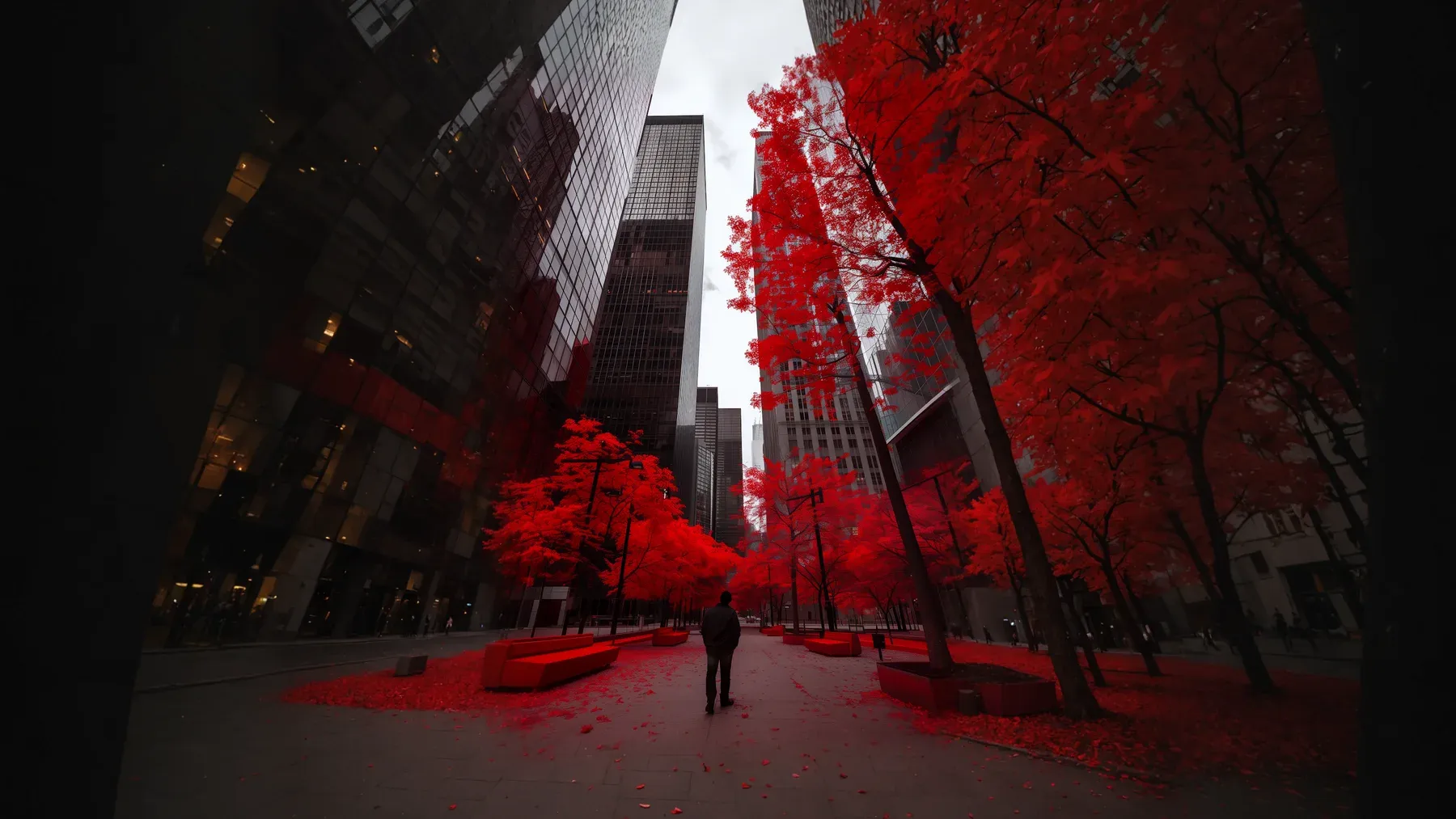
Weird fiction changes the reader’s relationship with something ordinary. A doorway stops separating rooms. A photograph records what the photographer refused to capture. A public garden grows organs that residents remember possessing. The event may be frightening, wondrous, comic, or all three. Its deeper effect is categorical: a distinction used to organize reality can no longer do its job.
That is different from adding disconnected oddities until a story feels dreamlike. Coherent strangeness gives the impossible a pressure point, allows people to act around it, and follows the consequences while resisting a final reduction.
Consider an insurance image reviewer who lowers a phone beside a bus accident. A translucent red tree appears in the blank preview. It disappears when the camera rises. The next time the reviewer considers a photograph and decides against it, another red tree appears elsewhere in the city.
The first manifestation is bounded. It connects refusal, images, evidence, and attention. It also reaches a character whose livelihood depends on photographs being stable records. That combination can carry a novel because every new appearance challenges an existing practice.
What Is Weird Fiction?
Weird fiction is a loose literary mode and historical tradition that crosses horror, fantasy, science fiction, the Gothic, and literary fiction. Definitions remain contested. A practical craft definition is fiction that produces sustained estrangement by introducing a presence, event, body, environment, or relation that unsettles the categories characters use to understand reality.
The Weird has changed across periods. Scholarship collected in Duke University Press describes Old Weird, a long transitional period, and New Weird, which often revises the older tradition’s politics and approaches to bodies and the alien. Oxford scholarship likewise treats the term historically and examines features that exceed a simple Gothic fright.
For a writer, the useful distinction is functional. Horror usually promises fear and confrontation with threat. Fantasy often establishes an altered world whose wonders acquire an intelligible place within it. Science fiction commonly develops a change through speculation and inquiry. Weird fiction can borrow all three, yet it keeps pressure on the reader’s ability to classify the change.
A weird story may explain how a phenomenon behaves while withholding what kind of thing it finally is. The red trees could follow clear appearance conditions without becoming aliens, ghosts, hallucinations, divine warnings, or software artifacts. Characters may argue for those accounts and make consequential decisions from them. The novel does not have to certify one account as the complete answer.
This differs from magical realism’s culturally situated treatment of the impossible. The terms should not be used interchangeably. Research the tradition in which a book participates, especially when its relationship with reality arises from a culture, history, or belief system outside the writer’s experience.
Begin With a Category Under Pressure
Choose one distinction that the impossible will repeatedly disturb. Useful fault lines include image and event, body and building, person and habitat, object and memory, language and matter, past and forecast, self and institution, or evidence and witness.
The image reviewer’s fault line is record versus experience. Photographs are treated as evidence at work and as memory in private life. The reviewer documented a parent’s final illness so thoroughly that the images now feel more available than the days themselves. An impossible tree created by declining a photograph threatens both professional certainty and personal habit.
Write a category statement before outlining:
In this novel, people believe a photograph preserves an event, but every act of capture or refusal redistributes what can be witnessed.
The statement has two jobs. It prevents random additions, and it tells you what variation means. A talking elevator may be interesting, but it belongs only if speech, capture, evidence, or witnessing connects it to the pressure already established.
Next, build an ordinary baseline. Show who takes photographs, who stores them, who can demand them, what metadata counts as proof, whose testimony is discounted, how families use images, and what happens when evidence is missing. The impossible gains force because it enters practices that already carry money, grief, authority, and exclusion.
Rayne Hall’s Writing Scary Scenes offers a useful setting principle on visually inspected PDF page 73: a familiar place can unsettle deeply when it violates an expectation of safety. Weird fiction can extend that breach beyond danger. A bus stop, claims office, kitchen, school corridor, or phone gallery becomes difficult to categorize while remaining materially recognizable.
Give the Impossible an Action Grammar
Mystery and arbitrariness are separate qualities. Readers can remain unsure what the trees are while learning how choices interact with them.
Create a manifestation ledger with six columns:
| Field | Question |
|---|---|
| Trigger | Which observable action precedes the change? |
| Result | What appears, disappears, moves, or becomes perceptible? |
| Witness boundary | Who can experience it, and through which senses? |
| Persistence | How long does the effect remain? |
| Residue | What physical, social, or informational trace survives? |
| Uncertainty | Which part still supports more than one account? |
For the red trees, the first pattern is simple. A person consciously abandons an intended photograph. A red tree becomes visible during the next abandoned photograph. It remains for several minutes. More than one nearby witness can sometimes see it. Completed photographs contain no tree, though image files acquire unexplained color data at the edge.
Test boundary cases through character action. A security camera records continuously, so no person makes a refusal at the moment of capture. An automatic camera predicts a shot before the user decides. A grieving family asks someone else to abandon a photograph on their behalf. A police officer closes the camera because a supervisor orders it. Each test reveals intention, agency, authority, and consent.
Avoid delivering a list of experiments detached from desire. The reviewer tests harmless objects because the employer has threatened suspension. Later tests become morally difficult because a claimant needs an image accepted before a deadline. The action grammar generates choices rather than serving as a lore appendix.
The guidance on psychological horror and testable anomalies can help separate observation from interpretation. Weird fiction can preserve a wider ontological remainder, but each observed change still needs a reliable place in the causal chain.
Escalate What the Phenomenon Means
Scale is one form of escalation. Interpretation is often stronger. Let different people recognize the same evidence and choose incompatible responses.
The reviewer thinks the trees expose a defect in photographic evidence. A transit investigator sees public risk because witnesses stop documenting accidents. Families begin seeking trees near places where deaths were poorly recorded. Activists coordinate abandoned images around demolished homes. Advertisers reproduce the color. A laboratory studies the image data. A religious group destroys cameras, which produces nothing because destruction removes the moment of choice.
These responses move the phenomenon through four stages:
- Private disturbance: one person’s trusted method fails.
- Shared procedure: a few witnesses learn repeatable conditions.
- Institutional adoption: organizations create rules, markets, prohibitions, and services around the effect.
- Category migration: ordinary language changes because the old distinction no longer works.
Institutional behavior should be specific. The insurance company does not merely “panic.” It adds a claim code for refused images, requires reviewers to document camera intent, and rejects cases whose trees cannot be independently witnessed. Police instruct officers to complete every evidentiary photograph. Galleries sell guided non-photography sessions while forbidding participants to record whether anything appeared.
Every policy makes an interpretation operational. The policy may protect one group and harm another before anyone knows what the trees are. That is how weirdness reaches rent, employment, care, privacy, and public memory.
Do not make every interpreter foolish except the protagonist. The investigator may be correct that abandoned accident images reduce usable evidence. The families may be correct that official images excluded essential experience. The laboratory may discover reproducible metadata without proving a final ontology. Each position needs evidence, value, and a blind spot.
Let Attention Alter the Prose
The impossible should change more than plot facts. It can disturb selection, syntax, metaphor, sensory emphasis, and the narrator’s confidence about categories.
The image reviewer initially describes scenes like a professional: angle, focus, exposure, timestamp, visible damage, absent subject. That voice creates a baseline. As the trees spread, perception moves beyond the visual. Red leaves produce a pressure in the jaw. Branches change the apparent distance between sounds. A witness feels roots through a chair on the seventh floor.
Hall argues on visually inspected PDF page 77 that several senses deepen an experience and that visual description is often the easiest default. Use that insight selectively. Weird prose benefits when an impossible object enters balance, temperature, pain, touch, hearing, or bodily orientation. The goal is to make the reader inhabit a changed relation rather than decorate the page with unusual adjectives.
Track each manifestation through three sentences:
- Report: What can the viewpoint character state with confidence?
- Comparison: Which familiar category does the mind reach for?
- Failure: What part refuses that comparison?
For example: The tree occupied the pedestrian island and cast a shadow east. Its leaves resembled fresh wounds under glass. When the bus passed through the trunk, the shadow remained on its roof. The passage offers position, comparison, and failure without declaring that reality is “surreal.”
Allow grammar to change gradually. Early scenes may use stable nouns: tree, camera, image. Later scenes can make those nouns conditional as characters coin legal and colloquial terms. Avoid making every sentence strange. Forms still need signatures. Buses remain late. The reviewer’s feet hurt. Ordinary continuity gives the changed language something to push against.
Build an Ending Around Consequential Uncertainty
The climax should force action under competing interpretations. It does not need to reveal the phenomenon’s origin.
Suppose the city plans to coat the largest red grove with reflective resin, forcing every angle into continuous capture. Officials believe this will stabilize the site. The laboratory expects measurable data. Families object because the grove marks events that official records ignored. The contractor intends to patent whatever the procedure produces.
The reviewer has discovered that completed photographs now lose a detail: a face, door, shadow, or hand vanishes from the image while remaining present in the event. Capture and refusal both transform evidence. No neutral procedure remains.
At the hearing, the reviewer can disclose the disappearing details and invalidate thousands of claims, remain silent and permit the resin experiment, or release a method that lets affected people test their own archives. The choice joins employment, grief, public evidence, and the fault line established at the beginning.
The reviewer releases the method with witness-consent rules and refuses to classify the grove as an object the city owns. Residents enter and begin photographs, then lower their devices together. Red trees appear across locations connected to poorly witnessed events. The resin cracks before application.
This is an action, not a solution diagram. The city changes policy. Some claims reopen. Other evidence becomes harder to trust. The reviewer loses the job and helps build an oral archive whose contributors choose whether an account is recorded, summarized, privately witnessed, or left uncollected.
The final image can widen uncertainty while proving change. A sibling tells a story about their parent that contradicts the photographs. The reviewer reaches for the phone, stops, and asks the sibling to continue. A red leaf lands on the table before the decision is complete.
Readers still do not know whether the trees are memory, organism, technology, judgment, or a category unavailable to the characters. They know how attention was governed, who paid for certainty, what the protagonist damaged, and what practice changed. The mystery has retained meaning because consequence stayed precise.
The guide to cosmic horror built through evidence and failing models offers another approach to a reality that exceeds explanation. Weird fiction can work at a smaller scale. One leaf on a familiar table may be enough to make the world newly unclassifiable.
Keep the Pattern Legible in NovelOS Studio
A weird novel needs continuity even when reality does not settle into one explanation. NovelOS Studio lets the writer preserve observable facts, disputed meanings, sensory changes, and institutional consequences without flattening them into one answer.
- Define the reviewer’s habits, grief, professional authority, need for proof, ethical limits, and changed relationship with attention in The Oracle. Add witnesses, relatives, investigators, claimants, officials, researchers, organizers, and contractors with their own evidence and stakes.
- Record the red trees, cameras, image files, manifestation conditions, residue, sensory effects, locations, claim rules, archive practices, resin process, public terminology, and unresolved contradictions in The Architect.
- Use Connections for witnessing, employment, grief, consent, evidence custody, institutional authority, commercial interest, disbelief, and the relationships changed by competing interpretations.
- Explore alternate triggers, boundary cases, explanations, policies, experiments, collective actions, and final residues in Spark without prematurely promoting one theory to truth.
- Arrange the first refusal, tests, shared sightings, public uses, policy changes, disappearing details, hearing, collective action, and altered archive in The Blueprint. Timeline View keeps objective events, discoveries, institutional responses, and each person’s knowledge aligned.
- Draft the reviewer’s changing sensory language in Manuscript. The Alchemist can compare a visually dominated passage with one grounded in sound, pressure, temperature, or balance while the writer chooses every revision.
- Track manifestations, boundary tests, witnesses, interpretations, policy consequences, category language, sensory passes, central questions, word goals, and revision progress.
- Send the finished work through Editorial Foundry for an EPUB, print-ready PDF, Word or rich-text handoff, Markdown, plain-text, or portable HTML edition.
NovelOS Studio keeps this pattern in a local project on Windows or macOS, and its lifetime license activates across the owner’s computers. Give your impossible premise a history readers can follow.
Sources and further reading
- “Old and New Weird,” New Literary History, Duke University Press, on Old Weird, transition, and New Weird as an unstable hybrid of horror, science fiction, and fantasy.
- “Weird Fiction in the Twentieth-Century Gothic,” Oxford Academic, on the term’s history and the atmospheric, conceptual features that extend beyond conventional Gothic fright.
- Guangzhao Lyu, “Deconstructing Cognitive Estrangement: Contingency and the Line of Flight in New Weird Fiction”, on New Weird’s combination of fantastic and science-fictional characteristics and its challenge to authoritative cognition.
- Kaisa Kortekallio, “Perceiving with Strangeness”, on altered consciousness, language, character action, and estrangement.
- Rayne Hall, Writing Scary Scenes, visually inspected PDF pages 73 and 77 on the disturbance of familiar locations and the use of multiple senses beyond visual description.
- Lummi source: surreal urban autumn
- Lummi source: eerie corridor
- Lummi source: surreal reflective scene