A Hospital Scene Runs on Four Different Clocks

An adult sibling reaches an emergency department after learning that their sister was injured in a collision. They carry her wallet, a nearly empty phone, and one urgent fact: she takes a medication under a former surname.
The sibling expects the scene to begin when a clinician explains whether she will live. The hospital scene has already begun. Staff must identify the patient, assess injuries, stabilize immediate threats, gather history, order tests, decide where she should go next, and protect information while doing all of it. The sibling’s private emergency has entered a system full of other emergencies.
That system gives the writer more than procedural realism. It creates goals, blocked access, unequal knowledge, physical movement, deadlines, and consequential choices. A convincing hospital scene follows those pressures through a particular institution instead of decorating a generic waiting room with medical vocabulary.
To write a hospital scene in fiction, choose the exact care setting and jurisdiction, map the patient’s route through care, decide who owns each piece of information, and run the scene on clinical, institutional, visitor, and outside-story clocks. Each delay should change knowledge, access, risk, or the next available action.
Draw the Patient Journey Before You Draft the Room
“The hospital” is too broad to research. An emergency department, outpatient clinic, labor ward, intensive care unit, operating theatre, psychiatric unit, and rehabilitation floor organize people differently. Country, historical period, hospital size, funding, specialist capacity, and the patient’s condition change the route again.
Begin with a one-sentence event definition. For this invented case: an adult patient arrives by ambulance after a road collision, is conscious but confused, has possible internal injuries, and cannot give a reliable medication history. The viewpoint belongs to a sibling who arrives later. That definition tells the writer what must be researched and what the viewpoint character cannot witness.
Now map the route as a chain of state changes:
- Before arrival: emergency call, care at the scene, transport decision, and any information passed ahead.
- Arrival and initial assessment: identification, urgency assessment, immediate stabilization, and placement.
- Investigation: examination, tests, imaging, consultation, observation, and repeated assessment.
- Disposition: discharge, admission, surgery, transfer, or continued care while an inpatient bed is unavailable.
- Aftercare: instructions, medication, transport, accessibility, follow-up, rehabilitation, or a death-care process appropriate to the setting and culture.
The route prevents a common error in hospital scenes: treating triage as a queue in which the most sympathetic character should be seen first. The Emergency Nurses Association describes the Emergency Severity Index as a five-level triage system. Its purpose is to sort patients by acuity and anticipated resource needs. Exact triage systems vary by country and institution, but urgency rather than arrival order is the crucial principle.
The sibling may therefore watch someone who arrived later disappear through a controlled door. The delay is credible because care priorities differ. It also has a dramatic consequence: the sibling initially reads the decision as neglect, challenges the wrong staff member, and loses time that could have been used to deliver the medication information.
Draw the physical route beside the care route. Mark the public entrance, ambulance entrance, reception point, waiting area, treatment zone, imaging department, lifts, controlled doors, family consultation room, and the place where belongings are stored. Only include spaces this story needs. The map exists to answer action questions: Where can the sibling speak privately? Which door can they approach but not cross? How long would a transfer take? Who would notice an attempt to follow a bed?
Jordan E. Rosenfeld’s Make a Scene treats setting as the physical framework that contains and supports scene action. The useful implication for medical fiction is that a corridor, badge-controlled door, chair bank, curtained bay, or lift should alter what the character can perceive or attempt. A setting detail earns its place when it carries location, pressure, or choice.
The same action-centered principle guides active setting in fiction: a place becomes dramatically useful when it changes the available action. In a hospital, geography and procedure often do that work together.
Give Information an Owner and a Release Condition
Hospital suspense often depends on delayed information. Delay becomes contrived when a writer assumes that every employee knows everything and refuses to speak only to prolong the chapter.
Build an information ledger before writing dialogue:
| Information | Likely source in this scene | Who needs it | What must happen first |
|---|---|---|---|
| Patient’s former surname | Sibling, wallet, prior record | Registration and clinical team | Identity is connected reliably |
| Medication and dose | Patient, sibling, pharmacy, record | Treating team | Source is verified and communicated |
| Current condition | Treating team | Patient and an appropriate contact | Assessment exists and disclosure is permitted |
| Collision circumstances | Patient, emergency crew, police, witness | Treating team and later investigators | Accounts are collected and compared |
| Next destination | Coordinating staff or treating team | Patient and family | A disposition decision and capacity exist |
This ledger separates three questions that fiction often merges: Who knows? Who has authority to act? Who may receive the information? A receptionist may confirm that a person is present without knowing the diagnosis. A nurse may understand the immediate problem but be unable to leave active care for a long conversation. A clinician may discuss a working diagnosis while remaining uncertain about the outcome. A social worker may help locate contacts without making treatment decisions.
Privacy also requires exact research. In the United States, the Department of Health and Human Services explains that HIPAA can allow certain communication with family members, friends, or others involved in care, depending on the patient’s wishes, capacity, circumstances, and professional judgment. A facility directory may permit limited location or general-condition information when its conditions are met. Local law and institutional practice still matter. Other countries use different legal frameworks.
For the invented collision scene, sibling status alone does not guarantee full access. The patient may have named a partner as the contact. She may be temporarily unable to express a preference. Staff may need to establish who the sibling is. Yet the sibling can still offer relevant information. Giving information to a care team and receiving protected information from it are different actions.
That distinction creates the scene’s first important decision. The sibling dislikes the patient’s partner and has avoided calling them. The partner has the current medication list and the legal document staff need. Once the sibling understands that anger cannot substitute for missing information, they must make the call.
Let every staff character have a work goal. The nurse who interrupts the sibling might be preserving privacy in a public area, responding to a change in another patient’s condition, or moving an unstable patient. The radiographer needs an image that can answer a clinical question. The interpreter needs space and time for accurate communication. Security manages access without knowing the medical details the sibling demands. Conflict emerges from simultaneous duties rather than from a hospital populated by arbitrary gatekeepers.

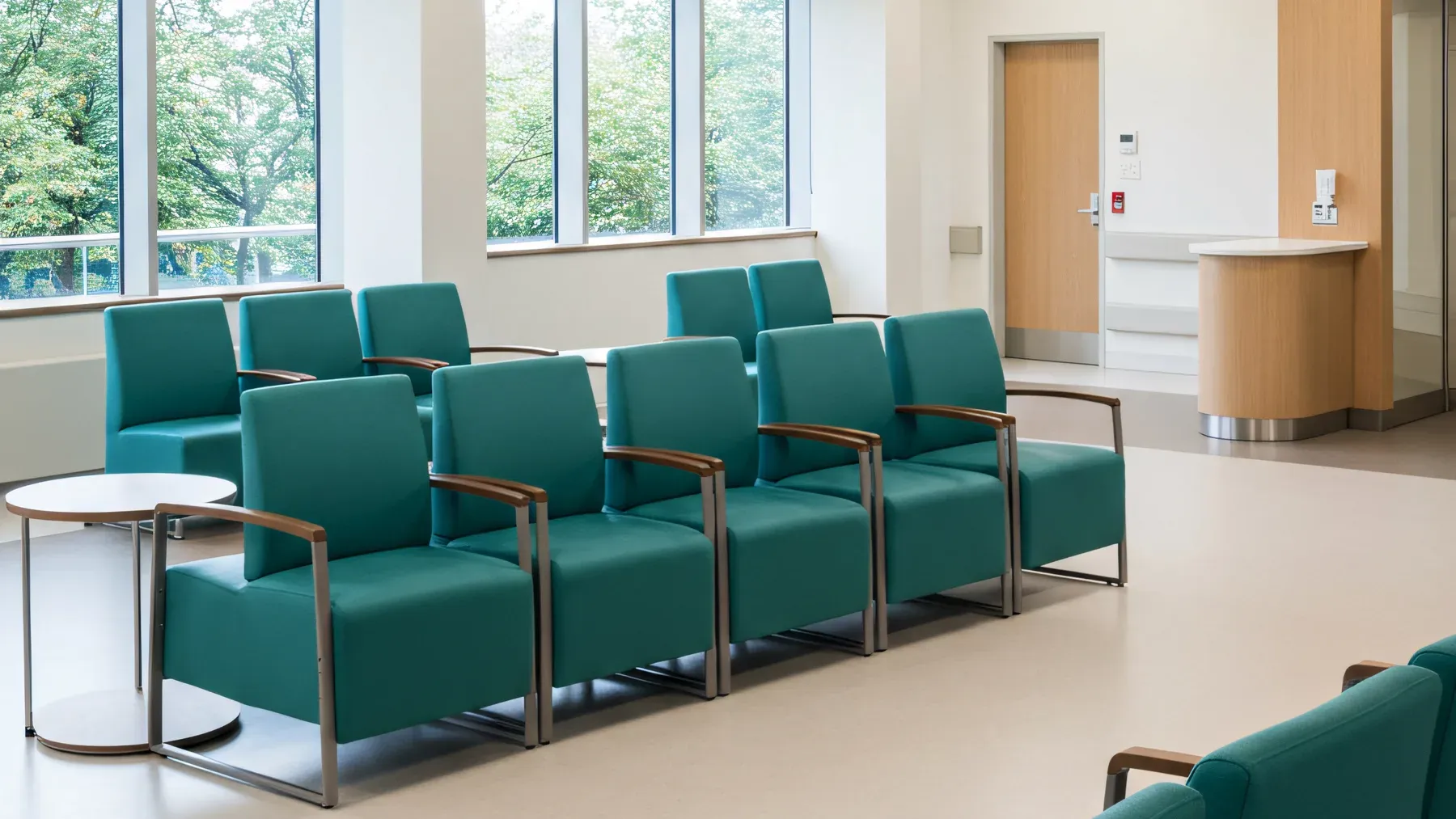
Make the Waiting Room Move on Four Clocks
Waiting is the feature readers remember and the feature writers most often leave static. A character worries, studies the floor, hears a trolley, worries again, and receives news. The passage feels long because nothing changes.
A hospital scene usually contains four clocks:
- The clinical clock follows the patient’s body: symptoms, monitoring, response to treatment, test timing, and the point at which delay changes risk.
- The institutional clock follows the system: staff workload, shift handover, laboratory turnaround, specialist availability, transport, theatre access, and beds.
- The visitor’s clock follows practical endurance: phone battery, food, childcare, travel, work, medication, parking, and the ability to contact other people.
- The outside-story clock follows the novel beyond the building: police questions, a flight, a public deadline, a missing witness, an unattended child, or evidence that may disappear.
The clocks intersect without moving at the same speed. A test may be clinically appropriate and still take longer than the sibling expects. A decision to admit the patient may already exist while the patient remains in the emergency department awaiting an inpatient bed. The Agency for Healthcare Research and Quality calls this boarding and treats emergency-department crowding as a system-level problem with consequences for care.
Turn each waiting interval into a state change. During the first interval, the sibling identifies the patient under the former surname. During the second, the phone falls to five percent and the partner still has not answered. During the third, staff confirm that the patient is stable enough for imaging but cannot yet explain the full injury. During the fourth, the police call with a detail that contradicts who the family thought was driving.
Each interval changes one of four variables:
- Knowledge: the character learns, corrects, doubts, or misinterprets something.
- Access: a person, room, record, phone, or decision becomes available or closes.
- Risk: the patient’s condition, an outside deadline, or a relationship becomes more urgent.
- Obligation: the character gains a task they cannot responsibly ignore.
This method keeps secondary encounters attached to the main scene. Another family’s good news matters only if it changes the sibling’s behavior, perhaps prompting shame at their envy or revealing how little they have told their father. A vending-machine conversation matters if it produces the phone charger, witness account, or family accusation that affects the next decision. Interesting fragments that alter nothing belong elsewhere.
Sensory detail should also follow a task. The sibling notices the automatic door because every opening might bring news. They notice dried mud on the patient’s scarf because it conflicts with the reported seat in the car. The overhead announcement matters because a repeated code stops at the moment staff movement changes. Fluorescent light and disinfectant smell are too general unless they trigger memory, impair thought, or shape action.
Rosenfeld’s discussion of suspense emphasizes pressure, delayed conclusions, and information introduced through uncertainty. In a hospital scene, delay does not require a false emergency or a villainous employee. The four clocks already produce pressure. The writer’s job is to make their movement legible.
Let Disposition Turn the Story
Medical news is rarely a complete scene ending. “She will live” resolves one question and creates a different life.
Disposition is the decision about where the patient goes next. Admission, transfer, surgery, discharge, rehabilitation, palliative care, or death changes who has access, what care is possible, and what the family must do. It should also change the novel’s next objective.
Suppose the patient survives surgery and will need months of rehabilitation. The sibling learns that she was a passenger, contradicting the first police account. The partner asks the sibling to leave. The patient is awake only briefly and refuses to explain why she used another person’s name at the scene.
The hospital chapter has now handed the story three connected consequences: a care arrangement, a damaged relationship, and a mystery about the collision. The next scene can pursue one of them while the others continue applying pressure. The guide to writing caregiver relationships is useful when an emergency becomes daily labor. Character decisions and the next scene can help convert the sibling’s choice to call the partner into a changed relationship rather than a completed errand.
Preserve the patient’s agency whenever their condition permits it. A patient may refuse a visitor, correct a family story, prioritize a concern nobody expected, or be too fatigued to provide the confrontation another character planned. Illness and injury constrain agency; they do not automatically erase it.
If the patient dies, research the institution, jurisdiction, faith, culture, and circumstances. Confirmation of death, contact with family, personal belongings, access to the body, certification, investigation, and mortuary procedures do not follow one universal script. The death should continue through relationships and practical consequences instead of serving as a brief source of motivation for the surviving viewpoint character.
Discharge deserves equal care. Instructions, medication, transport, mobility, cost, housing, follow-up, and available support determine whether returning home is relief or the beginning of another crisis. A technically successful treatment can produce a difficult social outcome. That gap often contains the most consequential scene turn.
Keep the Whole Sequence Visible in NovelOS Studio
A credible hospital chapter asks the writer to coordinate research, geography, roles, knowledge, timing, character history, and the consequences that leave the building. NovelOS Studio keeps those layers attached to the novel rather than scattering them among browser tabs and disconnected notes:
- Store the hospital type, jurisdiction, departments, access rules, local terminology, capacity assumptions, and physical route in The Architect. Link each fact to its research source and mark details that still need expert review.
- Define the patient, sibling, partner, clinicians, nurse, social worker, police contact, and any other necessary participant in Cast & World. Record roles, motives, limits, relationships, private history, and what each person knows.
- Map family authority, mistrust, care duties, and professional relationships with Connections inside Cast & World. The scene’s information problem becomes part of the relationship web.
- The Blueprint is where the patient journey meets the four clocks. Write the immediate goal, access barrier, new information, choice, and disposition into the relevant Scene Card; Timeline View aligns the collision, ambulance journey, tests, calls, surgery, bed availability, and police inquiry.
- Explore alternative complications in Spark when the sequence lacks pressure. Test a different missing record, contact, outside deadline, or disposition, then keep only the option that changes causality.
- Draft the limited viewpoint in The Manuscript. The Alchemist can help identify repeated waiting beats, staff used only as obstacles, unexplained knowledge, inert sensory detail, or a medical outcome that fails to redirect the plot.
- Track medical research, expert questions, continuity checks, chapter revision, and manuscript progress with Goals and Trackers. When the book is ready, Publish can prepare DOCX, EPUB, standalone HTML, RTF, Markdown, plain text, and PDF editions.
NovelOS Studio works locally on Windows and macOS. A portable .novelos archive can preserve the complete editable project, including its manuscript, planning, and media, for backup or import on another supported computer.
The hospital does not need to take over the novel. It needs to behave like a particular place where urgent work, limited access, and uncertain knowledge reshape what the character can do. Build the route, clocks, and consequences in NovelOS Studio, then let the viewpoint character experience only the part of the system the scene allows them to reach.
Sources and further reading
- Emergency Nursing Triage Education Portfolio, Emergency Nurses Association
- Emergency Departments, Agency for Healthcare Research and Quality
- Boarding and Emergency Department Crowding, Agency for Healthcare Research and Quality
- Disclosures to Family and Friends, U.S. Department of Health and Human Services
- Facility Directory and Patient Location, U.S. Department of Health and Human Services
- Jordan E. Rosenfeld, Make a Scene: Crafting a Powerful Story One Scene at a Time, especially the chapters on setting and suspense
- Healthcare Team in Action, Lummi
- Modern Waiting Room, Lummi
- Doctor and Patient Interaction, Lummi