Setting and Character Mood: A Fiction Writer's Guide to Biased Description

Rain does not mean sadness. It can mean relief to a farmer, concealment to a fugitive, ruined shoes to a wedding guest, or the return of a childhood fear to someone who once watched a river rise.
This is the central principle behind using setting to reflect character mood: the physical place supplies facts, while the viewpoint character supplies significance. Emotion directs attention. Attention selects details. Memory and judgment decide what those details mean. The character’s actions then leave fresh evidence in the place.
That sequence gives a writer far more control than changing the weather whenever the emotional tone changes. It also explains why a cheerful setting can deepen grief and why a frightening location can make one character feel strangely safe. The world does not need to imitate the character. It needs to pass through a particular consciousness.
Mood, character emotion, and atmosphere are related, although they are not interchangeable. A character’s emotion is their internal state. Atmosphere is the quality the prose gives the environment. Mood is the feeling the scene encourages in the reader. Setting connects all three when its description reveals how this person is experiencing this moment.
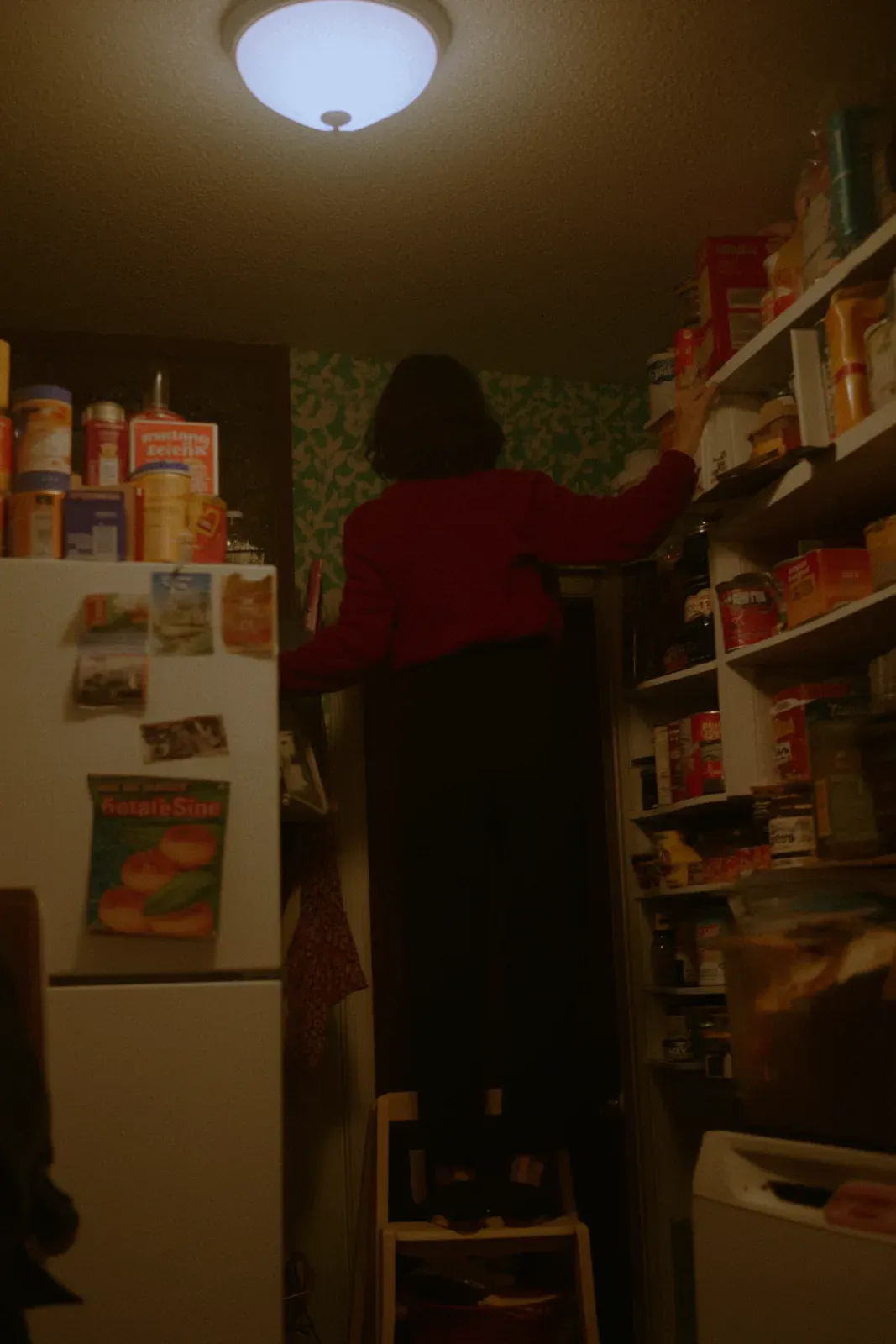
This guide follows Lina as she returns to her late father’s kitchen to find the deed before the house is sold. The room stays physically consistent while guilt, anger, relief, and new evidence change the details she notices and what she does with them.
Separate the room from the feeling
Before writing an emotional description, establish what remains objectively true. Lina’s childhood kitchen contains faded blue cupboards, a humming refrigerator, two unwashed glasses, afternoon sunlight across the table, and a clock that loses four minutes every week. Those details exist whether she is angry, frightened, relieved, or numb. Her emotion changes the rendering without altering the floor plan.
| Stable fact | What Lina’s appraisal can make it mean |
|---|---|
| Two glasses stand beside the sink | Her father had company, or someone arrived too late to help |
| The clock runs four minutes slow | He neglected the house, or he kept an imperfection that amused him |
| Sunlight reaches the table | The room feels exposed, or it reveals something she has avoided seeing |
| The refrigerator hums | The house is oppressively quiet, or daily life continues after death |
The second column is where interiority enters. In a 2014 University of Oregon thesis on setting as a reflection of character interiority, Zoë Livelybrooks describes setting as a lens for thoughts and feelings a character cannot or will not express. That lens can work through symbolism, atmosphere, interaction, or the narrative voice’s choice of subject. The practical lesson is simple: a place becomes emotionally revealing through selection and interpretation.
This distinction also protects continuity. If the north window has already been established beside the sink, grief should not move it across the room. Lina may barely notice the window, resent its brightness, or use it to watch the estate agent arrive. Its location remains stable while its dramatic value changes.
The same principle keeps emotion from turning into a list of decorated synonyms. If the portraits are “accusing,” the clock “scolds,” the cupboards “sulk,” and the floorboards “complain,” every object is delivering the same instruction. One charged comparison surrounded by accurate physical details usually carries more force. Readers infer the feeling instead of receiving it four times.
Weather can participate, too. The literary term pathetic fallacy describes a projection of human emotion onto the surroundings. A 2022 stylistics study defines it more precisely as emotion projected from an animate entity onto its environment. The study identifies uses such as implicit emotion, ambience, characterization, and foreshadowing. It is one available device, not the foundation of every emotional setting. Lina’s grief does not require rain. A clear, busy afternoon may hurt more because the rest of the world has declined to pause.
Let purpose control attention
A room contains more information than a scene can hold. The viewpoint character’s immediate purpose decides what earns space on the page.
When Lina enters looking for the deed, she is likely to notice drawers, folders, keys, the locked cabinet, and signs that someone has searched before her. If she enters to prove that her brother neglected their father, she looks for expired medicine, dirty dishes, unopened post, and dust. If she comes hoping to recover a lost recipe, scent and touch may lead: cardamom in a tin, the worn wooden spoon, grease-softened handwriting.
This is more technical than “describe the room through emotion.” Give attention a hierarchy:
- Action relevance: What can help or obstruct the character’s current goal?
- Emotional charge: What is connected to a fear, desire, relationship, shame, or unresolved question?
- Anomaly: What has changed, gone missing, appeared unexpectedly, or violated the character’s expectation?
Those three filters prevent description from becoming inventory. Mary Buckham’s A Writer’s Guide to Active Setting makes a related distinction: a comfortable character notices different details from someone who feels threatened, and changing the emotional state should change which sensory details attract attention. Ron Rozelle’s Description & Setting similarly emphasizes selected remnants and ordinary actions as ways to imply a state of mind rather than declaring it at the start.
Mood is only one job a location can perform. When the environment also needs to obstruct decisions, control movement, or change the plot, use the broader method in this guide to active setting in fiction. The present method stays focused on the narrower question of how a place reveals the person perceiving it.
The anomaly filter is especially useful in a familiar location. Lina does not need to catalogue the kitchen she grew up in. Familiar objects normally recede from awareness. The gap where her father’s radio used to sit matters because it breaks the remembered pattern. The dustless rectangle beneath it suggests recent removal. That single absence can orient the reader, create a question, and expose Lina’s assumption that nobody else valued the object.
Expertise changes attention as well. Lina restores paintings for a living, so she may read the room through deterioration: varnish-colored grease above the stove, moisture blooming beneath paint, a hairline crack spreading from the window frame. Her brother is a paramedic. He notices the medicine organizer, the path between chair and counter, the loose rug that could cause a fall, and the phone positioned within reach. Their observations can disagree without either character lying.
This is why deep point of view depends on more than removing filter words. The selected noun, sensory channel, and comparison must plausibly belong to the person perceiving them. A medieval farmer will not compare silence to a refrigerator switching off. A child may use a technically inaccurate image that is emotionally exact. Voice emerges from what the character knows and from what they lack words to explain.
Turn a detail into an appraisal
Selection decides what enters the frame. Appraisal decides how the reader receives it.
An appraisal is the character’s evaluation of a detail in relation to their present concerns. The evaluation can appear in diction, sentence rhythm, metaphor, memory, or action. It does not always require an explicit thought.
Take the same clock:
The clock dragged four minutes behind, as it had for years.
“Dragged” suggests resistance or exhaustion. Lina may see the clock as evidence of her father’s stubbornness.
The clock kept its private four-minute mercy.
Now the flaw feels affectionate or protective. Perhaps those four minutes once spared Lina from being late for school in her father’s eyes.
Four minutes slow. Still. She took it down before her brother could stop her.
The clipped rhythm and immediate action carry impatience. No emotional label is needed.
Sentence structure matters because attention has tempo. Fear often produces rapid checks, interrupted judgments, and a return to the possible threat. Numbness may flatten distinctions and reduce figurative language. Nostalgia can linger over texture, sequence, and association. Anger may compress a complicated place into evidence for one accusation. These are tendencies rather than fixed formulas, so match the syntax to this character’s behavior under pressure.
Memory should arrive through a present trigger and alter what happens next. Scorched milk takes Lina back to mornings when her father forgot the pan because he was helping with homework. That memory complicates her claim that he never paid attention. Once it changes the argument, return to the kitchen. Lina lowers the burner, cleans the pan, or admits the memory to her brother. A memory that leaves no mark on the present scene is likely a backstory detour.
Metaphor also reveals the mind making it. Lina sees water damage spreading through wallpaper like pigment blooming across wet paper. Her brother calls the same mark a bruise. The comparisons reveal training, association, and current concern. They also create a small conflict over what kind of damage the house has suffered and whether it can be repaired.
Strong sensory detail follows the same logic. The goal is not to include all five senses. Choose the sense that changes the scene. The grit beneath Lina’s palm matters if it tells her the table has not been used. The refrigerator’s hum matters if it fills the silence after her brother says their father asked for her. Cardamom matters if it releases a memory that changes her next choice.
Contrast deserves a deliberate place in this method. Matching surroundings can intensify a feeling, yet opposing surroundings frequently create more tension. A children’s party makes private grief harder to hide. A storm may comfort someone who believes it prevents pursuit. Lina may resent the kitchen’s bright order because it contradicts the collapse she expected to find. Contrast lets the environment resist the character’s preferred story about the moment.
Make emotion leave physical evidence
Setting becomes dramatically useful when the character changes it.
An anxious visitor aligns the magazines in a waiting room. A grieving widower leaves one cup unwashed. A furious tenant opens every curtain before the landlord arrives. These actions belong to the specific place, so they reveal more than a familiar clenched jaw or trembling hand. The altered environment can remain after the character leaves and affect whoever enters next.
Lina begins by searching the kitchen for proof of neglect. She opens drawers too hard, stacks post into accusations, and places expired medicine where her brother must see it. Then she finds a box containing every postcard she sent. The discovery changes her appraisal, although it does not erase the years between them. She moves the box into the sunlight. Later, she leaves the broken clock on the wall because her brother wants it.
The kitchen now records an emotional turn through spatial changes: drawers open, letters sorted, postcard box recovered, clock left in place. Description and action have become one continuous scene.
A useful revision test is to track the environment at three moments:
- Arrival: Which detail first expresses the character’s expectation?
- Pressure: Which object, sound, route, or change complicates that expectation?
- Departure: What has the character touched, moved, damaged, revealed, taken, or deliberately left behind?
This gives the setting an arc without pretending the architecture has feelings. It also answers a common search question directly: How can setting show a character’s changing mood within one scene? Repeat one or two stable details after the emotional turn, then change the character’s attention, appraisal, or action. The clock is still slow. The sunlight is still bright. Their meaning and use have changed.
Another character can challenge the filter. Lina calls the kitchen cramped; her brother says it feels empty. She remembers the table as a place of interrogation; he remembers doing homework beneath it while their father cooked. Each description exposes a relationship with the room and with the person they lost. Because both accounts share physical facts, their disagreement feels human rather than arbitrary.

Build an emotional map across the novel
A setting that reflects mood should develop across scenes. Repeating the same location with identical “sad” or “threatening” language flattens both place and character. A stronger return reveals changed knowledge, a different goal, a new relationship, or evidence left by the previous visit.
This is where NovelOS Studio can keep objective place and subjective experience connected without merging them into one note.
- Record the kitchen’s stable reality in The Architect: layout, light, materials, access points, ownership, history, recurring sounds, and physical changes. These facts keep later scenes spatially credible.
- Give each observer a private version in The Oracle: Lina’s guilt, her brother’s caretaking history, their father’s habits, important memories, professional vocabulary, and the details each person misreads.
- Map disagreement through Connections: who associates the kitchen with safety, debt, control, abandonment, or belonging, and how those meanings affect the family relationship.
- Track every return in The Blueprint: place the kitchen scenes on Timeline View and note the viewpoint, goal, dominant appraisal, new information, object moved, and meaning carried into the next appearance.
- Draft the changing filter in The Manuscript: keep setting details inside searching, cooking, arguing, cleaning, and deciding so description advances with the scene.
- Use The Alchemist for a focused revision pass: look for emotional labels that repeat an image, metaphors that do not belong to the viewpoint, and clusters of objects all performing the same mood.
The feature split reflects the craft problem. Architect answers, “What is here?” Oracle and Connections answer, “What does it mean to this person?” Blueprint answers, “How does that meaning change?” Manuscript and Alchemist shape the reader’s line-by-line experience.
During revision, highlight each setting detail and label its primary job: orientation, action, mood, character, conflict, setup, or payoff. One detail may do several jobs. A long passage labeled only “mood” probably needs compression or interaction. If every detail serves orientation, the scene may feel like a property listing. If every detail serves symbolism, the prose may begin insisting on its importance.
Lina leaves beneath the same clear afternoon in which she arrived. She has learned why the second glass was there, chosen to keep the postcard box, and left the unreliable clock for her brother. The weather has not changed. The kitchen has changed slightly. Most important, the pattern of her attention has changed, so the reader feels the emotional movement without being told that the room has become hopeful.
NovelOS Studio helps preserve that distinction across a full manuscript: one coherent place, several human interpretations, and a visible record of how every return changes the story.
Sources and further reading
- Mary Buckham, A Writer’s Guide to Active Setting: viewpoint-filtered details, sensory selection, contrast, and setting used to show emotion.
- Ron Rozelle, Description & Setting: selective description, ordinary action, sensory atmosphere, and setting details used to imply character mood.
- Zoë Livelybrooks, Setting as a Reflection of Character Interiority in Short Fiction, University of Oregon, 2014.
- Kimberley Pager-McClymont, “Linking Emotions to Surroundings: A Stylistic Model of Pathetic Fallacy”, Language and Literature, 2022.