A Duel Scene Is a Contract Written in Public

Two rivals enter a salt court before sunrise. The harbor captains form a ring around them. Each person carries the same kind of sword, yet the contest is unequal. One rival has trained for years. The other has chosen an old condition: whoever draws first blood earns one truthful answer before the duel continues.
The less experienced fighter wants the answer more than victory. A warehouse fire killed dozens of laborers, and the captain standing opposite knows who gave the order to seal the doors. The captain accepts the challenge because refusal would end a military career built on public courage. When the blades meet, both people are fighting over the meaning of the event. One needs the assembly to hear a confession. The other needs the assembly to see an unshaken commander.
This is the central difference between a duel scene and an ordinary fight scene. A duel is a recognized procedure. Someone issues a challenge, someone accepts, conditions are established, and an audience or institution decides whether the result counts. The weapons create danger. The procedure creates story.
Historical codes make that distinction unusually visible. John Lyde Wilson’s nineteenth-century Code of Honor assigns extensive duties to challengers, recipients, and seconds. The surviving regulations for the Hamilton and Burr duel specify time, place, weapons, distance, positions, a signal, and what counts as a shot. These sources describe harmful customs rooted in exclusion and coercion, so they are useful as evidence of how a procedure works rather than as traditions to romanticize. Their narrative lesson is clear: a formal contest depends on authority before it depends on technique.
Decide What Gives the Duel Authority
Before planning an exchange of blows, establish why the characters believe this duel can settle anything. The authority may come from law, military custom, religion, a criminal organization, a school culture, a magical oath, or a private agreement between two people who share the same code. It can also be disputed. A duel can be illegal under state law while remaining binding within an aristocratic class.
Write one sentence that defines its jurisdiction:
The salt court can strip a harbor captain of command because every officer swore to accept its witnessed rulings.
That sentence tells you who is subject to the result and what the result can change. It also exposes the limits. A court recognized by officers may have no authority over dockworkers, foreign merchants, or the families of people killed in the fire. The duel can decide command without proving innocence. That gap gives the scene political consequences.
Then identify the people who convert violence into a recognized event. A useful authority map includes:
- the person permitted to issue the challenge
- the person with power to accept or refuse it
- the seconds who negotiate conditions and seek a settlement
- the official who gives the signal or stops the contest
- the witnesses whose later accounts become the public record
- the institution that enforces the ruling afterward
Seconds deserve more than ornamental placement beside the arena. Historical codes assign them negotiation, inspection, communication, and procedural duties. In fiction, a second can discover that the proposed conditions favor one side, carry an attempted apology, disagree about whether a boundary was crossed, or refuse to validate a killing. The second has a goal and liability of their own.
This authority work also prevents a common worldbuilding problem. If everyone instantly accepts an obscure ritual, readers may feel the author arranged the culture around one dramatic scene. Show the institution earlier through a dismissed challenge, a scar treated as honorable, a disputed ruling, or an oath taken upon promotion. The later duel then activates an existing system. The article on political intrigue and competing leverage can help when law, reputation, and factional support pull the ruling in different directions.
Price Acceptance and Refusal Separately
A meaningful challenge offers at least two costly paths. If refusal carries no consequence, an intelligent character can walk away. If acceptance is compulsory in every practical sense, describe that coercion accurately. Participation alone does not prove free consent.
Give each duelist an acceptance cost and a refusal cost. For the accused captain, acceptance risks injury and forced disclosure; refusal costs command and the loyalty of the officers. For the challenger, acceptance risks death; refusal leaves the warehouse order concealed and makes future accusations look hollow. Their calculations differ, which produces different behavior inside the same rules.
The scene becomes richer when the characters also disagree about what winning means. Use two objectives for each participant:
| Participant | Official objective | Private objective |
|---|---|---|
| Challenger | Draw first blood or force surrender | Ask the question where every captain can hear the answer |
| Accused captain | Remain inside the court and win | Preserve the appearance of legitimate command |
| Challenger’s second | Secure a valid hearing | Keep the challenger alive long enough to use the rule |
| Presiding judge | Produce an enforceable ruling | Prevent the captains from splitting into armed factions |
Now a physically superior fighter can lose the larger contest. The captain might win by the formal victory condition while revealing cowardice, corruption, or contempt for the court. The challenger might be defeated and still obtain the confession. Readers can follow both scoreboards because the article’s opening establishes them.
Refusal should reveal values rather than function as a generic mark of cowardice. A person may refuse because the institution excludes women, because the challenger has manipulated the rules, because killing would violate a faith, or because the contest cannot repair the alleged harm. A society that punishes such refusal tells the reader something precise about power.
When both available choices damage something the character values, use the moral dilemma guide to test the decision. The strongest pressure comes from incompatible obligations, such as personal survival, duty to a crew, truth owed to victims, and obedience to a corrupt office.
Turn Each Rule Into a Story Lever
A rule earns space in the article when it changes a decision, creates evidence, or transfers power. A catalogue of weapon dimensions and ceremonial phrases can sound researched while doing little dramatic work. Select a small set of conditions that repeatedly affect cause and effect.
For the salt-court duel, four conditions are enough:
- Crossing the white boundary counts as surrender.
- First blood pauses the contest and grants one truthful question.
- A surrendered opponent is protected by harbor law.
- The incoming tide closes the court at sunrise.
Each condition has several jobs. The boundary gives the less experienced fighter a possible route to formal victory. The question rule turns a minor wound into access to information. Protection after surrender tests whether the institution can restrain its own champion. The tide supplies a deadline and physically alters the space.
Run every chosen rule through three questions:
- What choice becomes possible because this rule exists?
- Who has the power to interpret a borderline case?
- What new problem follows when the rule is obeyed?
The first-blood rule, for example, lets the challenger seek a shallow injury rather than attempt a killing. Yet the exact moment of blood may be hard to see. A judge could pause too late. A partisan witness could claim the stain came from an earlier cut. Even successful use creates a harder problem because the challenger has only one question and the answer may be narrowly literal.
Introduce conditions through action. A second checks the white line after rain. The judge asks each person to repeat the surrender signal. An officer objects when the tide touches the outer mark. These small events explain the procedure while revealing which details the participants fear.
Rules can carry culture as long as their origins and effects make sense. A ban on facial wounds might protect an elite class’s visible status. Permission to appoint champions could allow wealthy families to transfer danger to retainers. A truth-binding pause implies a society that considers testimony more valuable when purchased through risk. Ask who benefits from the custom, who is excluded, and which older conflict produced it.
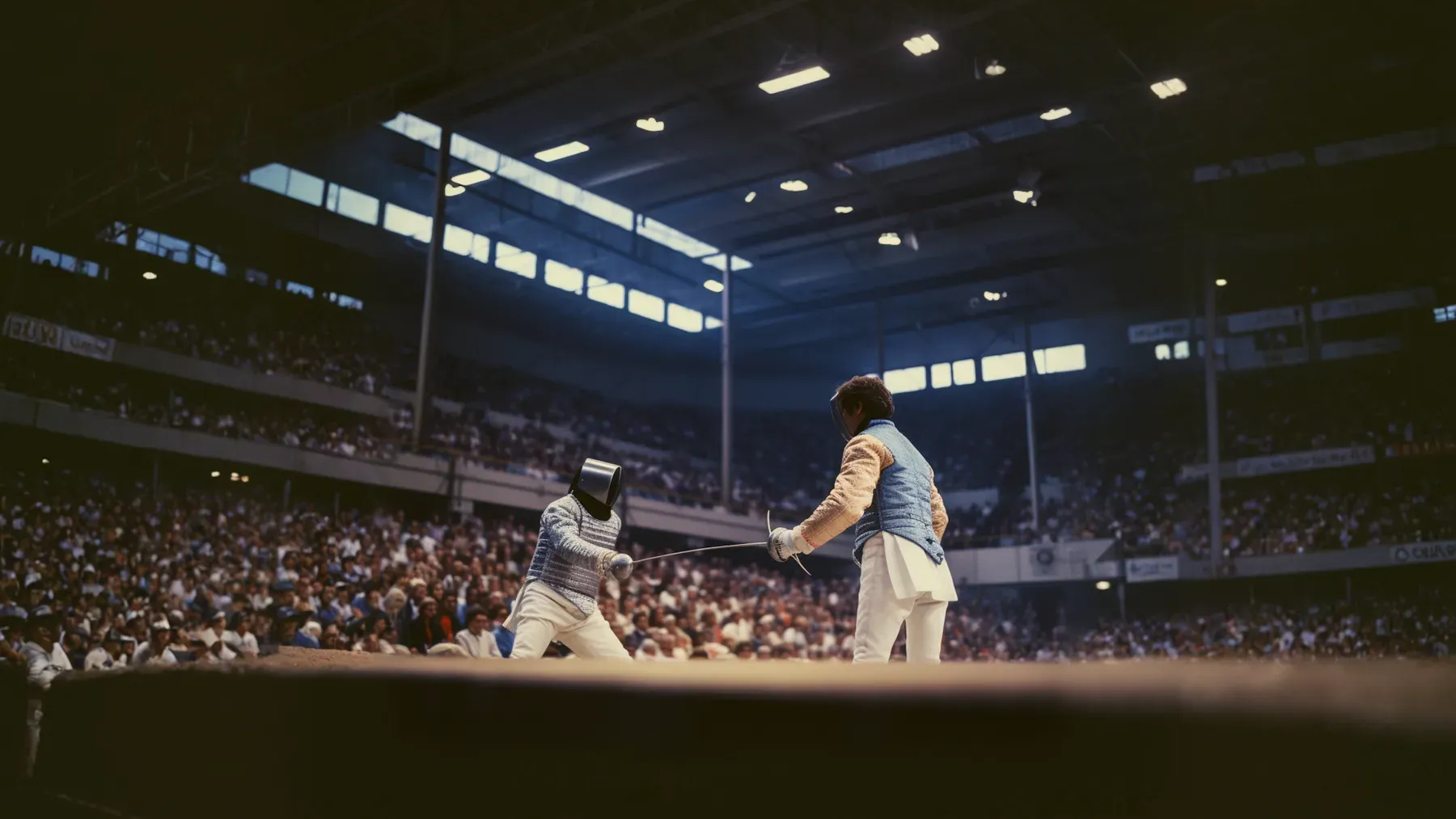
Keep Two Scoreboards During the Fight
Readers do not need a technical name for every movement. They need to know what each person attempted, what changed, and how the exchange affected the official and private objectives. The broader guide to writing a clear fight scene covers spatial orientation, physical cost, and readable action. A duel adds procedural state.
Track the scene in compact causal units:
- A participant acts toward an objective.
- Another person interprets that action and responds.
- Position, injury, knowledge, confidence, or legitimacy changes.
- The changed state alters the next available choice.
The challenger stays near the white line, inviting the captain to press forward. The captain recognizes the boundary plan and refuses to advance, which looks cautious to the witnesses. The challenger changes objectives and attempts to draw first blood. A cut appears on a sleeve, but the dark fabric hides its source. The judge must decide whether to pause. Every physical event also moves the public contest.
Keep a reader oriented with a few stable anchors: the boundary, the judge, the witnesses, and the advancing water. Mention an anchor when control changes. If the viewpoint character loses track of the opponent during a burst of action, let sound, crowd response, and the judge’s command provide limited information. Confusion can belong to the character without making the prose impossible to follow.
Injury and fatigue remain cumulative. A damaged hand affects grip, confidence, and later work. Wet ground changes what each fighter is willing to attempt. A breathless participant may waste the truthful question through poor phrasing. Rayne Hall’s Writing Fight Scenes separates suspense, start, action, surprise, climax, and aftermath, and stresses that consequences belong on the page. That sequence is useful as a diagnostic tool, although an individual duel can combine or reorder its parts.
Dialogue should spend power. A judge’s warning clarifies enforcement. A second’s objection delays the signal. The compelled answer changes allegiance in the crowd. Taunts that produce no choice or revelation slow the scene, while a single procedural sentence can redirect it.
Rule breaking becomes dramatic after the reader understands what compliance would cost. The breach should create evidence about character and institution rather than provide an automatic label of villainy.
Suppose the captain’s heel crosses the line. One witness calls surrender. Another insists the chalk washed away, so the boundary cannot be proven. The captain now has several options: accept the ruling, request review, exploit the uncertainty, or attack during the dispute. Each response tells the assembly what kind of authority this person plans to exercise.
The challenger can also violate procedure for a defensible reason. A collapsing section of gallery throws a child into the court. Lowering the weapon without permission gives the captain an opening, yet continuing would endanger the child. The decision tests whether the ritual serves human life or merely protects status.
Prepare enforcement before the breach. Readers should know who can stop the duel, whether guards answer to the judge or captain, and what witnesses can do if the official lies. A magical punishment may enforce the literal text while missing its spirit. A human tribunal may preserve the spirit while falsifying the record. Either version needs a traceable mechanism.
After the violation, write three records:
- the physical record, including footprints, blood, damaged equipment, and the position of witnesses
- the official record issued by the recognized authority
- the social record carried by rumor, testimony, songs, or factional propaganda
Those records need not agree. Their conflict extends the duel into later chapters. A footprint beyond the line might undermine the judge. A survivor may remember the breach differently under stress. A captain who controls the written record could still lose the loyalty of everyone who watched.
Carry the Ruling Into the Next Chapter
The last blow ends the physical contest. The duel scene ends when the story establishes what the result has changed.
Return to both scoreboards. Who formally won? Who obtained the private objective? Which authority recognizes the result? What physical cost persists? Which relationship has become impossible to restore? The answers can occupy a short aftermath, but they should be concrete.
On the salt court, the challenger draws blood and asks who ordered the warehouse sealed. The captain names the ruling council. The judge then declares the wound invalid because the blade touched cloth before skin. That decision cannot erase what the witnesses heard. Several officers protect the captain, several move toward the challenger, and one walks away from both. The duel has produced a confession, a disputed ruling, and a fractured command.
Follow the consequences at more than one distance. In the next hour, healers treat the wound and seconds dispute the transcript. During the next week, families of the dead demand arrests. Later in the novel, the captain’s injured hand affects a rescue, and the judge’s false ruling becomes evidence in a trial. A formal contest deserves this continuity because its whole purpose was to make private conflict publicly binding.
The reaction-scene guide can help when the next chapter must convert shock into decisions. Let participants pursue damage control, revenge, legal review, reconciliation, or reform according to what each person saw and wanted.

Build the Duel and Its Consequences in NovelOS Studio
A duel asks the writer to coordinate personal motive, public rules, physical continuity, witness knowledge, and later political effects. NovelOS Studio gathers that evidence in the novel project, where the contest stays connected to the chapters it changes.
For a rule-bound duel, the studio can hold the full working system:
- The Oracle develops each duelist’s history, fear, private objective, and likely response to victory or humiliation.
- Cast & World and Connections record seconds, judges, witnesses, factions, debts, loyalties, the arena, and the institution that enforces the result.
- The Architect helps define the culture’s challenge process, exclusions, surrender protections, and sources of legal or magical authority.
- Spark explores alternative conditions, disputed rulings, and aftermath complications when the first version feels predictable.
- The Blueprint and Timeline View arrange the insult, negotiations, inspection, contest, breach, ruling, and consequences while preserving injuries and deadlines.
- The Manuscript keeps the exchange readable at sentence level with the surrounding plot plan available for reference.
- The Alchemist supports controlled revision of pacing, clarity, and emotional emphasis while the original passage stays visible.
- Goals and trackers show whether the duel chapter, its setup, and its later consequence scenes are actually moving toward completion.
- Editorial Foundry turns the completed manuscript into a standalone HTML edition or an EPUB, PDF, DOCX, RTF, Markdown, or TXT file.
Writers can use NovelOS Studio on macOS or Windows. To change computers, export the project as a .novelos archive and import it on the other machine. The owner’s license supports activation across their personal computers without a fixed device cap. During a long revision, that portability keeps the duel’s witnesses, rules, injuries, and aftermath inside one authoritative project.
A memorable duel leaves readers arguing about more than who was stronger. Give the contest a jurisdiction, price both choices, make every rule alter behavior, and let the ruling travel through the rest of the book. Build the complete duel arc in NovelOS Studio, from the first challenge to the final public consequence.
Sources and further reading
- John Lyde Wilson, The Code of Honor, a historical primary source on the roles of principals and seconds, negotiation, procedure, and public sanction. Its violent and exclusionary assumptions require critical treatment.
- Nathaniel Pendleton’s regulations for the Hamilton and Burr duel, preserved by Founders Online at the National Archives, specifying the agreed time, place, weapons, distance, positions, signal, and firing procedure.
- The joint statement by William P. Van Ness and Nathaniel Pendleton, showing how seconds produced a contested factual record after the event.
- Rayne Hall, Writing Fight Scenes, in the local theory reference library, PDF pages 22 through 24 on suspense, action, climax, aftermath, and carrying physical and emotional consequences beyond the fight.
- How to write a clear fight scene