How to Build a World
The Fundamentals of Narrative Architecture
Worldbuilding is often the most seductive part of writing fiction.
It starts with a simple “What if?” and quickly spirals into thousands of words of lore, detailed maps of continents your protagonist will never visit, and complex social hierarchies that have no bearing on the plot. For many authors, it is a form of productive procrastination—a way to feel like you are working on the book without actually having to face the difficulty of writing the scenes.
If you want to do good worldbuilding, you have to stop treating your world as a backdrop and start treating it as a pressure cooker.
The Purpose of Worldbuilding is Pressure
The biggest mistake writers make in fantasy world building or science fiction is focusing on “breadth” instead of “depth.” Your reader doesn’t need to know the entire 2,000-year history of your empire. They need to know why the laws of that empire make it impossible for your protagonist to get what they want.
In professional narrative architecture, the world exists to generate conflict. If your world is perfectly peaceful and logical, your story has no traction.
The Logic of Geography and Economics
Every world, no matter how fantastical, is built on a foundation of resources and survival. One of the primary drivers of human history is the movement of goods and the control of trade routes. When you are building a fictional world, you should start with the map—not as a decorative asset, but as a strategic one.
Geography as Destiny
Where do people live, and why? In professional narrative architecture, geography is the silent protagonist. Cities are rarely founded in the middle of a desert without a very specific reason (like a unique mineral or a religious site). Most civilizations cluster around water. Rivers provide irrigation, sanitation, and transportation. Mountains provide defense but create isolation.
If your world has a massive mountain range separating two nations, those nations will develop different languages, customs, and religious interpretations. They will view each other with suspicion born from a lack of contact.
Climate and Culture: The environment dictates the rhythm of life across the centuries. A civilization developed in a permanent winter will have different concepts of “hospitality” and “thrift” than one built in a tropical paradise. Clothing, diet, architecture, and even the metaphors in their poetry will be shaped by the temperature of the air and the availability of shelter.
The Flow of Power
Who has the grain? Who has the steel? Who has the magic? In worldbuilding, power is almost always tied to scarcity. If magic is common and easy, it ceases to be a tool for drama and becomes a utility like electricity. But if magic is a finite resource that must be mined, stolen, or sacrificed for, it becomes an engine for war and politics.
Economics is the engine of the plot. If two nations are at war, it is rarely just because of an ancient grudge; it is because one nation needs the other’s harbor, or their mines, or their technology. When you understand the economic needs of your world, your character’s motivations become grounded and believable.
The Architecture of Institutions
Beyond the physical world lies the structural world—the institutions that govern how people live together. Good worldbuilding requires a deep dive into the systems that your protagonist must navigate, fight, or exploit.
The Power of Bureaucracy
In many great novels, the villain isn’t a dark lord; it’s a system. Guilds, corporations, churches, and governments all have their own internal logic and survival instincts. An institution’s primary goal is often to preserve its own power, even at the expense of its members.
When building an institution, ask:
- Who profits from the current system?
- How do they maintain their control? (Propaganda, violence, economic gatekeeping)
- What happens to those who try to change it?
Secret Societies and Subcultures
Not everyone follows the dominant rules. Every world has its subcultures—the groups that exist at the margins. These could be criminal syndicates, underground resistance movements, or specialized guilds of craftsmen. These groups should have their own internal languages, codes of conduct, and initiation rites. They provide a vital layer of depth, making the world feel like it exists beyond the immediate view of the protagonist.
The Invisible World: Faith and Taboos
While geography and economics provide the external structure of your world, the “invisible world”—the shared beliefs and unspoken rules—provides the internal pressure. This is often where worldbuilding for novelists becomes truly immersive.
Belief Systems that Shape Choice
Religion in fiction shouldn’t just be about which gods exist; it should be about how those gods influence daily behavior. A character who believes their soul is tied to their ancestral land will make very different choices than a character who believes life is a temporary trial before a celestial afterlife.
When building a religion, focus on the conflicts it creates. Does the church compete with the state for taxes? Are certain people marginalized by religious law? Does a character have a crisis of faith when their personal needs collide with their spiritual duties? A religion is most interesting when its demands create impossible dilemmas for your characters.
The Sound of the World: Language and Linguistics
You don’t need to invent a full language (conlang) like J.R.R. Tolkien, but you do need to understand how language reflects worldview. A culture with fifty words for “snow” thinks about the world differently than one with none.
Language is a tool for professional narrative architecture. It can be used to show class differences, regional tensions, or the exclusion of outsiders. Using specific loanwords, varying sentence structures, or unique metaphors can give your world a distinct phonetic “flavor” that makes it feel lived-in and ancient.
The Power of What Cannot Be Said
Taboos are the ultimate worldbuilding shortcut. Every culture has things they do not talk about, gestures they do not make, and people they do not touch. By introducing a social taboo early in your book, you create an immediate sense of danger. When your protagonist is forced to break that taboo to save someone, the stakes are instantly higher because the world itself is now their enemy.
Worldbuilding Through the Five Senses
To make a world feel real, you have to ground it in the sensory experience of the protagonist. Don’t tell the reader the world is ancient; show them the worn stone steps that have been hollowed out by centuries of footsteps.
- Sight: The specific color of the dust on a drafty road, or the way the sunset catches the smog of a coastal refinery.
- Sound: The rhythm of a city’s automated bells, the distant hum of a magic-shield, or the specific “click” of a common weapon.
- Smell: The pervasive scent of ozone before a technological surge, or the smell of roasting meat in a market that the protagonist cannot afford to eat in.
- Touch: The rough texture of a hand-woven garment in a low-resource district compared to the cold silk of the elite.
- Taste: The bitterness of travel rations, the metallic tang of blood in the air during a siege, or the overwhelming sweetness of a seasonal fruit.
The Rule of Three Changes
If you are writing in a setting that is similar to our own (like urban fantasy or historical fiction), you don’t need to rebuild everything. Use the “Rule of Three Changes.” Focus on three major ways your world deviates from our reality—perhaps magic replaced electricity, the oceans are made of mercury, and there is no such thing as gravity.
By deeply exploring the consequences of these three changes, you create a world that feels vast and alien without overwhelming the reader with unnecessary lore. One major change, followed to its logical extreme, is often more powerful than ten superficial ones.
Tutorial: Architecting Your World in NovelOS
In NovelOS, worldbuilding isn’t a separate document; it is a connected architecture. Here is the professional workflow for turning raw imagination into a stable, draftable universe.
Phase 0: Start with the Disruption
Before you name every plant in the forest, define what is broken in your world. Is there a resource scarcity? A forbidden magic? A social taboo? Good worldbuilding is defined by its limitations. What can’t your characters do?
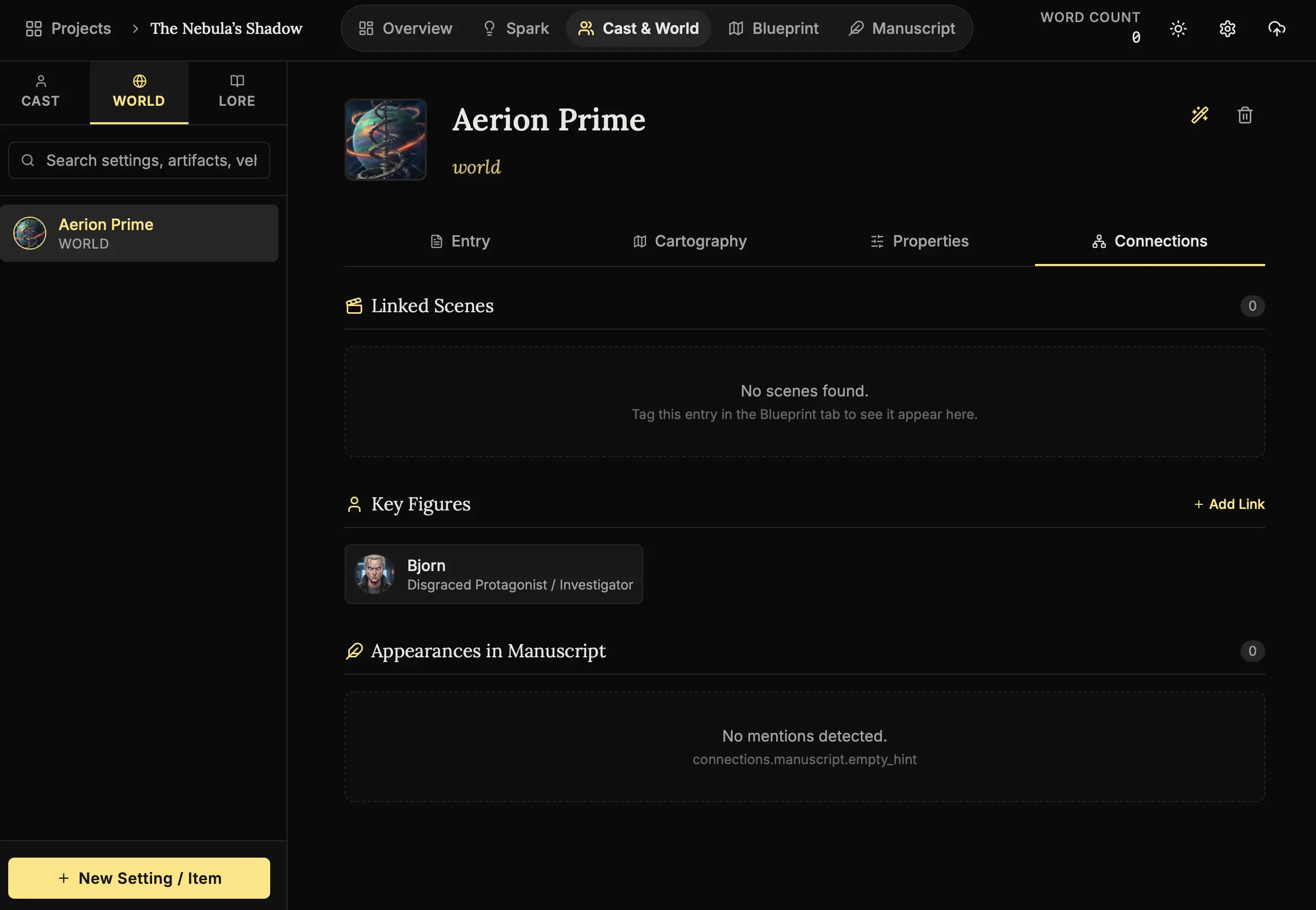 Worldbuilding connection as defined in NovelOS Studio features.
In NovelOS, this “Disruption” is the anchor of your series bible. You define it as a core Lore Property that influences every character and location entry.
Phase 1: The Cast (Identity & Psychology)
A story is only as strong as its people. In NovelOS, character creation starts in the Cast & World tab—powerfully managed by The Oracle.
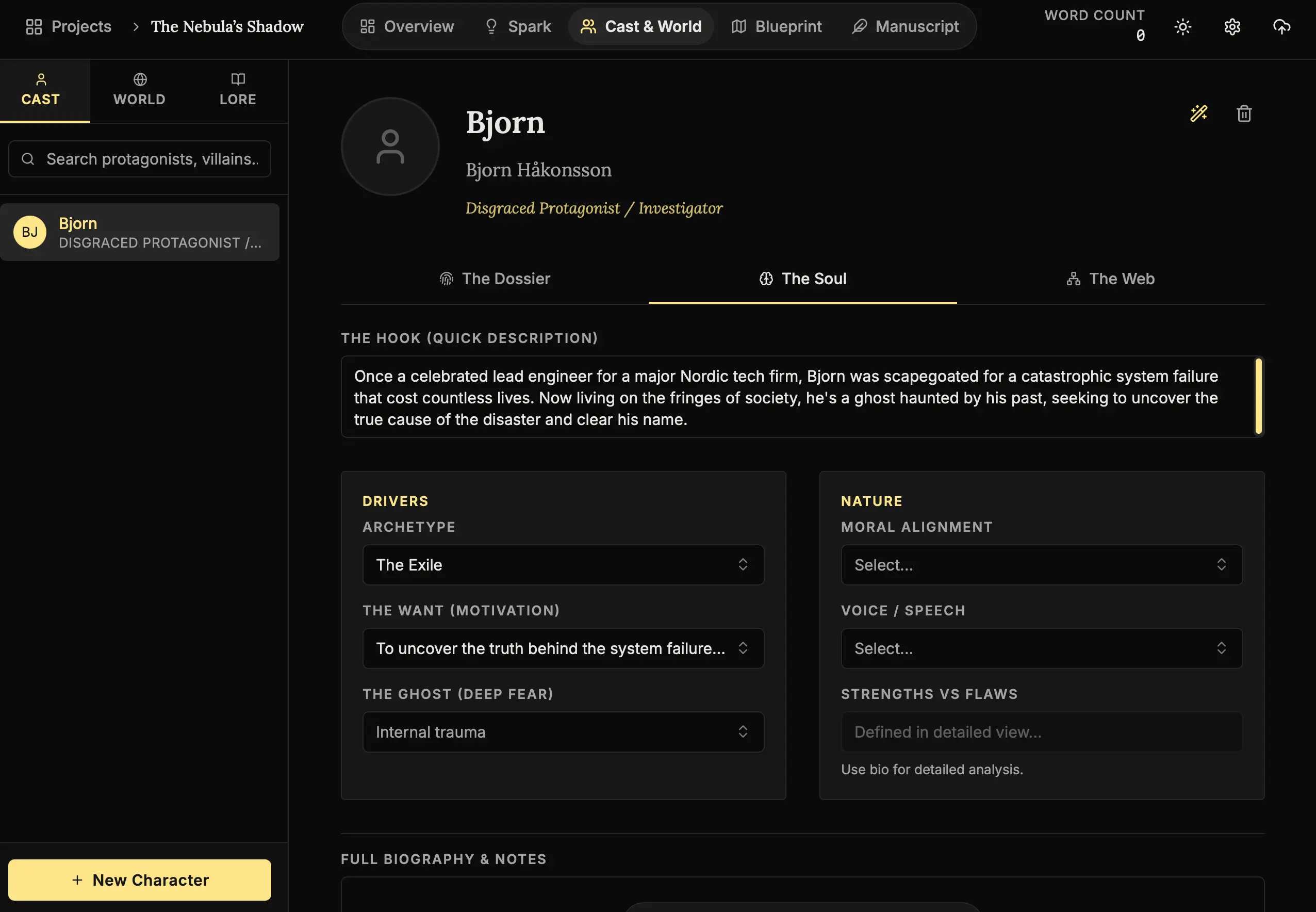
Instead of starting with superficial traits, we focus on the Psychology of the Soul.
- Identity: Use the Dossier to define the basics. Use the Magic Wand (🪄) to generate culturally resonant names and roles.
- The Soul: Define the Ghost (past trauma) and the Want (external goal). NovelOS uses these as “plot engines”—when you write, the system helps you maintain the tension between what the character wants and what they are afraid of.
- Visuals: Use the Portrait Generator to create a stable face for your character in various styles (Oil Painting, Anime, Noir), ensuring your descriptions remain consistent across hundreds of pages.
Phase 2: The Stage (Buildings & Cartography)
Your characters need a floor to stand on. In the World category, you transition from character to environment using the World Building tools.
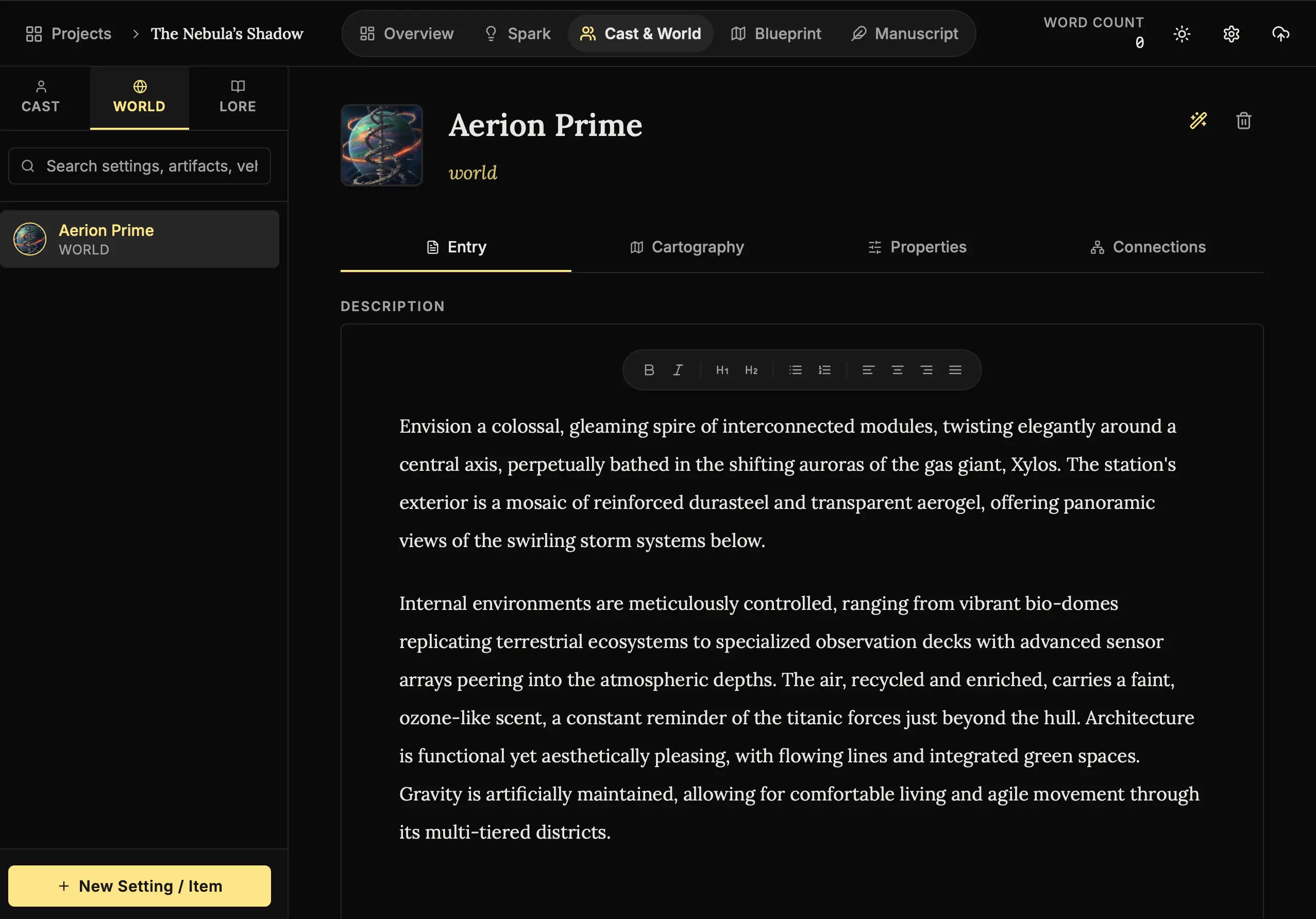
- Creation: Create a “New Setting” (Metropolis, Location, or Item).
- The Architect: Use the search-based generator to fill the entry with sensory details—local currencies, unique architecture, and the specific “smell” of the air.
- Cartography: Use the Cartography Editor to visualize the terrain. Whether it’s a topographical map of a continent or a floorplan of a space station, seeing the space helps you maintain descriptive consistency.
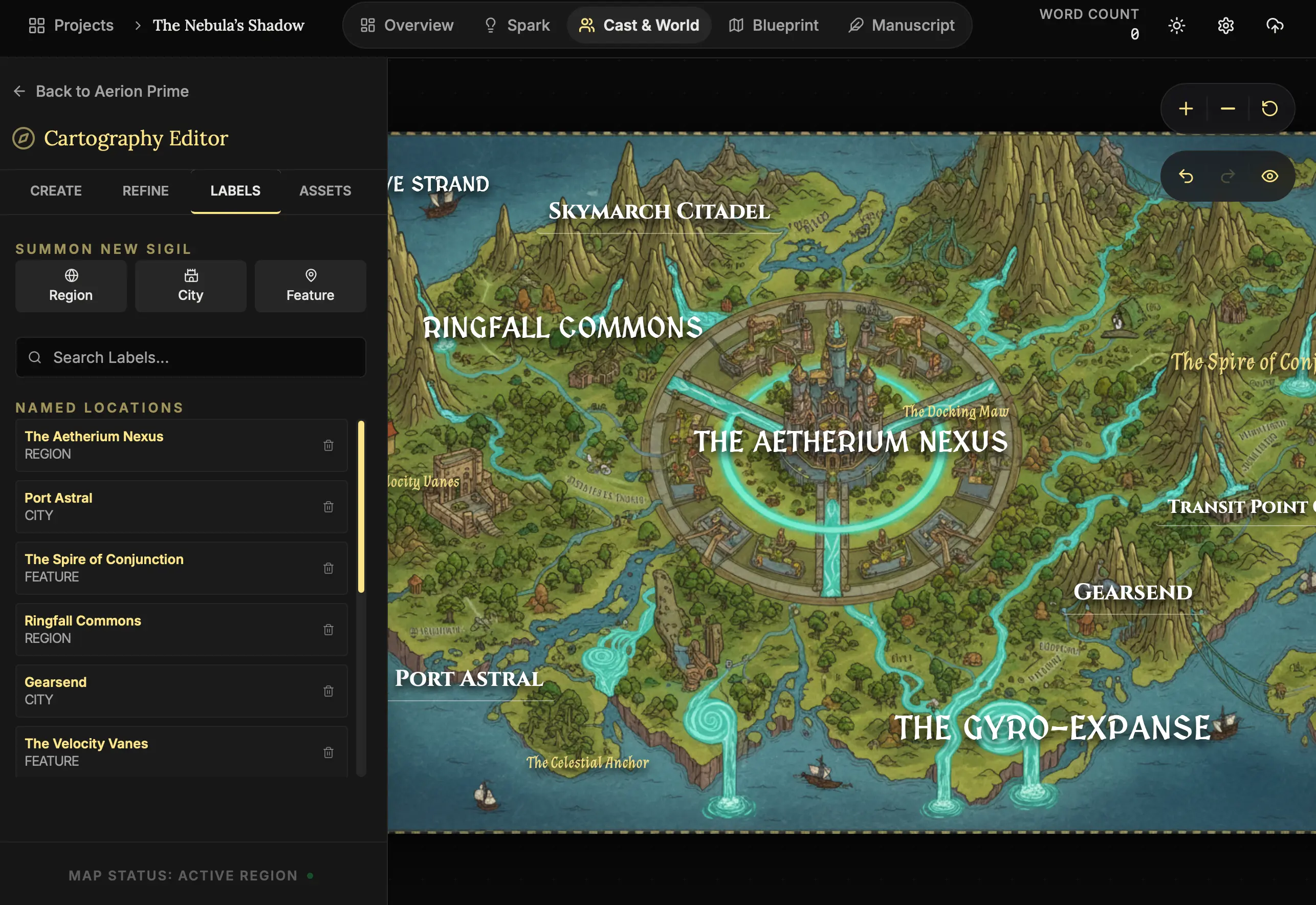
Phase 3: The Laws (Lore, Properties & Chronicles)
This is where your world becomes an unbreakable system. Navigate to the Lore section.
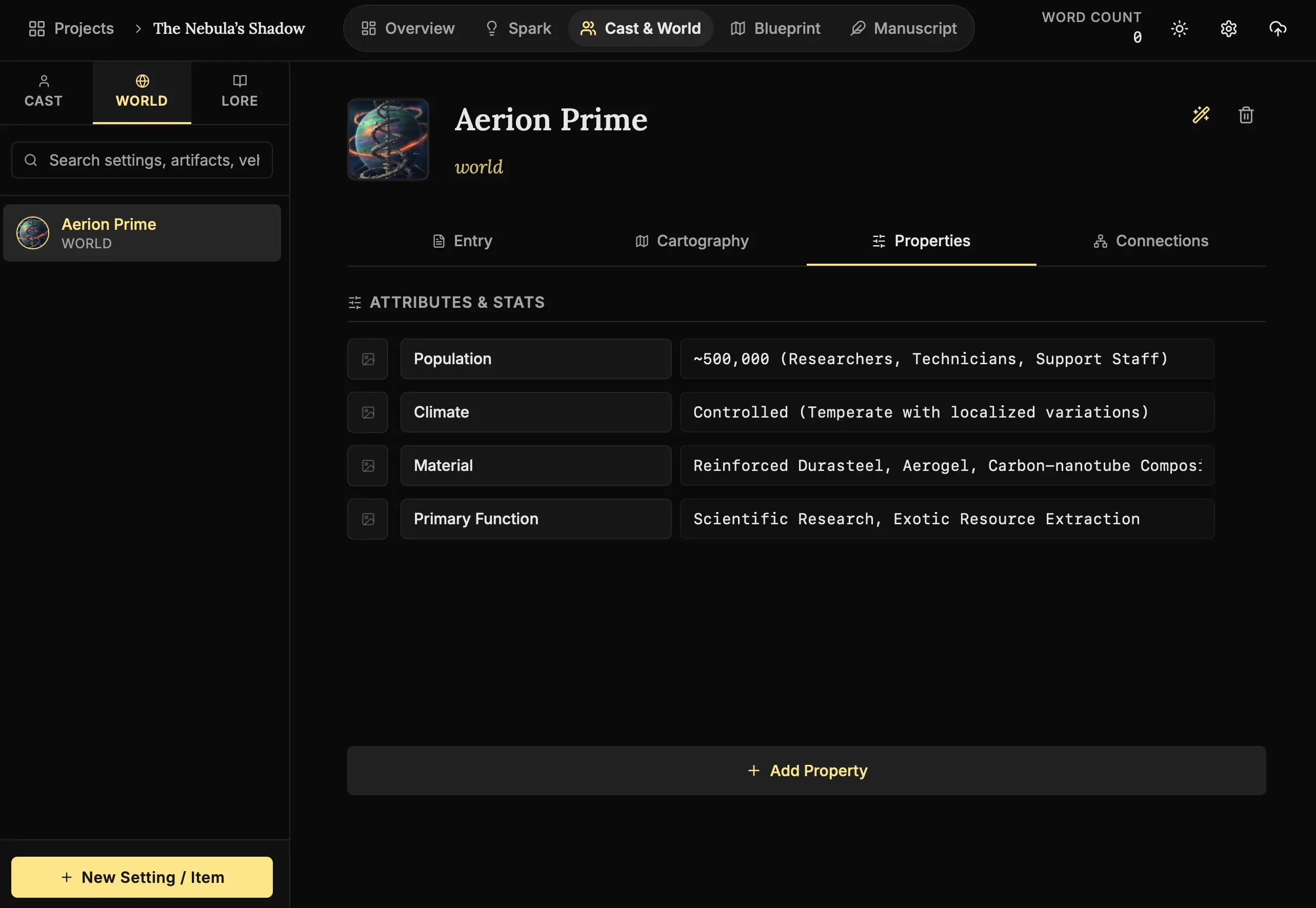
- Properties: Use the Properties tab for the “hard facts.” Set gravity to 0.8g, or establish that the currency is based on salt. These constants ensure that you aldrig make a mistake in Chapter 50 that contradicts Chapter 1.
- Mechanics: For magic or technology, use the Mechanics tab to define costs and limits. Power without cost has no dramatic value; NovelOS helps you track the “price” of every fantastical element.
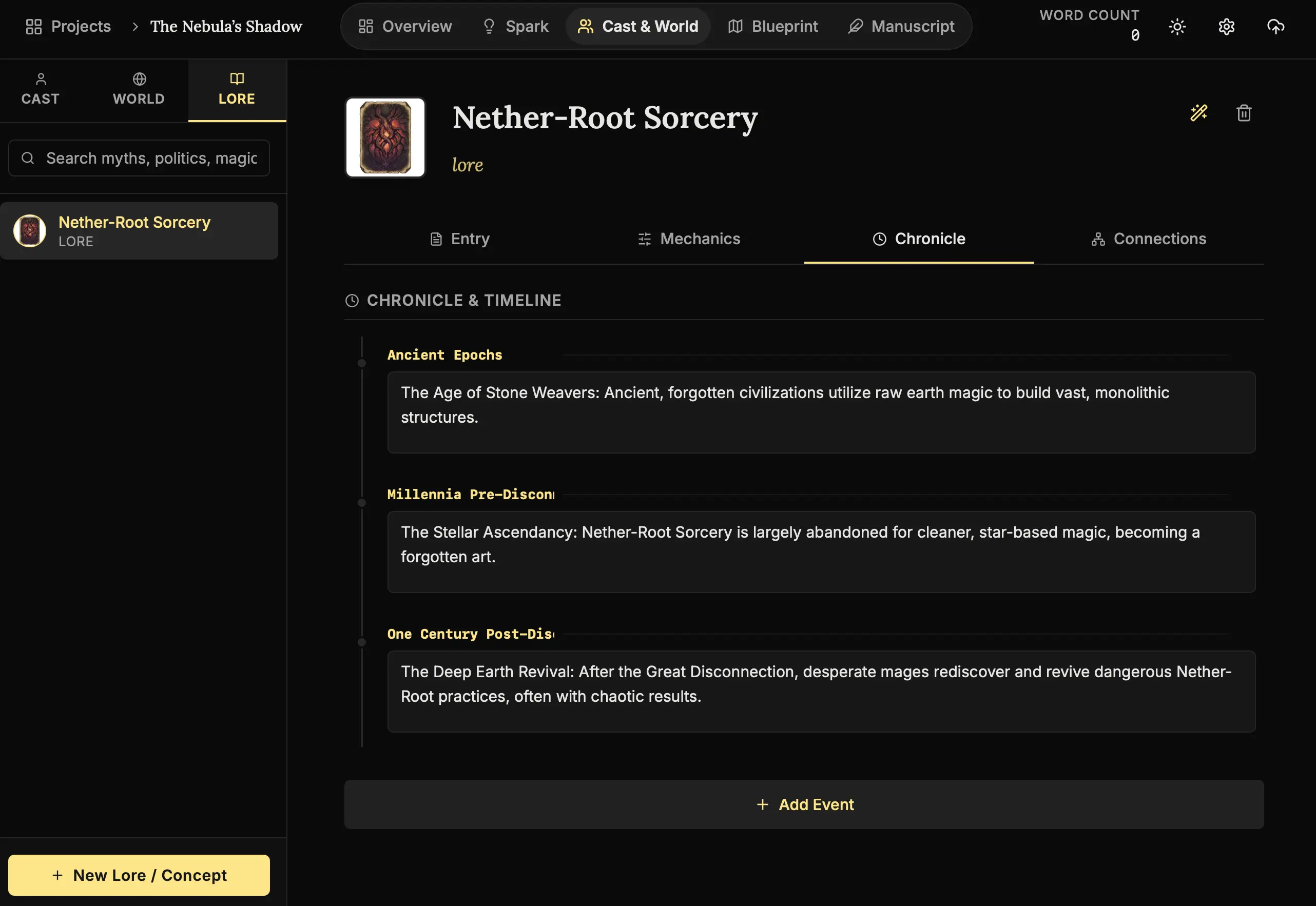
- Chronicles: Use the Chronicle tab to map history. A world feels ancient when its past is visible. Add events, dates, and lineage trackers to ensure the world’s memory is as long as yours.
Magic and Technology: Hard vs. Soft Systems
One of the most debated topics in worldbuilding is the “hardness” of the systems.
Hard Magic vs. Soft Magic
A “hard” magic system (like Sanderson’s) has clear, predefined rules. The reader knows exactly what magic can and cannot do, allowing it to be used for problem-solving. A “soft” magic system (like Tolkien’s) is mysterious and atmospheric; it creates the problems that the character must solve through mundane courage.
NovelOS supports both. You can use World Properties to define the rigid limits of a hard system, or use the Lore Chronicles to track the mysterious, ancient history of a soft one.
Worldbuilding as Theme
The best worlds aren’t just clever; they are thematic. The environment should reflect the core message of your book. If your story is about the cycle of revenge, perhaps your world is one of eternal autumn. If it’s about the search for truth, perhaps a permanent fog.
When the setting echoes the theme, every physical detail carries emotional weight. The worldbuilding stops being “background” and starts being part of the thematic argument of the novel.
Revision and Ruthlessness: What to Cut
Finally, remember the “iceberg principle”—only 10% of your worldbuilding should be visible on the surface. The remaining 90% stays in your NovelOS series bible.
If a piece of worldbuilding doesn’t directly influence a character’s choice, escalate the conflict, or establish a necessary rule, then it probably doesn’t belong in the manuscript. Ruthless editing during the planning stage saves you thousands of words of wasted prose later.
Conclusion: The World as a Character
Ultimately, good worldbuilding ensures that your setting is more than just a place; it is a participant in the story. It is the obstacle the hero must overcome, the weight they must carry, and the prize they are fighting for. When you build with intention, consistency, and a focus on narrative pressure, your world becomes a living, breathing engine of drama.
Build the world. Then, let the story destroy it.
Ready to architect your next masterpiece? Secure your lifetime license and reclaim your creative sovereignty.